
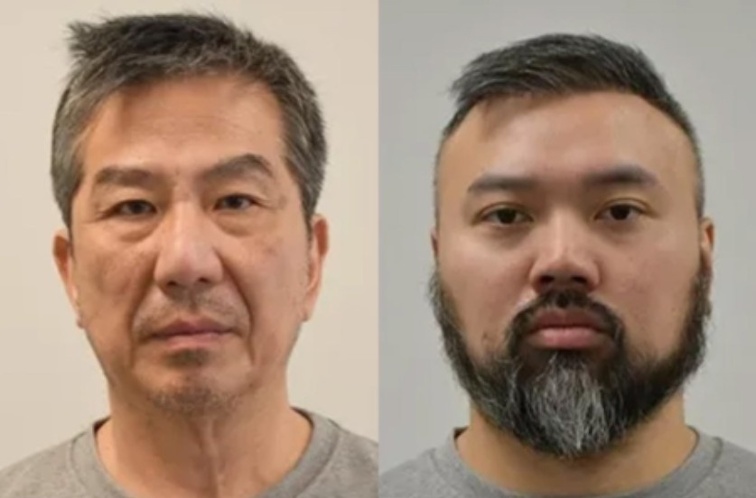
Two defendants in the espionage case involving the Hong Kong Economic and Trade Office in London, Yuan Songbiao (Chung Biu Yuen, Bill Yuen) and Wai Zhi Liang (Chi Leung 'Peter' Wai), have been found guilty. (UK Crown Prosecution Service)
[People News] Following the conviction of two CCP spies for intimidating and surveilling Hong Kong pro-democracy activists in the UK, the British government issued a warning to the CCP, emphasising that such actions constitute a serious infringement of British sovereignty. The UK also summoned Ambassador Zheng Zeguang. Observers widely believe that this case transcends a mere 'espionage incident' and highlights the CCP's recent trend of 'transnational repression' against overseas dissenters, which is raising significant concerns among Western nations.
As reported by The Epoch Times, on Thursday (May 7), the Old Bailey court in London convicted 65-year-old Yuan Songbiao and 40-year-old Wai Zhi Liang for violating the UK's National Security Act by engaging in 'shadow policing' activities within the country. Both men hold dual Chinese and British citizenship.
A spokesperson for the UK Foreign Office announced on Saturday (May 9) that the UK had summoned Ambassador Zheng Zeguang, stating that the case 'resulted in the conviction of the two for assisting Hong Kong authorities in violation of the National Security Act.'
The espionage activities conducted by the Chinese Communist Party represent a serious infringement of British sovereignty.
On Saturday, the British Foreign Office released a statement indicating that, under the direction of the Foreign Secretary, the Foreign, Commonwealth and Development Office summoned the ambassador of the Chinese Communist Party (CCP). This action was taken in response to the trial of a case in which two individuals were convicted for violating the UK's National Security Act by assisting the Hong Kong authorities.
The statement emphasised: "The UK has clearly stated that it will not tolerate any foreign (government) attempts to intimidate, harass, or harm individuals or communities within the UK, as such actions constitute a serious violation of British sovereignty. We will continue to employ all available means to protect UK security and hold China (CCP) accountable for actions that threaten UK security and democratic values."
On Thursday, prosecutor Duncan Atkinson informed the jury in court that Yuan and Wei were tasked with conducting "shadow policing operations" for the Hong Kong Special Administrative Region and the CCP.
Atkinson noted that the case involves espionage activities targeting dissidents currently living in the UK, including activist Luo Guancong, for whom the Hong Kong government has offered a reward of 1 million Hong Kong dollars for information regarding their whereabouts or arrest.
Other democratic figures impacted by this espionage operation include Liu Zudi, a protester from the 2019 and 2020 anti-extradition movement, and Meng Zhaoda, the general secretary of the Hong Kong Labour Rights Monitor.
Yuan Songbiao, 65, is leading the 'shadow police' operation at the Hong Kong Economic and Trade Office (HKETO) in central London. He has tasked 40-year-old Wei, along with others, including former British Royal Marine Matthew Trickett, with carrying out missions on behalf of Hong Kong's intelligence agency.
Wei Zhi-liang, a former employee of the British border forces, serves as a special police officer with the London Metropolitan Police. Yuan Songbiao initially acted as the liaison between Wei Zhi-liang and the Hong Kong authorities. He also directed Wei to focus particularly on government officials, British MPs, and local councillors who support the cause of dissenters, including Sir Iain Duncan Smith, the chairman of the Inter-Parliamentary Alliance on China.
This case involves charges filed in 2024, marking the second application of the National Security Law by the UK since its introduction in 2023 to counter hostile state activities, which broadened the definition of espionage.
Information revealed during the trial indicates that the Economic and Trade Office has allegedly been used to track the movements of exiled British pro-democracy activists, resulting in ongoing harassment and threats against dissenters. The Hong Kong Labour Rights Monitor asserts that members of the Economic and Trade Office have misused their privileges for intelligence operations, significantly violating their intended purpose, and that the legitimacy of their existence has come under widespread scrutiny.
The Hong Kong Labour Rights Monitor has strongly urged the British government to quickly reassess the status of the Hong Kong Economic and Trade Office and to consider revoking or terminating its diplomatic privileges. It should not permit the Hong Kong government to use trade as a guise for repression and attempt to extend its 'long-arm jurisdiction' into free territories.
The Chinese Communist Party (CCP) is extending its persecution overseas.
In reaction to this ruling, overseas Hong Kong organisations have welcomed the decision. Meng Zhaoda, the Secretary-General of the Hong Kong Labour Rights Monitor and one of the victims of cross-border surveillance in this case, stated that the ruling has allowed 'justice to be served' and has sent a clear message to the Hong Kong government that a free society will not tolerate any form of 'cross-border illegal surveillance.'
Meng noted that the presence of the CCP's 'overseas police stations' in various countries is no longer a secret, and pro-democracy activists from Hong Kong living in exile have long faced surveillance and intimidation from the CCP. He hopes that this ruling will act as a 'deterrent' against those who engage in intelligence gathering and repression for authoritarian regimes, warning that their actions will ultimately lead to 'self-destruction.'
Commentary from external observers generally suggests that the CCP is extending its Chinese-style high-pressure politics beyond its borders.
According to reports from Public Television News Network, many commentators have pointed out that in recent years, Beijing has not only suppressed dissenting voices within Hong Kong but has also sought to monitor and pressure exiled Hong Kong citizens through intelligence networks, overseas police activities, economic and trade organisations, and community groups. This has prompted several Western countries to begin reassessing the activities of CCP official agencies within their territories.
The British government has repeatedly accused Chinese citizens of involvement in espionage activities within the UK. In 2025, a parliamentary assistant was prosecuted for allegedly leaking British national security secrets to Xi Jinping's chief of staff, Cai Qi, but the prosecution was ultimately dropped, and no conviction was secured.
The spokesperson for the UK Cabinet Office, Baroness Anderson, remarked at the time, "The government has clearly stated that China poses a threat to the security of the UK, including our democratic system, and we will continue to hold China accountable for this."
While trade relations between the UK and China are robust, similar espionage allegations, along with the persecution of Hong Kong residents in the UK, have cast a shadow over the bilateral relationship. This year (2026), the UK government approved the construction of the largest Chinese embassy in Europe at the Royal Mint in London, prompting criticism of Prime Minister Rishi Sunak for prioritising commercial interests over national security.
Notably, in this case, the defendant is accused of using official UK databases to track information on Hong Kong residents, which has shocked public opinion in the UK.
Many commentators believe this indicates that the Chinese Communist Party is no longer satisfied with controlling only within its borders; it now aims to maintain surveillance over Hong Kong residents even if they flee overseas. Some human rights organisations have highlighted that this has fostered a climate of political fear, making it so that "exiles can never truly be safe."
Furthermore, numerous Western media outlets have pointed out that this case will further strain UK-China relations. △







News magazine bootstrap themes!
I like this themes, fast loading and look profesional
Thank you Carlos!
You're welcome!
Please support me with give positive rating!
Yes Sure!