

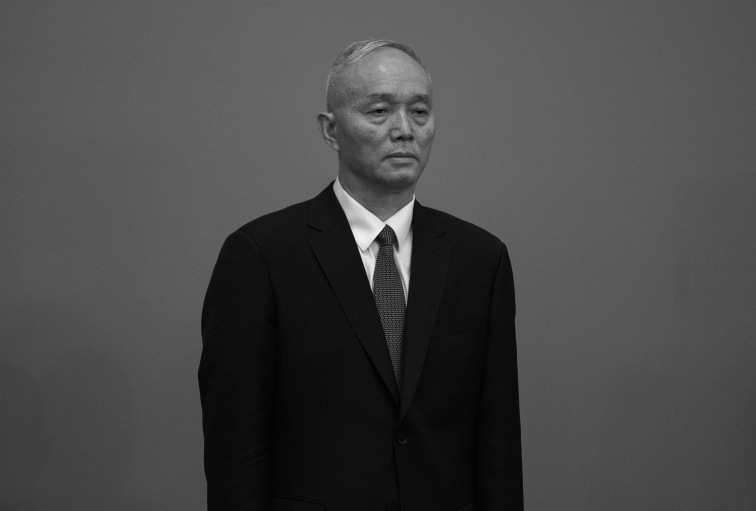
The picture shows Cai Qi, a member of the Politburo Standing Committee of the Chinese Communist Party, attending the National People&9;s Congress on March 12, 2023. (Screenshot from the web)
[People News] The economy of the Chinese Communist Party is genuinely in decline and has reached a critical point.
Cai Qi, a member of the Politburo Standing Committee who has consistently championed the narrative of 'optimism about China's economic prospects,' has unexpectedly submitted a thoroughly pessimistic internal economic report to Xi Jinping. This report, backed by stark data, has unflinchingly exposed the real challenges currently facing the Chinese economy at the highest levels.
What is even more telling is that Xi Jinping's well-known statement from years ago, 'What's wrong with deflation? Don't people prefer lower prices?' has now become a bitter irony in the context of Cai Qi's report. Once seen as a 'guiding principle,' this phrase now feels like a harsh slap in the face.
Cai Qi's internal data dismantles the illusion of economic recovery
According to revelations by former insider Du Wen on his YouTube program, Cai Qi, a core assistant highly trusted by Xi Jinping, recently presented a report on the Chinese Communist Party's economy to the top leadership. This report was based on an internal investigation team that bypassed the National Bureau of Statistics data, directly revealing the true state of the Communist Party's economy.
The report's core findings are alarming: the Producer Price Index (PPI) has seen negative growth for 42 consecutive months, the manufacturing Purchasing Managers' Index (PMI) has remained below the critical threshold of 50 for 17 months, prices have declined in 31 out of 41 key industries, industrial enterprise costs have risen for 50 consecutive months, corporate profit margins have fallen to their lowest level since 2012, at just 4.8%, and total profits have decreased by 2.1%.
Du Wenqiang highlighted that the alarming aspect of this report is not just the bleak data but also the fact that Zhongnanhai has lost trust in the official statistical system. This indicates a governance model where the 'two safeguards' have long taken precedence over economic principles, resulting in economic failure, disconnected decision-making, and distorted data.
Cai Qi's report ultimately reiterates that the 'two safeguards' are fundamental, yet the real economy is under 'immense operational pressure in certain industries, with most key sectors facing difficulties.' This economic warning signal, constrained by political pressures, while not directly challenging Xi Jinping's political taboos, dismantles the illusion of a recovering economy under the Communist Party.
Cai Qi's internal report undoubtedly represents a complete subversion of the official public economic data. However, the official false narrative has already established a political stronghold for Xi Jinping's vision of a rising great power, with the East ascending and the West declining. The path forward remains unclear and absurdly complicated. The falsification of economic data not only entangles Xi Jinping's political aspirations but has also formed a logical chain underpinning the Communist Party's political legitimacy. Even if Xi Jinping expresses anger and holds local officials accountable for deceiving the state, or punishes a few statistical officials or local leaders, he still refrains from making the data from Cai Qi's internal report public.
From the turbulence of 2025 to the ongoing decline in 2026
Former Central Party School professor Cai Xia predicted as early as 2024-2025 that 2025 would be the 'first year of unrest and economic depression,' describing it as 'the worst year of the past decade and the best of the next decade.' The subsequent developments have unfortunately proven her predictions correct.
Cai Xia has highlighted that the decline of the Chinese economy is fundamentally rooted in political regression, characterised by high centralisation, a lack of mechanisms for correcting errors, diminished confidence in the private sector, and an accelerated withdrawal of foreign capital. Concurrently, there is a trend of complacency among officials, escalating internal conflicts, rising public discontent, an increase in extreme incidents, and a collapse of social trust. On the international front, China finds itself further isolated from the free world, facing obstacles in its application to join the CPTPP, while geopolitical risks continue to rise.
As we move into 2026, issues such as deflationary spirals, a wave of factory closures, employment challenges for young people, and downward mobility among the middle class persist. Cai Xia's analytical framework attributes the economic failures of the Communist Party of China (CPC) to the leftward political shift initiated under Xi Jinping's leadership. This includes the lasting damage from the zero-COVID policy, the adverse effects of the common prosperity initiative on private enterprises, and the deterioration of the external environment due to a hardline foreign policy. These policies, driven by the consolidation of power, ultimately contravene market principles and common sense in social governance, leading to economic decline and worsening living conditions, which in turn result in a collapse of confidence and a political crisis.
Capital controls: The strictest measures in history are being implemented.
In response to mounting pressure, the CPC has swiftly enacted stringent measures. In May 2026, the CPC's Securities Regulatory Commission, along with eight other departments, jointly released the "Implementation Plan for Comprehensive Rectification of Illegal Cross-Border Securities, Futures, and Fund Management Activities." This plan initiates investigations into cross-border brokerages such as Futu, Tiger, and Changqiao, with intentions to confiscate all illegal earnings and impose severe penalties. Futu is facing a fine of approximately 1.85 billion yuan, while Tiger's related entities are looking at around 411 million yuan. Existing operations will enter a two-year concentrated rectification phase: new purchases and capital transfers will be prohibited, allowing only sales and capital withdrawals; after this period, all related domestic services will be completely shut down.
This initiative is seen as the most stringent capital control in history, effectively shutting down the avenues through which ordinary Chinese citizens could invest in overseas assets like U.S. stocks via foreign brokers. Previously, hundreds of thousands to millions of mainland investors were able to allocate U.S. stock investments relatively easily through online brokers. Public information indicates that Futu has around 438,000 asset clients in mainland China, while Tiger has asset clients amounting to approximately 6.08 billion U.S. dollars. Following this regulatory crackdown, these elite investors may redirect their funds back into A-shares, bonds, bank wealth management products, or real estate-related sectors. However, with the domestic economy currently facing deflation and a weakened investment appetite among the middle class, this move by the Communist Party of China (CPC) further diminishes consumption and investment willingness, potentially worsening the 'asset shortage' or heightening the risk of localised bubbles, leading to a continued deterioration of economic deflation pressures.
Moreover, the CPC's tightening of capital outflow controls contradicts the goal of internationalising the renminbi, as the saying goes, 'leeks can only be grown in their own fields.' This forces funds to remain in controlled markets like domestic A-shares, significantly diminishing the appeal of the renminbi, while the uncertainty surrounding policies undermines foreign investors' confidence in the Chinese market.
Following the announcement, the stock prices of Futu and Tiger in U.S. markets plummeted by over 30% in pre-market trading, leading to a substantial contraction in company revenues and necessitating a complete overhaul of their business models. Concurrently, Chinese concept stocks and the technology sector, which depend on mainland investors, are facing severe repercussions, with corporate financing channels being significantly restricted. Ecosystems that rely on cross-border allocations, such as KOLs, platforms, and fund sales, will suffer considerable damage.
To prevent capital outflow and sustain a struggling internal economic cycle, the Chinese Communist Party's (CCP) recent measures can be likened to killing the chicken to get the egg and quenching thirst with poison. This iron-fisted approach highlights that the challenges outlined in Cai Qi's economic report are not fabricated; the CCP's actual economic data is grim, resulting in a collapse of market confidence and an escalating risk of capital flight. In response, the CCP has implemented extreme capital controls.
Xi Jinping's governance philosophy is trapped in a critical contradiction, where political considerations take precedence over economic principles, which will inevitably lead to economic decline and hasten political collapse. Xi's anti-corruption campaign, aimed at consolidating power through platform rectification, promoting common prosperity, and enforcing strong industrial policies, has altered the relationship between the state and the market. However, this has resulted in the stifling of private sector vitality, a decrease in innovation, and foreign investment remaining cautious.
The current tension in China's economy and governance indicates that the CCP's economic problems have surpassed mere technical issues, touching on significant structural challenges related to systemic dysfunction and the public's welfare. Suppressing economic principles in favour of political loyalty and substituting market regulation with control measures will likely lead to even greater long-term risks.
This latest round of capital controls can be considered the most severe blunder in history; only Xi Jinping could devise such a foolish strategy, unmatched in its absurdity.
(Originally published by People News) △





News magazine bootstrap themes!
I like this themes, fast loading and look profesional
Thank you Carlos!
You're welcome!
Please support me with give positive rating!
Yes Sure!