
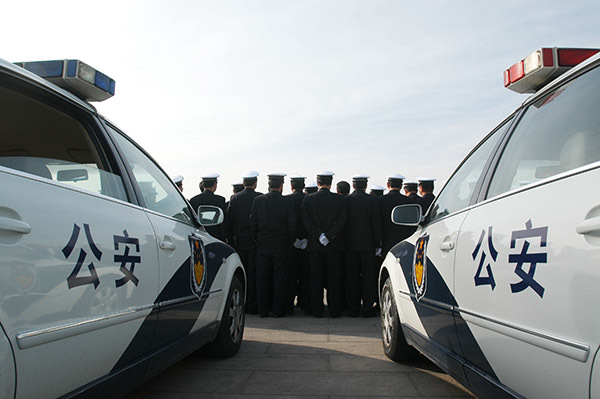
Illustration: CCP Police Vehicle (China Photos/Getty Images)
[People News] On June 6, 2026, the Chongqing Public Security Bureau reported a knife attack that occurred the previous day in a community located in the Banan District of Chongqing. The authorities did not reveal the identities of those involved, and the police categorised the incident as a 'dispute between colleagues.' Videos related to the incident were swiftly banned in mainland China.
However, information circulating on the internet has disclosed that the victim was the vice president of Chongqing University of Technology. On the morning of June 5, Wang Zhihua, a 58-year-old associate professor from the School of Electrical and Electronic Engineering at Chongqing University of Technology, fatally stabbed Liao Linqing, a 60-year-old member of the Party Committee and vice president, in the faculty staff community known as 'Rigour Garden.' After the attack, Wang did not flee the scene; instead, he raised his bloodied hands and shouted, 'Acting on behalf of heaven, eliminating harm for the people,' claiming, 'Look it up online, many people have reported him, causing numerous students to suffer from depression.' Wang's wife was present and broke down in tears, saying, 'How could a person kill unless they are pushed to the brink...'
Reports indicate that the conflict between the two had been building for over a decade, primarily revolving around long-standing obstacles to professional title promotions. Wang Zhihua joined the university in 2002 and had not been promoted to full professor in over 20 years. As he approached retirement, he remained stuck, facing disputes over teaching evaluations and personnel suppression. Wang had long harboured intentions to harm Liao Linqing, and his wife had repeatedly attempted to dissuade him. However, this time, taking advantage of his wife's absence, Wang waited at Liao's doorstep and committed the act, leading to this tragic outcome.
The incident may seem to be a conflict among teachers, but it actually highlights the distortion of human nature caused by the power dynamics of the Chinese Communist Party (CCP) in higher education, as well as the institutional trauma inflicted on the education sector. Furthermore, such cases are not isolated; across more than 2,000 universities in China, similar conflicts between faculty and administrative departments, as well as leadership, are frequently reported.
The CCP's higher education system operates under a president-responsibility system guided by the party committee. The intertwining of bureaucratisation, self-interest, and ideological control has created an environment that has fundamentally transformed universities from centres of knowledge into arenas of fame and profit, power struggles, and transactions involving power, money, and sexual favours. Educational activities are not centred on the scientific cultivation of talent but are instead focused on producing a large number of high-level cogs. The authority of the party and government supersedes academic autonomy, and bureaucratic interests have replaced academic ethics, resulting in chaos on university campuses. This is an inevitable outcome of the distortion and value confusion within the CCP's higher education system.
The tragic incident at Chongqing University of Technology is essentially a replication of the 2021 stabbing case at Fudan University in Shanghai. On June 7, 2021,
At 14:52, Jiang Wenhua, a 39-year-old male teacher and 'young researcher' at Fudan University's School of Mathematical Sciences, fatally slashed the throat of Wang Yongzhen, the 48-year-old Party Secretary of the same school. Media reports indicate that the suspect used a sharp object to stab the victim in the throat, ultimately causing his death from excessive blood loss. Jiang Wenhua, a mathematics PhD who had returned from studying abroad, was once a rising star in the mathematics community. However, under the so-called 'ascend and leave' personnel appointment system in Chinese universities, he was dismissed by Wang Yongzhen, which led him to retaliate violently. Online discussions have circulated claims that Wang Yongzhen had repeatedly plagiarised Jiang Wenhua's research achievements and abused his power to suppress him, ultimately resulting in this tragic incident. It was also revealed online that Wang Yongzhen had sent a 22-year-old female student from Fudan's mathematics department, Ren Yiyi, to a psychiatric hospital in 2018, which led to her suicide by jumping from a building. Jiang Wenhua was ultimately sentenced to death with a two-year reprieve.
Similar incidents include: On January 7, 2016, Li Siya publicly slapped Gan Yang, the then-dean of the Boya College at Sun Yat-sen University, due to dissatisfaction with the school's title evaluation system. On July 5, 2021, a similar case occurred at the Shanghai Municipal Design Institute, where a returning PhD, upset over a contract not being renewed, fatally slashed the throat of the research institute's director.
These tragic events reflect the distorted power dynamics of the Chinese Communist Party (CCP) within universities, highlighting the negative outcomes of power rent-seeking and personnel corruption under the dominance of administrative governance in higher education. The CCP enforces comprehensive leadership through party committees in universities, monopolising resources such as titles, funding, and positions, which creates a closed network of interests. Ordinary teachers often find themselves in a vulnerable position, facing targeting, suppression, and punitive actions. Although universities superficially establish complaint channels, these are akin to the CCP's petition system, where teachers attempting to sue administrative officials face an uphill battle, much like citizens suing the government—essentially throwing eggs against a rock.
Beyond the alienation of administrative power, CCP-controlled universities also function as relatively closed environments for corrupt transactions involving power and money. In recent years, there has been a surge in corruption cases within these institutions. Since the 18th National Congress, the website of the Central Commission for Discipline Inspection and the National Supervisory Commission has reported over 50 corruption cases in universities, involving multiple institutions. Statistics from the Haidian District Procuratorate in Beijing from 2005 to 2012 indicate that individuals involved in job-related crimes in universities span over 40 departments, including finance, infrastructure, teaching materials, and equipment.
The infrastructure sector, in particular, has been a major area of concern. An analysis of the corruption database in universities from 2000 to 2018 reveals 209 cases in the infrastructure sector, with a high average amount involved, the largest exceeding 200 million yuan. Data from the Ministry of Education previously indicated that infrastructure project cases accounted for 24% of job-related crimes in the education system. Notable cases include Zhou Wenbin, the former president of Nanchang University, who accepted bribes totalling 22 million yuan and embezzled 58 million yuan; and An Xiaoyu, the former vice president of Sichuan University, who accepted bribes of 3.534 million yuan in engineering bidding. In the construction of new campuses at several universities, party secretaries and vice presidents often serve as leaders of the infrastructure leadership group, resulting in a high concentration of power.
Corruption in higher education exhibits a multidimensionality that is not typically seen in other sectors. A notable example is the case of Cai Rongsheng, the former head of the Employment Office at Renmin University of China, who was implicated in a bribery scandal related to the autonomous admissions process, highlighting the issue of corruption in admissions and academic titles. Additionally, there is widespread academic corruption, including paper falsification and project rent-seeking. In recent years, several Changjiang Scholars and National Outstanding Youths have been exposed for committing fraud in prestigious journals, with platforms like New Threads revealing these issues for years, yet the response rate remains around 1%. Furthermore, incidents of power-for-sex transactions and sexual assault by professors are alarmingly frequent. For instance, Shen Yang, a former associate professor in the Chinese Department at Peking University, was accused of sexually assaulting student Gao Yan, which tragically led to her suicide in 1998, with alumni bringing the case to light in 2018. Professor Zhang Peng from Sun Yat-sen University has faced allegations of sexually harassing multiple female students and faculty members over the years. Recently, several universities, including Renmin University and Shaanxi Normal University, have seen real-name reports of such misconduct, but school authorities often downplay these incidents as 'violations of teacher ethics,' making it challenging for victims to pursue justice.
Higher education institutions are regarded as the vanguard of the Chinese Communist Party's ideology and a bastion of public opinion. The educational model reinforces the leadership of the Party Committee, and the suppression of public opinion and restrictions on the ideological freedom of faculty and students are quite severe. The Communist Party invests heavily in creating so-called safe campuses, where surveillance cameras are omnipresent, leaving almost no blind spots. In classrooms, alongside physical surveillance cameras, there are also student informants monitoring teachers' every word and action. Dissidents, sensitive students, and foreign individuals are primary targets of the Communist Party's surveillance on campus. Academic integrity is compromised in favour of political loyalty, transforming both teachers and students into instruments for the Communist Party to uphold its one-party rule.
The murder case involving a teacher from Chongqing University of Technology has exposed the crisis in higher education. Within a university environment characterised by a combination of negative factors such as power imbalances, rampant corruption, ineffective grievance mechanisms, and ideological control, the once-revered institution of knowledge is increasingly descending into a realm dominated by power monopolies, corruption linked to power and sexual misconduct, and violence. Under the governance of the Chinese Communist Party, university campuses have transformed from sanctuaries of education into high-pressure environments that are persistently destructive and rife with crises.
(First published in People News)△






News magazine bootstrap themes!
I like this themes, fast loading and look profesional
Thank you Carlos!
You're welcome!
Please support me with give positive rating!
Yes Sure!