
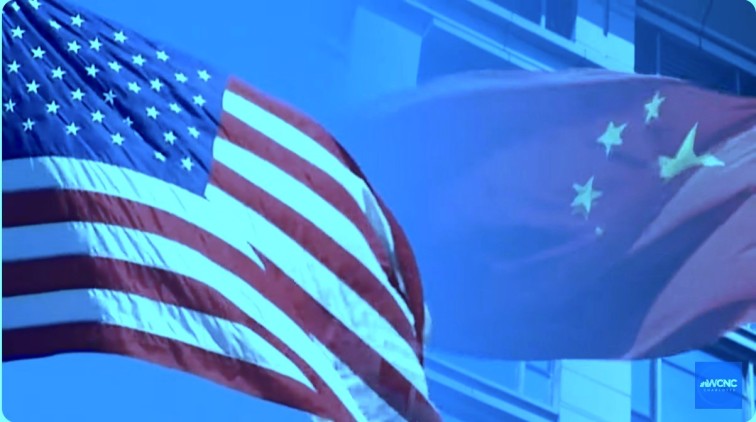
U.S.-China Confrontation. (Video screenshot)
[People News] The student newspaper at Stanford University has recently revealed that the university has accepted donations from individuals and enterprises associated with the Chinese Communist Party (CCP). The report includes a list of individual and corporate sponsors, among whom one individual is suspected to be Chen Yuan, the son of CCP elder Chen Yun. In a response to Voice of America, Stanford University stated that many of the contracts and donation details mentioned in the article are 'years old and have expired.' The Hoover Institution at Stanford also denied that the 'Chen Yuan' listed is the son of Chen Yun.
According to Voice of America, the Stanford Review reported on Monday (June 1) that a whistleblower provided the publication with foreign funding disclosure documents from Stanford University. Many of the foreign donations received by the university came from institutions and individuals with official connections to the CCP, including the university's prominent think tank, the Hoover Institution, which also accepted donations related to the CCP.
Review: CCP elder Chen Yun's son suspected of donating to the Hoover Institution; university clarifies that this 'Chen Yuan' is not the same as that Chen Yuan.
Documents released indicate that in 2025, Stanford University received a donation of at least 3 million dollars from a donor named 'Chen Yuan' (of Chinese nationality), which was classified as a restricted donation for directed research at the Hoover Institution. The documents did not specify which 'Chen Yuan' made the donation. However, the Stanford Review noted that based on the name, nationality, and financial capacity, the most likely donor is Chen Yuan, the president of the China Association for International Friendly Contact (CAIFC).
Chen Yuan is the eldest son of Chen Yun, a senior official of the Chinese Communist Party, and has held positions as the president of the China Development Bank and vice chairman of the National Committee of the Chinese People's Political Consultative Conference. In its 2018 report, the U.S.-China Economic and Security Review Commission (USCC) described the China Association for International Friendly Contact as a 'front organisation' for the former General Political Department of the Chinese Communist Party's military, suggesting it plays a dual role in intelligence gathering and conducting propaganda and public opinion guidance activities.
Additionally, the Stanford Review reported that Chen Yuan's sister, Chen Weili, spent two years at Stanford University as a visiting scholar; Chen Yuan's son, Chen Xiaoxin, also attended Stanford and donated 1.02 million dollars to the university in 2024. Members of the Chen family are recorded at Stanford University both as alumni and donors.
Condoleezza Rice, the director of the Hoover Institution and former U.S. Secretary of State, issued a statement on the institution's website asserting that an article in the Stanford Review "used insinuation and speculation to wrongly identify a donor of Hoover as the chairman of the China Association for International Friendly Contact (CAIFC)." The statement further noted that a Chinese scholar from the Hoover Institution had informed the Stanford Review before publication that the identity of "Chen Yuan" was incorrect.
The statement called on the Stanford Review to promptly retract its report. It also indicated that the Office of the General Counsel at Stanford University, along with relevant federal and local agencies, including the Department of Education, and the chairman and chief members of the House Select Committee on China, had been made aware of the misuse of leaked information.
The statement highlighted: "For more than a century, the Hoover Institution has supported the efforts of dissidents and freedom fighters against authoritarian regimes, including China. As a result, our archives house numerous valuable documents and testimonies from these courageous individuals—who have entrusted us with this material to safeguard their stories and preserve them as part of historical records. Any support received by the institution is consistent with its mission and these values."
It is worth noting that the Hoover Institution holds the diaries of Li Rui, which contain commentary on senior Chinese Communist Party leaders (including Chen Yun, Xi Jinping, and their families), as well as records related to the Tiananmen Square protests of 1989. These archives were donated by Li Rui’s daughter, Li Nanyang. Li Rui’s widow, Zhang Yuzhen, previously filed a lawsuit in the United States, but a California court ruled this April that the archives will remain at Stanford University.
The Hoover Institution holds significant influence in U.S. geopolitical discussions and also participates in U.S. “research security” efforts, including the congressionally authorised “Securing the Entire Community of the U.S. Research Ecosystem” (SECURE) program, led by the National Science Foundation.
Researchers at the Hoover Institution have long studied China’s global influence operations. Related initiatives include “China’s Global Sharp Power” (now renamed “U.S., China, and the World”), which aims to track and analyse how the Chinese Communist Party projects political and cultural influence abroad.
Stanford Review: Multiple Chinese companies and institutions linked to the CCP have donated to Stanford; university says the information is from years ago
According to The Stanford Review, disclosed documents show that, in addition to donations received by the Hoover Institution from individuals with official CCP backgrounds, Stanford University has also continued to accept substantial funding from Chinese state-owned enterprises, as well as entrepreneurs and political figures linked to the CCP’s United Front Work Department.
These companies providing donations and contracts include BOE Technology Group and Huawei Technologies. In 2019, BOE provided Stanford with a contract worth $254,000 for research on highly conductive stretchable electrode arrays. This February, BOE, along with other Chinese firms—including robotics company Unitree Robotics, internet companies Alibaba Group and Baidu—was placed by the U.S. Department of Defence on a list of “Chinese military companies.” In January, a U.S. federal jury ruled that BOE had infringed American patents.
Huawei Technologies provided contracts and gifts worth $250,000 between 2019 and 2020, after being placed on the Entity List by the U.S. Bureau of Industry and Security. The specific use of these funds was not disclosed.
In addition, organisations such as the Chinese Academy of Sciences, JD.com, Tencent, the Ma Huateng Foundation (founded by Ma Huateng), State Grid Corporation of China, and China National Petroleum Corporation have each donated amounts ranging from hundreds of thousands to millions of dollars.
On the individual side, Tung Chee-hwa, former chairman of the China-United States Exchange Foundation, and his wife donated $3 million between 2020 and 2024. The foundation has long been viewed by some U.S. think tanks as linked to United Front work.
Additionally, William Ding donated $25.1 million between 2020 and 2021. Ding previously served as a deputy to the 11th Guangdong Provincial People’s Congress and is currently a member of the 13th National Committee of the Chinese People’s Political Consultative Conference.
These funds reportedly supported faculty research, professorships, research fellowships, and new laboratories in Stanford’s engineering, medical, and business schools, as well as at the Freeman Spogli Institute for International Studies. Many contracts specifically designated faculty working in artificial intelligence, robotics, semiconductors, and other emerging technologies. Other donations funded executive training for Chinese industry leaders and scholarships for graduate students in China’s energy and technology sectors.
Fields such as AI, robotics, and semiconductors are considered key technologies by both Washington and Beijing.
Angie Davis, Assistant Vice President for Strategic Communications and Media Relations at Stanford University, stated in an email response to Voice of America that it is Stanford’s practice not to disclose donor names or donation details without explicit authorisation from donors. Therefore, the university cannot share further information about individual contributions. She added that “many of the contracts and grants listed in the article occurred several years ago and are no longer active. For example, Stanford has suspended accepting funding from Huawei since 2018.”
The Stanford Review article presented a different view of the university’s practices, arguing that without transparent disclosure mechanisms, the public has no way of knowing who is funding researchers or what the ultimate purposes of such funding may be.
Davis also stated in her email that Stanford conducts “rigorous due diligence” on all philanthropic donations and sponsored research projects, especially those from international sources and particularly from countries of concern. This includes screening for restrictive clauses, assessing ties to foreign governments, and evaluating research security implications, “to ensure that all donations advance our mission of exploration and knowledge creation for the benefit of humanity.”
Her statement added that if a funding source raises legal or ethical concerns, if donation conditions could compromise the independence or integrity of university research, or if accepting a donation is otherwise deemed inappropriate, Stanford reserves the right to decline any donation, whether domestic or international.
It is also worth noting that Elsa Johnson, editor-in-chief of The Stanford Review, testified before the U.S. Congress in March that she had been harassed and surveilled by CCP-affiliated individuals due to her participation in a Hoover Institution research project related to China’s industrial and military strategy.



News magazine bootstrap themes!
I like this themes, fast loading and look profesional
Thank you Carlos!
You're welcome!
Please support me with give positive rating!
Yes Sure!