
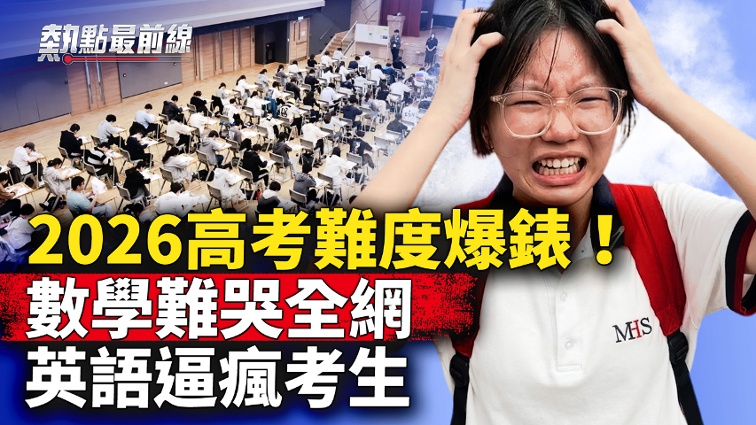
Top students are in tears! The sky has fallen! Is the difficulty of the 2026 college entrance examination destined to be recorded in history? (Video)
[People News] Hello, dear viewers, and welcome to "Hotspot Frontline." I am Xiaokun.
The college entrance examination days in mainland China are set for June 7th and 8th. During these two days, the entire nation’s attention is focused on one term—the college entrance examination. After twelve years of hard work, millions of students are facing a crucial battle for their futures. However, as they exit the examination room, their complaints perfectly capture the absurdity of this life-changing test: after finishing the Chinese exam, one student remarked, "The light boat has passed through ten thousand mountains"; after the mathematics exam, another said, "Where should I go to attend college?"And after the English exam, they questioned, "Do you want me at college?"
Is this truly about selecting talent, or is it indicative of a collective psychological breakdown? Today, we will dissect the historically significant 2026 college entrance examination.
This year's college entrance examination featured the Chinese test on the morning of June 7th and mathematics in the afternoon. As soon as they finished the mathematics exam and stepped out of the room, candidates were in despair, exclaiming, "It's too difficult!" "I bombed the exam!" "I didn’t finish the questions!" Some even expressed their frustration by saying they wanted to lock up the teacher who created the exam.
Some joked that if the mathematics paper was too challenging, the teacher responsible for it might be summoned by the education bureau for questioning. Interestingly, this year's English paper has been labelled by netizens as "the hardest since the resumption of the college entrance examination," with reports suggesting that even foreigners struggled to pass it.
In addition to language, mathematics, and English, let's explore how candidates are voicing their frustrations about other subjects. History candidates remarked, 'This isn't an exam; it's merely a 'petition';' while physics candidates have escalated the difficulty to the level of a major disaster documentary. When all these challenges are presented, we must ask: 'Are we testing students' intelligence, or are we pushing their psychological limits?'
After hearing the candidates' grievances, doesn't it remind you of the phrase: 'It's so tough for me'? The difficulty of the 2026 college entrance examination has completely shattered the facade of traditional education, leaving countless candidates and parents feeling bewildered. Yet, whether in the competitive atmosphere of the exam room or in the realities of life, we need to possess strong confidence.
Recently, I've received considerable feedback from viewers who mentioned that after trying the 'Xuanbao Black Ginseng' recommended by our program, not only did their energy levels surge, but their complexion also improved significantly. Currently, Puritan is offering an incredible deal: for every purchase of $500, you will receive a hand-crafted original ginseng made through a traditional process of nine steams and nine sun exposures! The more you buy, the more you receive; if a single purchase exceeds $3000, we will include an additional premium original ginseng! Click the link in the comment section below and enter the discount code RMB888 for free shipping worldwide.
Now, let's return to the main topic.
This year, aside from the challenges posed by mathematics and English, the most talked-about topic is the national essay prompt - 'The Changes in Word Understanding.'
This essay prompt was initially designed to evaluate students' reflections on language, society, and life experiences. However, online, many individuals have provided entirely different responses.
Li Chengpeng, a well-known Chinese essayist and public intellectual who critiques society, focuses on the underprivileged and confronts authority, expressed that his understanding of the phrase 'serve the people' has evolved over the years, including the meanings of the words within it. This short essay quickly ignited discussions and was humorously referred to by many netizens as a 'perfect grassroots composition.' Let's take a look at his essay.
'For instance, when I think of 'the people,' I used to believe it referred to the citizens of this country. However, I later realised that we have no citizens, only residents. Even the term 'residents' is questionable because we are merely temporary tenants for seventy years, unable to challenge the property manager, and lacking many rights. For example, if you want to display a slogan demanding officials to disclose their assets, a local police officer can simply tell you to leave.
We have never encountered a ballot, but we have seen cloth tickets, grain tickets, sugar tickets, and even during the family planning period, we encountered 'birth permits.'
Regarding 'service,' I have never witnessed any officials genuinely serving. Sometimes they feign 'service,' such as pretending to show concern and picking up a pot lid. However, when they lift the lid, they do not reflect on the Great Famine or consider their own 'special supply food.' When they visit disaster-stricken areas, they are always far removed from the truth, staging photo opportunities, delivering speeches, and detaining a few low-ranking officials to suggest that those in power are good, while blaming the people below for the problems.
As for the impact and significance of these changes in words on my growth... I have come to appreciate the brilliance of homophones in the Chinese language. Whenever I see 'serve the people,' I hear a voice in my ear: Hey, people, serve!'
Li Chengpeng's clever use of this Chinese homophonic phrase is something everyone should appreciate. He has also divided these five characters into three parts using punctuation. Do you all understand what this means? Picture this: a scene that unfolds daily in mainland China, where officials, who claim to be public servants, abuse their power, while ordinary people serve the elite like cattle and horses. This not only exposes the hypocrisy of 'serving the people' but also reveals the harshest truth of our time.
If a student were to write an essay like Li Chengpeng's, how many points do you think they would receive? Full marks or zero? Please share your thoughts in the comments section.
The college entrance examination has concluded, but the real test of 'personal growth' for these children has just begun. This year, the enthusiasm for the college entrance examination in mainland China is at its lowest. One insightful comment captures the reason: if you get accepted, you might be delivering takeout four years later; if you don't, you could be delivering takeout just four days later. Given such immense pressure, young students in mainland China need to think critically about their futures.
Thank you for tuning in to this episode of 'Hotspot Frontline.' I am Xiaokun. What are your thoughts on this historic exam paper? Feel free to leave a comment, and let's discuss it together.
△





News magazine bootstrap themes!
I like this themes, fast loading and look profesional
Thank you Carlos!
You're welcome!
Please support me with give positive rating!
Yes Sure!