
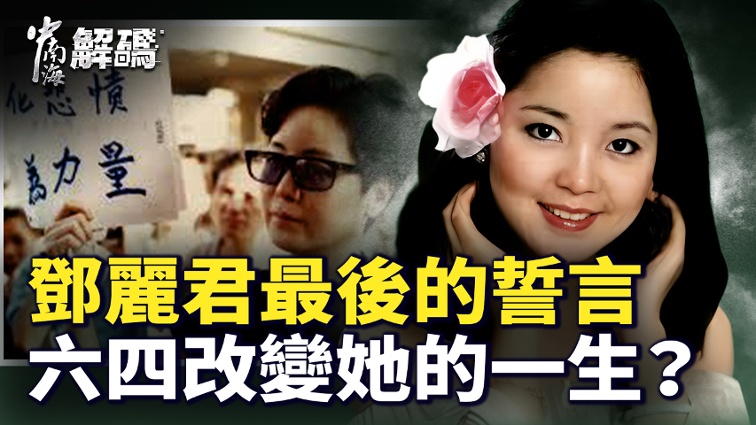
Teresa Teng's Final Oath: June Fourth Changed Her Life (Video)
[People News] Throughout the passage of time, certain melodies are destined to carry extraordinary memories.
On May 27, 1989, more than a hundred stars from Hong Kong and Taiwan gathered at Happy Valley for a charity performance titled 'Democratic Songs for China,' uniting to support the students in Beijing. The event raised a total of 13 million Hong Kong dollars, all of which was dedicated to supporting the 1989 student movement. In a show of solidarity for the mainland students, Teresa Teng (Deng Lijun) defied the objections of those around her and participated in a protest rally as a singer. She wore a sign around her neck that read 'Oppose Martial Law' and performed 'My Home is on the Other Side of the Mountain.' It is reported that the broadcasting station, in an effort to avoid angering Beijing, adjusted camera angles multiple times to prevent her outfit from appearing on screen.
As the years go by, time often conceals the most heart-wrenching secrets behind the gentlest smiles. Do you know why, when the other side once opened its doors, and even high-ranking officials in Beijing rolled out the red carpet and extended lavish invitations for her to return for a concert, Teresa Teng, who sang about her hometown throughout her life, never set foot on that land she yearned for?
On this special day, I would like to discuss with everyone the voice that once softened an entire era—Teresa Teng. Let us follow the song that cut through the storms and delve into the depths of history, uncovering the 'spy suspicion' that once shocked the world, to understand the pride and helplessness that lay hidden behind her gentleness.
The 'Spy' Fear in CCP Intelligence Files
Deng Lijun (Teresa Teng) was undoubtedly the most adored star among Chinese people in the 1980s. Many mainlanders hold a special affection for 'Little Deng.' In today's era of entertainment overload, it may be difficult for many to envision that such a soft-spoken woman, whose eyes radiated warmth, was once under intense scrutiny for years in the confidential files of the Chinese Communist Party (CCP) leadership and the national security intelligence department, even being suspected of being a 'top spy sent by the Taiwan Kuomintang authorities.'
This is not just a one-sided narrative from overseas pro-democracy or anti-communist groups, but a genuine absurdity that even contemporary Chinese websites are compelled to disclose in their historical articles. During those years of fear and paranoia, the CCP's intelligence system was on high alert for any voices from across the Taiwan Strait. Furthermore, under the CCP's political scrutiny, Deng Lijun's background appeared particularly 'unusual.'
Deng Lijun was born in a military dependents' village in Yunlin, Taiwan. Her father, Deng Shu, was a second lieutenant in the Republic of China Army, having graduated from the 14th class of the Whampoa Military Academy. At the end of 1948, he retreated to Taiwan with the Kuomintang forces, initially stationed in Tainan, and was promoted to lieutenant in 1952.
In the eyes of the CCP's totalitarian regime, which emphasised 'checking three generations and examining backgrounds,' Deng Lijun was considered a 'genuine enemy military dependent.' What further troubled the CCP's intelligence agencies was her close ties with the Taiwanese military after she reached adulthood. She frequently declined commercial performances and selflessly travelled to Kinmen, Matsu, and other Cold War frontlines to boost troop morale, posing for photos alongside armed generals and soldiers of the Nationalist Army.
In 1979, the shocking 'fake passport incident' occurred, leading to Teresa Teng (Deng Lijun) being expelled from Japan by the government and subsequently seeking refuge in North America. Analysis reports from the General Staff Department and the National Security Bureau of the Chinese Communist Party questioned how an ordinary Taiwanese singer could navigate the geopolitically complex landscape between Northeast Asia and North America. Was there covert support and funding from Taiwan's 'Ministry of National Defence Intelligence Bureau' behind her?
During the Cold War, officials from totalitarian regimes operated under a zero-sum mindset, never believing in the existence of pure art or the gentleness of human nature. In their view, Teresa Teng's music, which captivated everyone in China—from elderly citizens to ten-year-old children, and even soldiers of the People's Liberation Army secretly listening under their blankets—was far more than just popular songs. It represented a meticulously planned peaceful evolution, a psychological warfare nuclear weapon aimed at the so-called proletarian steel will of the new China, launched by the Taiwanese authorities.
In 1980, the China Musicians Association convened a meeting in Xishan, Beijing, specifically to discuss and critique the songs of Teresa Teng (Deng Lijun). Experts from the traditional academic community argued that some of Teng's songs had relatively dark and decadent themes, labelling them as 'mellow music' and 'yellow songs.' They particularly raised concerns about the thematic implications of her rendition of 'He Ri Jun Zai Lai' (何日君再來), a song composed in 1936 during the Japanese invasion of China. In this context, 'Jun' refers to the nation or the Kuomintang army, and 'He Ri Jun Zai Lai' suggests 'When will the territory be reclaimed?' From this angle, the song title resonates with the Kuomintang's rhetoric of 'counterattacking the mainland' and is thus considered 'reactionary.' Consequently, 'He Ri Jun Zai Lai' was labeled as 'toxic grass,' and this 'both yellow and reactionary' song was criticised in an environment that was 'both red and specialised.'
They referred to her privately as a 'cultural spy,' and internal documents were meticulously guarded, with strict prohibitions against radio stations playing her music. Even the unauthorised recording of Teresa Teng's tapes was classified as a political offence for listening to enemy broadcasts.
Less than six months after the mainland music community's meeting to criticise Teresa Teng, on October 4, 1980, she held a charity concert at the Sun Yat-sen Memorial Hall in Taipei, donating all ticket proceeds to a public welfare foundation. During the concert, the host asked Teng, 'I heard that many people in the mainland want to invite you to perform there.' Teresa Teng responded, 'If I were to perform in the mainland, then the day I sing there would be the day our Three Principles of the People are implemented in the mainland.'
In 1981, Teresa Teng (Dèng Lìjūn) travelled to Taiwan to entertain the troops for a month and produced the documentary "You at the Outpost."
In the eyes of the authorities, such declarations and actions by Teresa Teng (Dèng Lìjūn) were undoubtedly considered politically incorrect.
However, the most ironic and beautiful aspect of history is found here. Faced with the prevention, suspicion, and smear campaigns that crossed the strait, this gentle woman never once stood up to defend herself. Unlike today’s stars, who are quick to write clarification letters or pledge loyalty to those in power, she simply sang quietly. Her voice, filled with humanity, longing, nostalgia, and warmth, silently soothed the countless lonely souls on both sides of the strait during that turbulent era. The Chinese Communist Party, fortified by guns and high walls to guard against the military, was horrified to realise that despite deploying all state machinery, they could not prevent the people of the mainland from yearning for freedom and tenderness in the night. The human heart cannot be contained.
The reason Teresa Teng (Dèng Lìjūn) suddenly became "popular" during that time is closely tied to her singing style and the content of her lyrics. After decades of being educated by model operas and revolutionary songs, people were astonished to discover that songs could be sung in this way and that lyrics could be written like this. The minds that had been confined suddenly opened up to a new perspective.
The outpost of Kinmen, the echoes of the "Three Principles of the People."
By the mid-1980s, as the mainland's reform and opening-up progressed, the public's intense admiration for Teresa Teng (Dèng Lìjūn) compelled the Beijing authorities to revise their approach. At that time, high-ranking officials from the Ministry of Culture, China Central Television (CCTV), and even underground agents from the Hong Kong branch of Xinhua News Agency, all brought substantial amounts of renminbi and political commitments, and went overseas to rally support for Teresa Teng. They told her, 'As long as you are willing to return, all past political misunderstandings will be overlooked. The finest stadiums in Beijing, hundreds of thousands of fans, and the highest honours are all waiting for you.'
Confronted with this overwhelming allure of fame and fortune, this seemingly delicate woman provided her answer at a pivotal moment in history.
No end to one-party rule, and absolutely no going to the mainland.
Now, let’s continue with Teresa Teng's story. The decisive turning point in her fate, which marked her complete break from the Chinese Communist Party (CCP) regime, is forever etched in history on May 27, 1989, in Hong Kong.
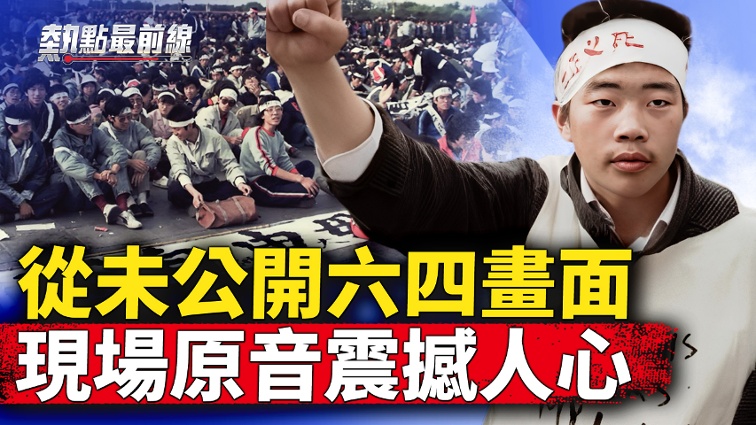
To support the students who were on a hunger strike in Tiananmen Square in Beijing, advocating for democracy, Teresa Teng, despite the strong opposition and discouragement from all her business partners, agents, and political lobbyists, resolutely chose to step onto the stage of the protest rally 'Democratic Songs Dedicated to China' at the Happy Valley Racecourse as a pure singer.
As Teresa Teng slowly approached the centre of the stage, she surprisingly wore a rough, hand-written placard around her neck that read 'Oppose Military Control,' and on her head, she had a ribbon that proclaimed 'Long Live Democracy.'
In just a few minutes on stage, history left behind an extremely subtle and ironic detail. It is reported that the senior executives of Hong Kong's Television Broadcasts Limited (TVB), who were responsible for the live television broadcast across Hong Kong and overseas, were in a state of panic in the backstage control room. To avoid provoking Beijing, the director issued an urgent and desperate order to the cameramen: during the entire broadcast of Teresa Teng's performance, they had to deliberately adjust the camera multiple times!
Consequently, an absurd scene unfolded on the live broadcast screen that year: the cameramen frantically zoomed in, tightly focusing on Teresa Teng's eyes and facial close-ups, awkwardly and carefully avoiding her clothing and chest, fearful that the sign reading 'Oppose Martial Law' would be visible on the television screen.
When Teresa Teng sang tearfully, 'Friends, do not indulge in momentary joy. Friends, do not seek momentary comfort; you must return quickly and ignite the torch of our nation. Do not forget that the place where we grew up is on the other side of the mountain.' Her voice, filled with tears yet high-pitched and fearless, is forever etched in the historical records of the free world.
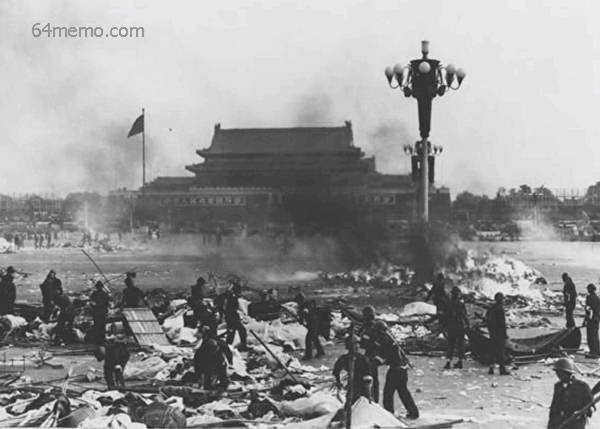
A few days later, the gunfire of the June Fourth Massacre shattered everyone's dreams. Teresa Teng was left with a deep emotional scar. After that, she moved to Japan.
On November 24, 1989, during a performance in Tokyo, Teresa Teng, dressed in a black dress, once again shed tears for the souls lost at Tiananmen in front of the cameras.
She made the most resolute vow of her life to the mainstream media in Japan: 'As long as the Chinese Communist Party does not rectify the June Fourth incident and does not end one-party rule, I will never set foot on the land of mainland China in my lifetime.'
Deng Lijun's (Teresa Teng) later years embodied her vow not to submit to oppressive forces. More than thirty years later, the Chinese Communist Party (CCP) still hesitates to confront the brilliance of the nameplate she wore.
On that Cold War coastline, she never needed to kneel before any regime or conform to any grand narrative of united front efforts. She understood that the essence of art is freedom, and the dignity of a singer lies in standing firmly on the side of love and truth.
A Timeless Reflection
In early summer 1995, Deng Lijun passed away unexpectedly in Chiang Mai, Thailand, leaving behind unfinished connections to the mainland, never having the chance to see the land she loved and resisted throughout her life.
Over thirty years have swiftly passed, leading us to this historically significant day. Yet, as we revisit this faded historical narrative and juxtapose it with today's vibrant and tumultuous entertainment industry, it inevitably stirs a deep sense of nostalgia and a chilling awareness of the passage of time.
Many may not realise the extent of the state machinery the CCP employed to facilitate Deng Lijun's return to the mainland for united front purposes. Recent disclosures of top-secret historical documents from abroad reveal that in the mid-1980s, to arrange for Deng Lijun's concert on the mainland, then Vice Premier Wan Li personally approved the initiative! The Hong Kong branch of Xinhua News Agency even dispatched secret envoys to orchestrate a transnational plan, offering an unprecedentedly high appearance fee along with political privileges.
At that time, the united front strategy was implemented so thoroughly that the Beijing authorities had constructed a massive stage for Teresa Teng (Dèng Lìjūn) at the Workers' Stadium, capable of hosting hundreds of thousands of people, complete with top-of-the-line sound equipment. For the senior leaders of the Communist Party of China, if Teresa Teng was willing to step onto that red carpet in Beijing, it would signify a monumental political victory.
However, this woman, who appeared gentle and soft, demonstrated remarkable resolve in the face of immense interests and the most enticing power brokers pleading with her. When gunfire erupted in Tiananmen Square in 1989, and she recognised the brutal reality of a regime that crushed ideals with tanks, Teresa Teng did not hesitate for a second; she decisively cancelled the concert that had been meticulously planned in Beijing. Through her actions, she conveyed a powerful message to the elite in Zhongnanhai: your renminbi cannot purchase my conscience; your stadium cannot contain the song of freedom.
This is where history reveals its most brutal and ironic truths.
In stark contrast, more than thirty years later, many new-generation Taiwanese artists are enjoying the democratic and free benefits that their predecessors fought for in Taiwan, while also facing the temptations of the renminbi market and capital from across the strait. What we observe is a collective silence within the entertainment industry, or even a tendency towards active flattery.
In the current cross-strait entertainment industry, is there really a need for the Vice Premier of the Communist Party to step in personally? Just a glance or a mention from the propaganda machine across the strait, or even a few online threats from the so-called 'little pinks'—staunch supporters of the Communist Party—can prompt those celebrities in Taiwan, revered by countless fans as 'Kings' and 'Queens,' to quickly retweet standardised political loyalty statements on Weibo. They perform songs that have been altered and censored on variety shows across the strait, reciting lines that align with the mainstream narrative, all while fearing that any misstep could jeopardise their financial prospects.
Modern celebrities and their management companies often hide behind phrases like 'politics is politics, art is art,' or 'artists are just trying to survive, forced by circumstances' as a way to justify their actions and display their cowardice. However, this excuse seems utterly feeble and laughable when held up against the historical legacy of Teresa Teng (Deng Lijun).
Teresa Teng faced the harsh realities of Cold War tensions and the scrutiny of intelligence agents; the pressure she endured was a thousand times greater than what today's stars experience, yet she stood firm and refused to flatter. True superstars do not merely accumulate wealth in the present; they earn a respect that is timeless and cannot be erased by history.
As we reflect on history today, we see two generations of artists responding to similar interests and choices with vastly different outcomes. After watching the entire film, what thoughts arise when you compare today's stars who bow before the renminbi? Do you believe that in this era, the integrity of a public figure still holds significance? We invite you to share your thoughts in the comments section, and let's engage in a discussion.
(Decoding Zhongnanhai)
△



News magazine bootstrap themes!
I like this themes, fast loading and look profesional
Thank you Carlos!
You're welcome!
Please support me with give positive rating!
Yes Sure!