
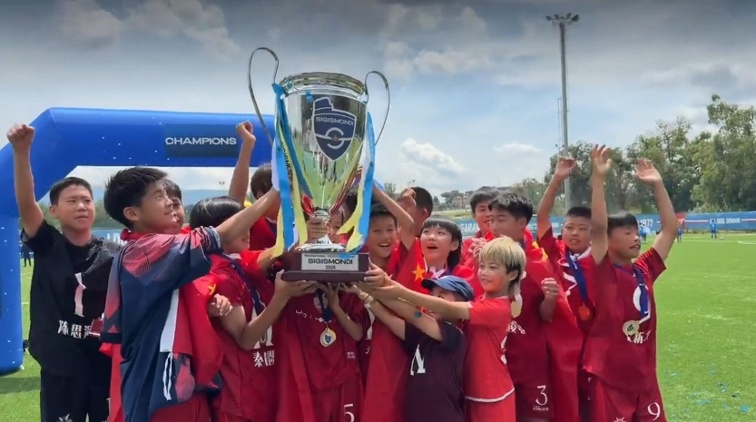
A grassroots team with no official funding—the “Chinese Football Boys 2014 Team”—won the U12 International Youth Cup in Rome, Italy, on June 2. (Video screenshot)
[People News] A completely grassroots team made up of ordinary public primary school students, with not a penny of official funding—the “Chinese Football Boys 2014 Team”—won the “Sigismondi International Youth Cup” (U12) held in Rome, Italy, on June 2. As the only non-European team among 48 participants, they proudly lifted the trophy with a perfect record of seven wins in seven matches. On the same day as their victory, 14-year-old winger Li Haoyan, developed by the program, officially signed with FC Barcelona’s famed “La Masia” U15 academy, becoming the first Chinese player in history to enter Barcelona’s youth system. With a world championship and a contract from a top club, these public school children proved a striking truth to the world: “It’s not that Chinese people can’t play football—it’s that the system has crippled them.”
1. Seven Wins, Zero Losses: Winning the “Little World Cup”
According to media reports, the “Sigismondi International Youth Football Tournament (U12)” is a highly prestigious and competitive youth event in Europe, often referred to as the “Little World Cup” for the U12 age group. Held annually in Rome, it attracts 48 teams from top European clubs, including youth academies from the English Premier League, Serie A, and the Portuguese Primeira Liga, serving as a major platform for talent scouting and development.
This year’s tournament featured elite youth teams from clubs such as Everton (England), Fiorentina (Italy), Copenhagen (Denmark), and Braga (Portugal).
Dong Lu’s “Chinese Football Boys 2014 Team,” the only non-European team, showcased remarkable ball control:
In the group stage, they swept through opponents—defeating Italy’s TTT 2–0, crushing Copenhagen 5–0, and routing Italy’s GGR 7–0—advancing with three wins and zero goals conceded.
In the knockout stage, they grew even stronger—defeating Fiorentina 3–1, edging Braga 1–0, and beating Copenhagen again 2–0 in the semifinals. In the final, they defeated Everton in a penalty shootout, completing a perfect run of seven wins, scoring 21 goals and conceding only 2. Everton’s youth academy is widely regarded as one of Europe’s most prolific talent factories.
2. The Journey of a Young Star
Among the heroes, 12-year-old Nanjing player Meng Xinyi, who scored the decisive penalty, became the spotlight of the match. His development story is unique—he trained in martial arts for over a year in kindergarten, which laid a strong foundation for flexibility and explosive power. Later, due to his speed and reflexes, he was discovered and switched to football.
His father, Meng Qinghua, noted that in six years of playing, his son has “never once complained of being tired.” Meng himself said, “Football gives me happiness and the spirit of never giving up. Even when we’re behind, I believe we can come back. As long as we don’t give up, there is hope.” His signature backflip celebration has become iconic—he previously scored 17 goals in a provincial tournament and celebrated the same way.
3. A Grassroots Miracle Built on 58 Million Yuan
Leading this team to global success was not bureaucrats from the state football system, but commentator Dong Lu.
Since 2017, Dong has personally invested over 58 million yuan (about £6 million), mostly from his own livestreaming income, with only about 14 million yuan from outside funding.
Remarkably, the club charges no training fees and imposes no binding contracts, aiming only to let children enjoy football freely and purely.
4. Breaking Free from Institutional Constraints and Going International
After the match, Dong Lu reflected: “Chinese football has brought too little joy to people. We are not a national team, just a grassroots team.” He pointed out that Chinese children are fully capable of playing good football. For Chinese football to improve, the only path is to break free from institutional constraints, allowing more grassroots teams to step onto the international stage and directly engage with European youth training systems.
After winning the championship, Dong Lu demonstrated a mindset completely different from that of bureaucrats within the system. The official prize money for this tournament was €50,000 (approximately 400,000 RMB). Together with livestream donation income after the semifinals, he distributed all of it—without keeping a single cent—among the 14 participating players, with each receiving about 28,000 RMB. All financial details were made fully transparent. Dong commented: “The honour the children fought for should belong to them.”
Parents were deeply moved, saying: “This is not just honour—it is genuine respect.”
When asked whether it was worth investing tens of millions of yuan over nine years, he simply replied: “I don’t seek fame or profit. I just want to give ordinary children who love football a chance.” Chinese football has never lacked hope; what it lacks is people willing to dedicate themselves patiently and persistently. The rise of these 12-year-old children and Dong Lu’s perseverance may be the best answer.
This youth team only gathers for intensive training during winter and summer holidays or short school breaks.
Dong Lu has also adopted a “learning through matches” approach to help the children accumulate real-game experience.
Youth teams within the official system often have few opportunities to play high-level international matches due to bureaucratic procedures. In contrast, the grassroots team led by Dong Lu has completely bypassed these administrative constraints. Over the past nine years, he has taken the team to play more than 300 international matches in a private capacity.
This trip to Italy was also a direct clash with strong European teams. Having experienced many high-level competitions, the players developed strong mental resilience and showed no fear during the penalty shootout in the final.
5. Producing World-Class Talent
The success is not a one-off. On the same day, 14-year-old Li Haoyan officially joined Barcelona’s La Masia U15 team—the first Chinese player to do so.
Starting from grassroots football in Dalian, he progressed through the system and even represented a Catalonia U14 selection team before being signed by Barcelona—an extraordinary validation of grassroots training.
6. Chinese People Can Play Football—But the System Has Crippled Them
This victory has helped many people understand a key point: over the past decades, in order to gain face internationally, to promote the so-called “Chinese Dream” and the narrative of “the East rising and the West declining,” and to prove the supposed greatness and correctness of the CCP, enormous sums of money have been poured into the national football team. However, taxpayers’ hard-earned money has not been used to “improve football skills,” but has instead been wasted on “maintaining a bloated and corrupt bureaucratic system” and “superficial image projects.” In the end, this spending has resulted in repeated defeats and internal corruption, leaving the national team within the CCP system with a tarnished reputation. In recent years, they have suffered a historic first loss to Vietnam (2022), drawn with Malaysia and Lebanon, and most recently endured a humiliating 0–7 defeat to Japan in World Cup qualifiers—the worst loss in the team’s history. They also recorded their worst-ever Asian Cup performance with “zero goals, zero wins, and elimination in the group stage,” slipping to the level of a third-tier or even bottom-tier Asian team.
In addition, repeated scandals involving gambling and match-fixing, along with the downfall of figures such as former head coach Li Tie and former FA chairman Chen Xuyuan, reveal a deeper problem. All of this suggests that in China, playing football, entering the national team, and even getting match time are tied to a shadowy chain of money and influence. This system of “no payment, no opportunity” creates a reverse selection process that excludes genuinely talented players from disadvantaged backgrounds.
In contrast, these 12-year-old children, operating as a loose grassroots team, have demonstrated that without the constraints of the CCP system, and as long as each player is given proper respect and the freedom to develop, Chinese children are fully capable of competing with Europe’s top clubs.
Through their achievements, the children have proven one thing: “It’s not that Chinese people can’t play football—it’s that the system has crippled them.”
The rise of this grassroots youth team, composed of ordinary public primary school students, has effectively torn away the façade of the CCP’s football system. Free from official control, contractual constraints, and the pursuit of fame and profit, they have played in a joyful environment and used their gold medals and performance to restore confidence for Chinese people. They have shown that the future of Chinese football does not lie in the plans behind the red walls of Zhongnanhai, nor in the offices of bureaucratic football associations, but in the grassroots and in genuine passion and freedom.
In contrast to the widespread celebration among fans online, the coldness and collective silence from the bureaucratic football system and professional circles appear strikingly abnormal.
7. The CCP Rushes to Claim Credit Without Shame
Faced with a story like “a Chinese team defeating Premier League and Serie A giants to win a championship”—perfect material to ignite extreme nationalism—the CCP’s propaganda machine will never refrain from claiming credit simply because it was a grassroots team. It forcefully repackages the hard-earned efforts of civilians as a “gift from the Party,” appropriating the glory of this victory into the narrative of the Party’s “wise leadership.”
In their reporting, state media deliberately downplays the element of “challenging the system,” instead portraying Dong Lu’s selfless dedication and the children’s hard training as “a successful example of the diversified development of Chinese football youth training,” attempting to incorporate this grassroots honour into the CCP’s official national sports achievements.
Many fans have noticed that online footage showing the young players lifting the trophy and receiving awards—those emotional, celebratory moments—were quickly taken down or blurred across major platforms.
Many fans wonder: if these football youngsters consistently win championships at home and abroad, bringing honour to the country, why are Dong Lu and this grassroots training system not recognised by the mainstream football establishment? One blogger offered a blunt explanation: the reason is simple and realistic. This program is purely public-interest training—it charges no fees, uses no套路 (schemes), follows no industry “hidden rules,” relies on no connections or background, and depends solely on the children’s hard work and results. Yet precisely this pure model has produced top-tier performance, exposing the shortcomings of institutional training systems that possess abundant resources but fail to deliver results. It disrupts entrenched interests and breaks established rules, which is why it is smeared, sidelined, and deliberately ignored.
But fans can see clearly. These passionate, sincere, and unpretentious young Chinese footballers represent the most vibrant and genuine hope for the future of Chinese football.
Many independent media voices have issued warnings: “Do not let the football association notice these kids,” and “Once they are absorbed into the system, they will be ruined.” People understand well that in the past, many grassroots talents declined after entering the official national system, worn down by complex relationships and the corrosive effects of political culture.
There is growing concern: although this U12 team has won on the field, after returning home, will they be able to avoid the grip of the professionalised state system?
(First published by People News)






News magazine bootstrap themes!
I like this themes, fast loading and look profesional
Thank you Carlos!
You're welcome!
Please support me with give positive rating!
Yes Sure!