

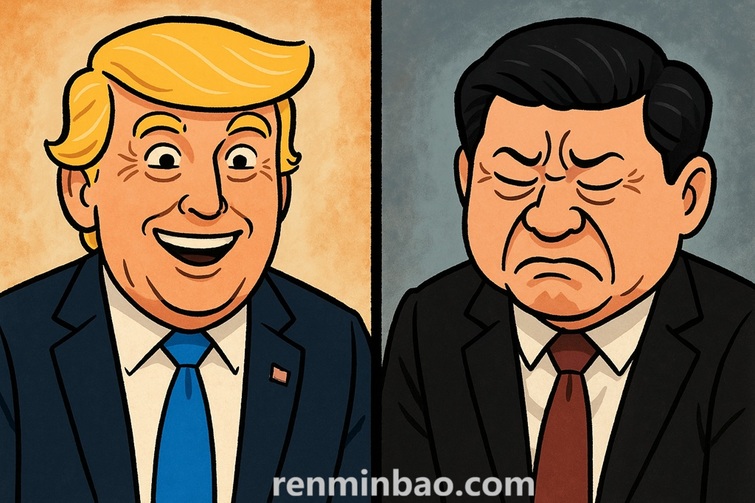
On September 19, 2025, during a phone call between Trump and Xi, Trump came away with a double win, while the CCP’s wolf warrior diplomacy was left deflated. (Image by People News)
[People News] July 4 this year marked the 250th anniversary of the founding of the United States. The U.S. celebrated the occasion with grand festivities, and many world leaders publicly extended their congratulations to President Trump and the American people. Among them was Russian President Vladimir Putin. However, Chinese Communist Party (CCP) leader Xi Jinping was notably absent. As of now, China's Ministry of Foreign Affairs has released no related statement.
By contrast, when the People's Republic of China celebrated its 75th anniversary in 2024, then-U.S. President Joe Biden sent Xi a congratulatory message despite heightened tensions between the two countries, albeit one day late. Is Xi delaying a congratulatory message out of resentment over that incident, or does he simply have no intention of sending one at all?
One thing is certain: today's CCP still believes it has sufficient confidence to confront the United States, making it somewhat different from Mao's CCP, which once sought to improve its position by going to great lengths to court American favor. Looking back at how lavishly Mao's CCP praised the United States eighty years ago may come as a surprise to many Chinese today.
While the Nationalist Army was fighting bloody battles against the Japanese invasion, the CCP sought to conceal its strategy of using the war as an opportunity for expansion rather than genuine resistance. To elevate its own standing and win sympathy and support from Western countries—especially the United States—the CCP invited Western visitors, including journalists, to Yan'an whenever possible, presenting them with an image of a supposedly "clean" and "people-oriented" communist regime. Left-leaning American journalists such as Edgar Snow, Anna Louise Strong, and Agnes Smedley wrote glowing accounts of the CCP, which indeed played a significant role in winning favorable opinions among both the U.S. government and the American public.
As victory in the War of Resistance against Japan approached, Mao Zedong intensified his praise of the United States in hopes of securing American support. On June 12, 1944, Mao addressed Chinese and foreign journalists. The key theme of his remarks was "democracy," which he repeatedly emphasized as the fundamental solution to all of China's problems.
At the time, both the Xinhua Daily in Chongqing and the Liberation Daily in Yan'an published numerous editorials and commentaries praising the United States. On September 12, 1943, Xinhua Daily published an article titled "The Ideals and Democratic Spirit of the American People," quoting two passages by André Maurois: "I love America because here I see the radiance of freedom that ennobles human life. I love America because here I see that matters which so often become the cause of war in other countries can instead be resolved in an orderly manner through democratic means."
Most notably, on July 4, 1944—America's Independence Day—Xinhua Daily published an editorial entitled "America's Independence Day: A Great Festival of Freedom and Democracy," enthusiastically praising the United States and expressing gratitude for its substantial assistance to China's war against Japan and its democratic movement. The editorial concluded with the slogans: "Long live July Fourth! Long live democratic America!"
On July 22, an American delegation arrived in Yan'an, and Mao met with its members several times. Mao said, "Every American soldier in China should become a living advertisement for democracy. He should speak about democracy to every Chinese person he meets. American officials should speak about democracy to Chinese officials. In short, the Chinese people respect the democratic ideals of the American people."
On October 10, Mao explicitly told John Stewart Service, an American military observer, "The Communists are unwilling to risk friction with the United States and are therefore willing to keep 'in step' with American policy."
...
Ironically, after deceiving and exploiting the Americans, the CCP in December 1946 used the so-called "Shen Chong Case"—in which a Peking University student was allegedly raped by U.S. Marines—to launch a massive anti-American campaign. After seizing power in 1949, it "leaned to one side" toward the Soviet Union and openly denounced the United States.
Later, as Sino-Soviet relations deteriorated and eventually collapsed, Mao's CCP once again sought to improve relations with the United States. This led to U.S. President Richard Nixon's historic visit to China. As Sino-American relations began to thaw, the CCP gained considerably more diplomatic room on the world stage.
After Deng Xiaoping launched the policy of reform and opening up in the 1980s, many Americans who believed that economic reform would eventually bring political democratization to China—the so-called "Panda Huggers"—began providing economic support to the CCP while reducing political confrontation. The result, according to the author, was that over the following three decades the CCP not only grew stronger in every respect but also infiltrated the United States across multiple sectors, seeking to undermine it from within and even secretly wage unrestricted warfare.
Fortunately, the article argues, the CCP's deception was recognized by Donald Trump, who has served two terms in the White House. Trump regards the CCP as America's number one "enemy." Especially during his second term, he has intensified efforts to contain the CCP, eliminate its infiltration into the United States, and root out communist influence.
Recently, Trump has repeatedly criticized communism. For example, during a speech at Mount Rushmore in South Dakota on July 3, he praised America's achievements while describing the current challenge posed by "communism" as a "deadly threat" to the nation's survival.
On July 4, during his speech commemorating the 250th anniversary of American independence, Trump declared: "Communism is a loser, and it always will be. The communist system is completely opposite to the American system, and it has never worked." He continued: "We like to stop this threat immediately—before it even begins. It's like cancer; you have to cut it out, and you have to cut it out quickly." He also stated: "We don't want communists in our country. It didn't work before, and it never will."
According to the author, Trump's remarks were directed not only at communists within the United States but also at the leadership of the world's largest communist country—the CCP. The implied message, the article says, is that the U.S. government intends to eliminate the CCP's infiltration into America. Such strong rhetoric would naturally displease the CCP leadership in Zhongnanhai, making it unwilling to extend congratulations to the United States.
However, while Xi's CCP, following Mao's principle of "avoiding the risk of friction with the United States," refrained from issuing a congratulatory message, it did release Jin Mingri, pastor of China's Zion Church, on July 4 after he had been imprisoned for more than eight months, placing him directly on a flight to the United States. During Trump's meeting with Xi in May, the matter had reportedly been discussed.
According to the author, Xi's calculation was that this move both gave Trump face and served as the CCP's "gift" to the United States on Independence Day, thereby leaving Washington with little room for criticism. The article concludes that the CCP has long mastered this form of "hostage diplomacy." However, it argues, under Trump's leadership, the United States is serious about eliminating communist influence, making it highly likely that the CCP will face significant setbacks in the future.
(First published by People News) △




News magazine bootstrap themes!
I like this themes, fast loading and look profesional
Thank you Carlos!
You're welcome!
Please support me with give positive rating!
Yes Sure!