

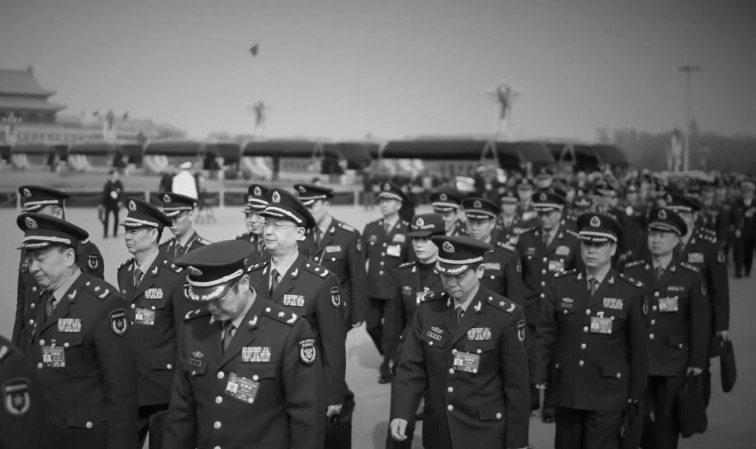
At the CCP's 75th anniversary reception, former Vice President Wang Qishan, who once aided Xi Jinping in purging political opponents, was seen with a sullen expression throughout the event. (Video screenshot) dajiyuan
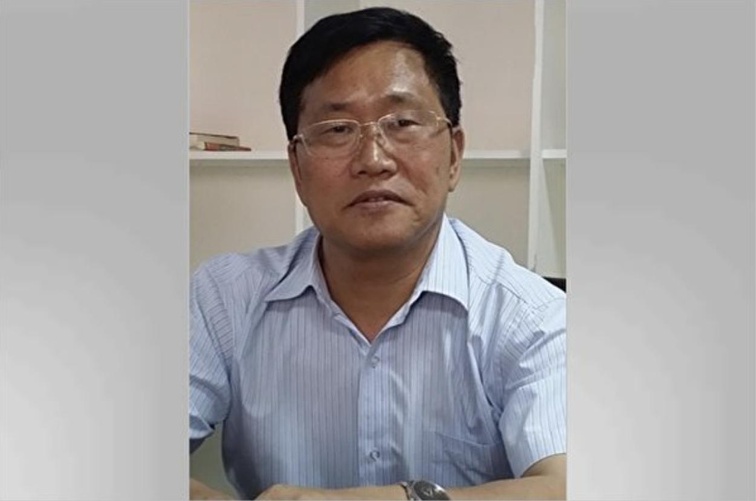
[People News] In July 2026, the Central Commission for Discipline Inspection and the National Supervisory Commission of the Communist Party of China announced that Ouyang Weimin, the former deputy secretary of the Party Committee and president of the China Development Bank, is under investigation for serious violations of discipline and law. This news quickly garnered widespread attention from the public.
Ouyang Weimin is characterized as a 'local official + financial technocrat' who began his career in the central bank system, moved on to local governance, and then took the helm of a policy bank. The timing of his investigation is particularly sensitive, given his deep connections with the 'financial czar' Wang Qishan and Ma Xingrui, a member of the Politburo and former governor of Guangdong Province, throughout his career. This has led to significant speculation and commentary from observers.
A Repeated Financial Career Path, A Typical Example of a Financial Technocrat
Ouyang Weimin, born in January 1963 in Hengyang, Hunan Province, holds a PhD in the history of Chinese economic thought from Fudan University. After starting his career in 1986, he initially worked as a lecturer at Central South University of Finance and Economics before joining the People's Bank of China, where he held several key positions, including president of the Xiamen Central Branch, the first director of the Anti-Money Laundering Monitoring and Analysis Center, and director of the Payment and Settlement Department. In 2011, he was appointed vice mayor of Guangzhou, later serving as secretary of the Zengcheng District Committee and deputy secretary of the Guangzhou Municipal Committee. In 2018, he was promoted to vice governor of Guangdong Province, and in 2019, he returned to the financial sector, taking on roles as deputy secretary of the Party Committee, vice chairman, and president of the China Development Bank. After stepping down in 2023, he became vice president of the China Finance Society.
Ouyang Weimin's career trajectory clearly illustrates a three-stage pattern, transitioning from central and local finance to local experience and ultimately to policy banks. This pattern is not uncommon in the selection of cadres by the Communist Party of China, as it reflects a pathway for technical bureaucrats to achieve cross-sector promotions through their professional skills and local experience. During his tenure at the central bank, Ouyang Weimin was involved in building the anti-money laundering system and reforming payment and settlement processes, showcasing his strong professional expertise. While serving in Guangdong, he focused on finance and commerce, driving the integration of the local economy and finance. Later, as head of the China Development Bank, he oversaw developmental finance operations. The China Development Bank is one of the three major policy banks of the Communist Party, primarily tasked with providing stable financing for national infrastructure and regional development. By the time Ouyang Weimin was investigated, he had already left his main position at the China Development Bank for several years. The disciplinary committee's announcement did not reveal specific details, but it likely pertains to common issues such as financial decision-making, credit approvals, and interest transfers. Given the China Development Bank's vast business scale and high leverage, it represents a significant risk area for anti-corruption efforts. As a technical bureaucrat deeply embedded in the financial system, it is unlikely that he is without blemish. Ouyang Weimin is certainly within the crosshairs of the Communist Party's power struggles, but he is merely a component that is close to the target, not the ultimate aim.
Indirect connections and intersections with Wang Qishan
Wang Qishan has long been regarded as the 'financial tsar' by the public, having played a pivotal role in the Construction Bank and financial system reforms in his early career. Senior executives at institutions like the China Development Bank and the Construction Bank, including Ouyang Weimin, have spent significant time in the central bank and the China Development Bank, creating a high likelihood of interaction during the financial reform period led by Wang Qishan.
However, Ouyang Weimin is not listed as Wang Qishan's secretary, subordinate, or core confidant in his public resume. Instead, he is more involved in a wide range of business interactions within the same high-level financial circle. Overseas commentator Cai Shenkun suggests that Ouyang Weimin's closeness to Wang Qishan is facilitated by Zhou Liang. In recent years, during Xi Jinping's anti-corruption campaign in the financial sector, several of Wang Qishan's former associates, including Dong Hong, Tian Huiyu, Zhou Liang, and Li Xiaohong, have been implicated and removed from their positions. Furthermore, there are rumors that Wang Qishan was placed under house arrest before Zhang Youxia's arrest due to his significant involvement in the anti-Xi movement led by Zhang Youxia. The arrest of Ouyang Weimin may represent a critical juncture in Xi Jinping's efforts to dismantle Wang Qishan's power structure. This analysis aligns with the underlying logic of Xi Jinping's political power struggle, as he seeks to consolidate financial authority within a decision-making framework centered around himself, further diminishing Wang Qishan's factional influence. This action appears to be unavoidable.
The Red Families Under Ongoing Crackdown
Ouyang Weimin is often discussed in the context of the princeling faction or the financial networks of the second generation of red elites, primarily due to his background with the China Development Bank. Chen Yuan, who has long served as the president and chairman of the China Development Bank, is a key figure in the establishment of developmental finance. The influence of Chen Yuan, the son of Chen Yun, within the financial system is indisputable, and the early development of the China Development Bank is closely tied to his efforts.
Cai Shenkun further analyzes that the China Development Bank is widely recognized as Chen Yuan's domain. In recent years, Xi Jinping has targeted a significant number of Chen Yuan's former associates. This is part of Xi Jinping's strategy to continuously purge influential representatives of the red families in preparation for his re-election at the 21st National Congress. With Wang Qishan and Chen Yuan's former associates being arrested and investigated, it is likely that this crackdown will extend to them as well.
Chen Yun, a senior figure in the party, holds a significant place in the party's history due to his economic ideas and personnel policies. Family members of Chen Yun, including his eldest daughter and Chen Yuan, have shown a certain level of policy support during the power restructuring that followed Xi Jinping's rise to power. Since 2015, Xi Jinping has frequently commemorated Chen Yun's birthday with high-profile events and has delivered speeches at symposiums, highlighting Chen Yun's contributions to economic development and the establishment of party integrity. He seeks to partially draw on Chen Yun's 'old left' tradition, which is marked by strong party discipline and a focus on planned economy, to lend historical legitimacy to his own policies.
Conversely, Xi Jinping is making relentless efforts to consolidate his personal authority by aggressively targeting the 'red second generation'. He has shown no mercy in dismantling Chen Yuan's influence within the China Development Bank (CDB) and the broader financial system, implementing widespread anti-corruption measures and specifically targeting Chen Yuan's faction. Consequently, the CDB has become a 'disaster zone' for financial anti-corruption, with numerous high-profile executives being ousted over the past decade. Notable examples include Chen Yuan's former aides, such as the three secretaries of the CDB's executive committee, the former head of the Tianjin branch Guo Lin, and Zhang Linwu, a former senior expert from the second review bureau who previously served as the party secretary and president of the CDB's Chongqing branch. Additionally, Zhang Maolong, the former executive director who once directed the CDB's office (party committee office), has also been removed. Hu Huaibang, who succeeded Chen Yuan as the former party secretary and chairman of the CDB, is viewed as a successor and continuator of Chen Yuan's legacy after his retreat from the forefront. Furthermore, Yao Zhongmin, the former deputy party secretary and vice president of the CDB, known as a 'CDB elder', has recently been investigated and dismissed. The latest wave of investigations into Chen Yuan's former associates includes the presidents of the Sichuan branch, Wei Wei, and the Guangxi branch, Jiang Zhigang, among others. Essentially, Xi Jinping has effectively dismantled Chen Yuan's personnel structure and power network within the CDB, leading to a near-total collapse. Simultaneously, Xi Jinping has also launched a vigorous campaign against the power structure and influence of the Wang Zhen family within the CITIC system.
Xi Jinping employs a dual strategy: on one hand, he publicly praises and commemorates the deceased political elders of the red family, leveraging their political capital within the party to legitimize his own power. On the other hand, he ruthlessly suppresses the descendants of these red families, controlling financial resources and reclaiming financial authority, compelling them to submit and preventing any collective opposition against him. This approach reflects his sinister intentions, meticulous planning, and a willingness to engage in extreme measures.
On the Relationship with Ma Xingrui: Close Interactions in Guangdong's Political Landscape
In contrast to the previous two figures, the relationship between Ouyang Weimin and Ma Xingrui is the most straightforward and direct. When Ouyang Weimin was appointed Vice Governor of Guangdong Province in 2018, Ma Xingrui was serving as the Governor of Guangdong Province (later becoming the Secretary of the Provincial Party Committee). Both were part of the provincial leadership team, and Ouyang's responsibilities were closely tied to the economic development and financial reforms overseen by Ma Xingrui, exemplifying a typical superior-subordinate and colleague dynamic.
As a technical bureaucrat with an aerospace background, Ma Xingrui promoted innovation-driven initiatives and reforms in Shenzhen during his tenure in Guangdong, while Ouyang Weimin's expertise in finance complemented these efforts. Public reports indicate clear interactions between the two; on July 14, 2026, Ma Xingrui was officially expelled from the party, with reports citing issues of family corruption and power-for-sex transactions.
Ouyang Weimin's progression from Deputy Secretary of the Guangzhou Municipal Committee to Vice Governor of Guangdong Province represents an eight-year period of local experience in Guangdong, marking a golden phase in his political career and serving as a significant stepping stone. However, this period may also become a focal point for scrutiny, particularly due to the ongoing purges and upheaval within the factional system triggered by Ma Xingrui's downfall.
Ouyang Weimin's official announcement of his investigation appears to be yet another step in the systematic dismantling of the old power structure, which includes figures like Wang Qishan, Chen Yuan, and Ma Xingrui. For Xi Jinping, it is crucial to utilize red authority for his political survival while simultaneously using the anti-corruption campaign to reshape the financial and power dynamics, dismantling factional strongholds and stripping potential power challengers of their resource mobilization capabilities. This reflects Xi Jinping's long-held aspirations for power, but can the ageing and fragile apparatus of the Communist Party endure the repeated upheavals caused by this reckless endeavor?
(First published by People News) △




News magazine bootstrap themes!
I like this themes, fast loading and look profesional
Thank you Carlos!
You're welcome!
Please support me with give positive rating!
Yes Sure!