
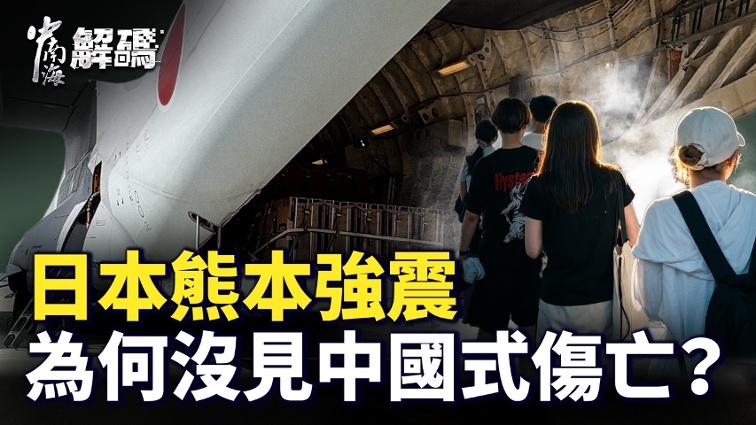
Japan's Kumamoto Earthquake: Why Were There No 'Chinese-Style Casualties'? (Video)
[People News] Hello, dear viewers, and welcome to 'Zhongnanhai Decoding.' I am Sun Ning.
On July 28, 2026, at 4 PM, a sudden earthquake struck Kumamoto Prefecture in Kyushu, Japan, without any warning.
This was a devastating earthquake measuring 7.1 on the Richter scale. The intense shaking caused by the seismic waves left even the battle-hardened Japanese public feeling rattled.
However, after the initial panic caused by surface deformation and traffic disruptions, a few days later, statistical data began to emerge. A fact that shocked the world and could even be described as miraculous came to light: in the epicenter of such a high-intensity earthquake, aside from some damage to older wooden houses and a very small number of minor injuries due to falls or psychological panic, the number of direct deaths from the Kumamoto earthquake, according to the latest statistics at the time of video production, was only 14. In the face of such a terrifying natural disaster, this is nothing short of a miracle.
As we watch international news showing Japanese rescue workers racing against time to search for survivors in the ruins of the 'Aeon Shopping Center' and the 'Nippon Paper' factory, we can't help but ask: How did Japan manage to keep the death toll from a 7.1 magnitude earthquake so low? What exactly did the Japanese public and government do in the face of disaster?
Japan's Extreme Defense Measures.
To grasp Japan's 'miracle of low casualties', we must first focus on the country's civil society. In Japan, disaster prevention is not merely a sporadic 'political spectacle', but rather a deeply ingrained 'muscle memory' and way of life.
The Kumamoto earthquake struck at precisely 4:27 PM. At that moment, hundreds of shoppers were inside the 'Aeon Mall' in Kashima Town, Kumamoto Prefecture. When the strong tremor hit, the escalators in the mall abruptly stopped due to a power outage, and the shelves shook violently. In many other countries, this situation could have quickly escalated into a chaotic scene of customers fleeing, potentially resulting in a stampede. However, in Japan, footage from the scene revealed that after the earthquake occurred, staff from various stores promptly stepped in to direct everyone to the safe exits for evacuation, while customers calmly and orderly followed the instructions. Within just an hour and a half after the earthquake, the mall successfully evacuated the vast majority of its patrons. Although the second floor of the mall later collapsed due to a severe gas explosion triggered by the earthquake, the casualty count was kept to a minimum because most people had already evacuated safely in advance.
This level of composure is rooted in the disaster prevention education that is 'etched into the very fabric' of Japanese society. In Japan, from elementary school onward, everyone participates in multiple earthquake drills each year. 'Cover your head, hide under the table, do not run around blindly'—this sequence of actions is as instinctive to Japanese people as breathing. A 75-year-old grandmother from Yatsushiro City, Hiroko Ogata, shared in a media interview that although she felt intense fear when the earthquake struck, her immediate instinct was to hide under the table in the restaurant.
Beyond the quality of its people, Japan's hardware protection has been crucial. In 1981, Japan established the 'New Seismic Standards' for the construction industry, which mandates that all buildings must withstand earthquakes of magnitude 6 to 7 without collapsing. This explains why, in the epicenter of the recent 7.1 magnitude earthquake, the vast majority of residential homes, commercial buildings, and elevated bridges remained intact, with only a few older houses or structures damaged by secondary disasters. Some knowledgeable netizens even remarked that the damage to the Hachidai Expressway appeared to be 'intentionally designed to fail' in order to absorb energy and protect the main structure.
The rigorous safety standards for Japanese buildings extend beyond residential properties; even factory buildings are constructed to the highest seismic resistance standards. Kumamoto is a key semiconductor hub in Japan, home to TSMC's factory. During the earthquake, TSMC's facility experienced significant shaking. However, due to the use of top-tier seismic and isolation technologies during construction, the factory's structure remained secure despite the intense shaking. TSMC later issued a statement confirming that all employees were safe and that operations were gradually resuming after a brief pause for self-inspection. This reflects the confidence derived from self-discipline and technology!
Japan's Government's 'Proactive Support'
Having examined the private sector, let's now take a look at how the Japanese government has responded.
Prior to the strong earthquake in Kumamoto, while the powerful horizontal seismic waves were still propagating deep underground, the Japan Meteorological Agency had already detected the preceding vertical wave signals. In this brief window of just a few seconds to over ten seconds, the 'Emergency Earthquake Alert' was accurately sent to the mobile phones of every resident in Kumamoto. Television stations immediately interrupted all programming, switching to black screens with white text to provide evacuation instructions.
Although the alert lasted only a few seconds to over ten seconds, this was more than enough for the well-prepared Japanese public. The Shinkansen bullet trains received the signal and initiated emergency braking before the violent shaking began, thus averting a potential disaster at speeds of several hundred kilometers per hour; factories and natural gas pipelines were automatically shut down; and ordinary citizens had already taken cover under tables and protected their heads before the shaking started.
Following the earthquake, the response speed of the Japanese central government surpassed expectations. The Prime Minister's Office quickly established the 'Emergency Disaster Response Headquarters' immediately after the disaster, and Prime Minister Suga Yoshihide promptly held a press conference to update the public on the latest developments, dispatching 3,600 Self-Defense Force personnel to the disaster area for search and rescue operations.
Additionally, there is a crucial detail: during the meeting at the Prime Minister's Office, Suga Yoshihide clearly emphasized that the government would fully enhance 'proactive support.' What does 'proactive support' mean? It means that the central government does not need to wait for local governments in the disaster area to request specific supplies; instead, based on the estimated disaster situation, it actively sends food, drinking water, mobile toilets, cooling equipment, and power supply vehicles directly to the affected areas!
The Kumamoto earthquake struck during the sweltering summer at the end of July, with temperatures in the affected areas soaring to 34 to 35 degrees Celsius. The Japanese government and local disaster prevention experts have repeatedly urged disaster victims through the media to drink plenty of water, even if the water supply is cut off. They emphasized that one should not reduce water intake out of concern for the inconvenience of using the restroom, as this could lead to heatstroke or deep vein thrombosis in evacuation shelters or vehicles. The supply trucks sent by the government are specifically designed to address these critical issues.
Beyond the swift response following the disaster, the Japanese government's transparency in its 'information disclosure mechanism' serves as a global benchmark. From the very first day of the earthquake, the government has provided real-time updates to the public and media regarding the number of casualties, injuries, areas experiencing power outages, and which Shinkansen lines were suspended, without withholding any information. Chief Cabinet Secretary Kihara Minoru even took the opportunity at a press conference to remind the public to be vigilant against false information circulating online, stressing that authoritative disaster information should come from the government and mainstream media.
In Japan, officials do not appear on camera making grand statements or shouting slogans, nor do the media focus on uncovering heartwarming stories amidst tragedy. This is because, within Japan's political framework, safeguarding the lives and property of citizens is a legal obligation of the government. Failure to fulfill this duty could result in the cabinet's resignation and legal accountability for officials. This commitment to the rule of law and transparency instills a profound sense of security across society.
In contrast
Having observed Japan's profound respect for life, let us now shift our focus back to China.
What would happen if a shallow earthquake measuring 7.1 on the Richter scale struck a densely populated town in China? We need not speculate, as history and reality have provided us with countless painful answers.
The 2008 Wenchuan earthquake, which registered 8.0 on the Richter scale, left many government office buildings and luxury residences standing after the disaster, with even the exterior tiles barely dislodged. In stark contrast, hundreds of school buildings suffered catastrophic collapses within mere seconds of the quake. Tragically, many children were unable to escape their classrooms and were buried under tons of substandard concrete. Investigations revealed that the cement used in the school’s concrete floors lacked adequate mortar, the load-bearing columns contained substandard rebar, and in some cases, bamboo skewers were used instead of steel bars. In China, under Communist Party rule, urban construction may appear impressive with its towering skyscrapers and vibrant lights, but the reality is marred by layers of subcontracting and cost-cutting, leading to what is often referred to as 'tofu-dreg projects.'
In December 2023, a 6.2-magnitude earthquake struck Jishishan, Gansu. While this magnitude does not classify as a major earthquake by seismic standards, it resulted in 151 fatalities and the collapse of thousands of homes during the harsh winter in Northwest China. The reason for this devastation? Many rural low-income housing units, which were supposedly planned and approved by the government to meet the 'poverty alleviation and earthquake resistance hard indicators,' crumbled in large sections within seconds. The so-called 'standards' of public works under the Chinese Communist Party (CCP) were easily shattered like paper toys when faced with a mere 6.2 magnitude earthquake. Homes that ordinary citizens had painstakingly built over a lifetime were obliterated in just moments.
In China, the seismic resilience of buildings has never been dictated by scientific principles or the value of human life; instead, it is controlled by the corruption of officials and their vested interests. Funds that should have been allocated for reinforcing buildings were embezzled at various levels, ultimately lining the pockets of officials and funding luxury items like Maotai liquor. The casualties under the CCP are not the result of natural disasters, but rather a complete and systemic man-made catastrophe!
What does the CCP prioritize?
Whenever disaster strikes, the CCP government activates a vast propaganda machine, attempting to turn human tragedies into a triumphant narrative. The military is deployed, 'red flags wave,' leaders shed tears at the scene, and the media proclaims 'adversity strengthens the nation.'
In the CCP's approach to disaster relief, what do they truly prioritize? Why can the CCP government be so cold-hearted as to disregard human life in the face of calamity?
The chilling and brutal truth is that, in the eyes of the CCP, the security of the regime far surpasses the lives of ordinary citizens.
Do you remember the parents who lost their only child in the Wenchuan earthquake? They did not wait for the government to hold those responsible for the shoddy construction accountable through legal proceedings; instead, they faced prolonged surveillance, house arrest, and repression. Civil rights activist Tan Zuoren was sentenced to five years in prison by the Chinese Communist Party (CCP) simply for trying to compile a list of the names of students who died in the earthquake, charged with 'inciting subversion of state power.'
In 2010, a 7.1 magnitude earthquake struck Yushu, Qinghai. In the immediate aftermath, thousands of Tibetan monks spontaneously began digging through the rubble with their bare hands and shovels, successfully rescuing many affected individuals. However, by the third day after the quake, the authorities, aiming to 'unify command' and 'prevent the expansion of religious influence,' suddenly dispatched a large number of armed police, forcibly expelling thousands of monks from the disaster area and completely blocking grassroots rescue efforts.
As a result, the official firefighting teams sent from the mainland were severely incapacitated by altitude sickness, rendering them unable to conduct search and rescue operations. The CCP, with a harsh political red line, forcibly cut off the most effective self-rescue efforts in the area, leading to countless lives, weakly calling for help beneath the rubble, suffocating and dying in the power vacuum.
Recently, a dam disaster struck the Liulan Reservoir in Hengzhou, Guangxi. The combination of high temperatures and muddy conditions has put the disaster area at serious risk of secondary epidemic diseases. In the face of this urgent public health crisis, the local government's immediate response was to deploy a large contingent of armed police and officers to establish a strict defense line, completely blocking access to the mountain roads and intercepting civilian convoys that were attempting to deliver disinfectants, bleaching powder, and emergency medical supplies. Meanwhile, the official distribution of aid has been severely delayed, forcing some remote disaster-stricken areas to have their affected populations resort to drinking contaminated surface water due to a lack of clean water and food, which has led to outbreaks of acute gastroenteritis and fever symptoms. To hide the true number of casualties and suppress online dissent, the authorities chose to let disaster victims endure suffering after the event rather than allow civilian aid to enter.
Under the Chinese Communist Party's twisted 'politics first' logic, natural disasters have become a stage for political display. Rescue operations are not conducted to save lives in a race against time, but rather to showcase the strength of the 'CCP system' for the cameras.
When human lives are reduced to mere statistics, and when each individual is seen as an insignificant 'cost' in a grand narrative, this government has fundamentally diverged from the true purpose of 'disaster relief.'
The arrogance built on lost lives
In comparing Japan and China, we observe not only the geographical and technological disparities between the two nations but also a significant divide in terms of humanity and civilization between their respective regimes.
In Japan, Prime Minister Takashi Sanae only sleeps two to three hours a day, while officials face tough questioning from the media during press conferences. The Self-Defense Forces and firefighters work tirelessly through the gas ruins of the Aeon Mall, doing everything possible for the 'potentially missing persons.' For them, the 14 lost lives represent a pain that the entire nation must confront and reflect upon.
In China, facing a similar disaster, what do we observe? The disaster has become a spectacle of power for the Chinese Communist Party! Ordinary citizens are desperately struggling in the chaos of shoddy construction and military-police blockades, while the Communist government busily covers up the truth, manages public opinion, and engages in political theatrics. What else could this be but a blatant disregard for human life?
A regime that does not treat people as human beings, regardless of how many skyscrapers it builds or how many 'advanced' weapons it develops, will always be seen as a savage monster in the hierarchy of civilization.
That concludes today’s content. If you enjoyed our program, please like, subscribe, and turn on the notification bell. If you have thoughts on the comparison of disaster management between China and Japan, feel free to leave a comment in the comment section. We’ll see you in the next episode!
(‘Decoding Zhongnanhai’)
△





News magazine bootstrap themes!
I like this themes, fast loading and look profesional
Thank you Carlos!
You're welcome!
Please support me with give positive rating!
Yes Sure!