
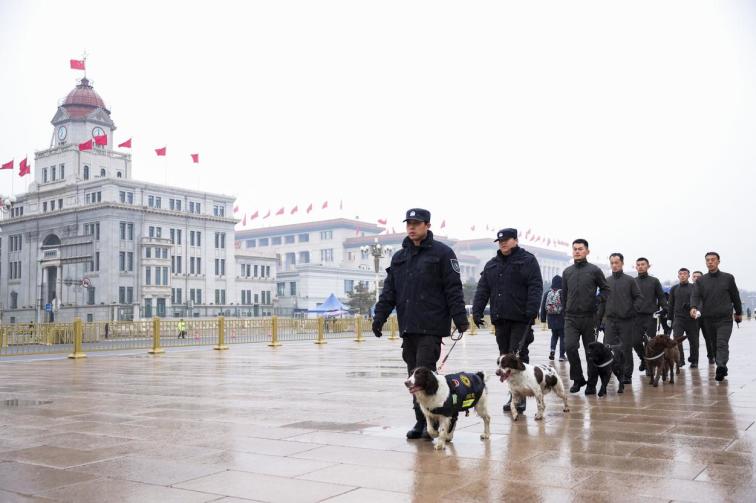
File photo: Plainclothes security personnel walk outside the Great Hall of the People during the opening ceremony of the National People's Congress in Beijing, China, on March 5, 2024. (Photo by Lintao Zhang/Getty Images)
[People News] In modern rule-of-law nations, 'national security' is a policy goal defined by strict legal boundaries, subject to judicial oversight, and must strike a balance with citizens' fundamental rights. However, under the totalitarian regime of the Chinese Communist Party (CCP), 'national security' has been conceptualized, pocketed, and weaponized, transforming it into a political tool that allows rulers to override all laws, infringe upon civil rights, and sacrifice the livelihoods of the people.
Recently, the State Council of the CCP issued the 'Regulations on Exit and Entry Management,' citing national security as a pretext to deprive and suppress the people's rights to travel abroad. Many scholars and expatriates have openly remarked that this action is akin to 'isolation.'
Deng Haiyan, a prominent internet writer and commentator who served in the Chinese public security system and as a criminal police officer for 17 years, recently shared on the X platform that the 'Regulations on Exit and Entry Management' will enforce 'isolation' starting September 15. He expressed his concerns, stating, 'This new exit and entry regulation in China has significantly intensified border control measures. Even ordinary individuals who are not connected to the system will encounter numerous challenges when attempting to travel abroad in the future, as the reasons for being blocked at the airport are exceedingly broad. In total, the period during which Chinese citizens could relatively freely apply for passports and travel abroad has been less than 20 years, and it seems that this era is nearing its end...'.
His post garnered 510,000 views and 600 comments, sparking intense discussions, with many Little Pink supporters attempting to downplay the situation by asserting that the new law 'is not aimed at ordinary people' and 'has little relevance to ordinary people,' among other claims.
In response to such comments, Deng Haiyan expressed her anger in a post, stating, "I find it infuriating how naive some people can be. They quickly forget the pain of past wounds, claiming that the new immigration regulations are not directed at ordinary citizens. Well, let's consider land reform, anti-rightist campaigns, public-private partnerships, the Four Clean-ups, and the Cultural Revolution... Look at the policies from China's decades of self-imposed isolation; which of them was explicitly aimed at ordinary people? Yet, which ordinary person could truly remain unaffected? Whether you are considered an 'ordinary person' depends entirely on the state's perception of you. A wise individual can discern the larger context from a small detail, while in reality, fools can pretend that spring is still here even as the leaves have fallen all around."
Deng Haiyan's post struck a chord with many internet users, who responded with comments like: "We are learning from North Korea's most effective tactics. First, lower the big iron gate, then gradually divide everything inside until every village, community, and building is completely grid-managed. To step outside the rules requires an application, and entering the grid must be reported. Ten households must support and supervise each other. It doesn't matter if you are afraid; the real question is whether you will comply."
"When the Hong Kong National Security Law was first enacted, officials claimed it was only aimed at a small number of individuals who posed a threat to the state, not at ordinary Hong Kong citizens... Now, do ordinary citizens still dare to express themselves freely on social media? Do they still have the courage to criticize the Communist Party when interviewed by foreign media?"
"This year, we have seen bans on VPNs and restrictions on leaving the country. Is it because too many people have managed to escape abroad in recent years? Has this created a negative impact on the old Communist Party?"
I once told a relative of mine in China that Chinese people are prisoners of the Communist Party, not of their own country, and that China itself is a prison. If China were truly their own country, citizens should be able to move freely in and out. Unless one is a prisoner, any restriction on personal freedom of movement is, in theory, akin to being a prisoner, similar to being under residential surveillance.
Wang Huning returned from North Korea with insights and immediately put them into action, which shows that they are indeed heading towards a closed-off state like North Korea!
If the knife doesn’t reach these bastards’ necks, they all act tough.
There are far too many fools, and quite a few sycophants are helping the Zhao family’s oppressive regime with their propaganda. In fact, I find that the online supporters are even more disgusting and extreme than those behind the Great Firewall. The pink trolls in the comment section will learn their lesson after facing the iron fist just once.
Most of these individuals who assist in the whitewashing do not possess the ability to travel abroad.
They are turning all aspects of social life into a battlefield.
In Communist China, as long as they use the excuse of 'maintaining national security,' the Communist Party can act with impunity, disregarding all laws, civil rights, and the livelihoods of the people, operating without any legal constraints.
Since Xi Jinping took office, he has introduced the so-called 'overall national security concept,' which expands the definition of security to encompass political, economic, cultural, social, technological, network, ecological resources, and even data across more than a dozen areas.
When economic issues (such as local debts and the collapse of real estate companies), social issues (like unemployment and gatherings of unemployed youth), and cultural issues (such as film and television production and freedom of expression) are all raised to the level of 'affecting national security,' the space for legal protections and civil rights is instantly reduced to zero.
As long as the terms 'endangering national security' or 'colluding with foreign forces' are invoked, public authorities can circumvent standard legal procedures—resulting in arbitrary detentions, secret trials, asset seizures, exit bans, and forced examinations of mobile data. The law has ceased to be a shield for citizens and has become a weapon wielded by bureaucrats and enforcers to impose their will.
The 'three-year dynamic zero-COVID' policy serves as the most glaring example— in the name of the political prestige of top decision-makers and the so-called 'epidemic prevention safety', the economy can be halted, citizens can be confined to their homes and left to starve, those suffering from illnesses can be forcibly taken to makeshift hospitals with no regard for their lives or deaths, and seriously ill patients can be denied entry at hospital doors. When national security is at stake, the fundamental dignity of people's livelihoods and the losses of property are entirely disregarded by decision-makers.
While the Chinese Constitution contains provisions to protect citizens' freedoms and property rights, any mention of 'national security' renders these legal protections void. This approach of 'substituting political movements for the rule of law' has led the entire country into an unpredictable 'state of lawlessness'. Entrepreneurs can be 'captured from afar' at any moment for 'suspected national security or economic crimes', personal property can be seized at any time, and the right to exit can be arbitrarily revoked, prompting capital and talent to flee rapidly, resulting in a stagnant society that lacks innovative capabilities.
This approach to governance, which treats 'national security' as a catch-all excuse for unchecked authority, may appear to maintain absolute social control in the short term, but in the long run, it is hastening the collapse of the entire system. When a regime can freely invoke 'national security' as a license for lawlessness, it not only strips the people of their rights but also undermines the country's potential to progress towards modern civilization.
When laws are disregarded, livelihoods are sacrificed, and civil rights are crushed, this so-called 'absolute security' upheld through oppression and fear represents the most insecure and vulnerable phase of the system. The more the authorities rely on high-pressure tactics and the pretext of national security to stifle public opinion, the deeper the societal resentment grows; and as resentment deepens, the rulers increasingly perceive 'enemies all around,' prompting them to issue even more severe national security directives. This vicious cycle of 'suspicion leading to oppression, and oppression inciting resistance' will ultimately drive society to a breaking point.
(First published in People News)
△





News magazine bootstrap themes!
I like this themes, fast loading and look profesional
Thank you Carlos!
You're welcome!
Please support me with give positive rating!
Yes Sure!