
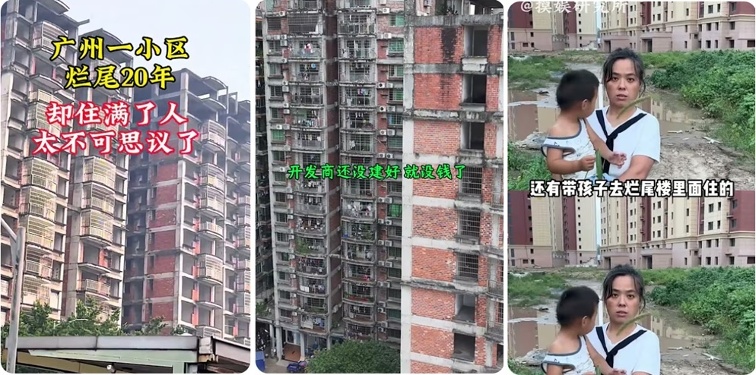
Across major cities and small towns in China, unfinished buildings are widespread, leaving buyers with no option but to move into these properties that lack basic utilities like water and electricity. (Video screenshot)
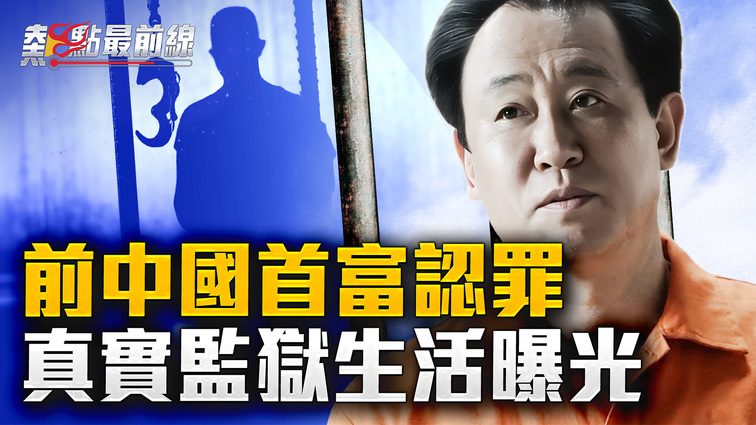
[People News] On August 20, Xu Jiayin, the founder of China Evergrande Group, was sentenced to life imprisonment for multiple offenses, including fundraising fraud and embezzlement. Following this, topics such as 'What should Evergrande homeowners do about their unfinished buildings?' quickly climbed to the top of Weibo's trending searches.
On the morning of August 20, the Shenzhen Intermediate People's Court in Guangdong Province publicly delivered its first-instance verdict against Evergrande Group Co., Ltd. (hereinafter referred to as Evergrande Group), Evergrande Real Estate Group Co., Ltd. (hereinafter referred to as Evergrande Real Estate), and defendant Xu Jiayin.
The court imposed a combined penalty on Evergrande Group for multiple crimes, resulting in a fine of 8.82 billion yuan (RMB, the same below); Evergrande Real Estate was fined 7 billion yuan; and Xu Jiayin received a life sentence for multiple offenses, with all personal assets confiscated and illegal gains subject to recovery, with any shortfall mandated for compensation.
On that day, topics labeled 'What should Evergrande homeowners do about their unfinished buildings?' and 'Unfinished houses, still paying loans' surged to the top of Weibo's trending searches.
According to media reports, Evergrande has left around 1,300 unfinished construction projects nationwide, with an estimated 1.62 million to 2 million unsold pre-sold homes (unfinished buildings) remaining. When including related projects and delayed-delivery buildings, the total impact is estimated to reach as high as 5 million to 6 million units.
Based on the calculation of one housing unit per family (approximately three people), the number of directly affected homeowners—who refer to themselves as victims—ranges from 1.5 million to 2 million households, impacting a population of over 5 million to 6 million individuals.
Among these millions of victims, many are caught in the dilemma of "having to continue repaying mortgage loans to the bank while also needing to pay out of pocket to rent a place to live."
The most unfortunate are the ordinary citizens who have been exploited.
Witnessing Xu Jiayin's fall from grace—once a powerful figure who siphoned company funds abroad, now facing life imprisonment and confiscation of personal assets—most victims' immediate reaction is one of "great relief" and "he got what he deserved."
However, once the initial relief fades, the harsh reality quickly sets in. The primary demand of homeowners remains "to ensure the delivery of their homes"—they hope to receive the properties that rightfully belong to them. While Xu Jiayin's imprisonment offers some accountability to society, it does not magically resolve the issue of unfinished buildings.
One netizen remarked, "Many ordinary people who have poured their life savings into Evergrande's unfinished projects feel as if their lives have been sentenced to an indefinite term." "The challenges faced by homeowners of Evergrande's unfinished buildings are frustrating not due to fluctuations in housing prices, but because of the underlying sense of neglect that has emerged during years of collective waiting."
"As trending discussions focus on the extravagant details of Xu Jiayin's past lifestyle, countless homeowners of unfinished buildings continue to endure the pressures of reality. In the past, companies flourished, and executives indulged in extravagance, but when the debt crisis hit, it is ordinary citizens who are left to bear the consequences. This stark contrast is one of the most poignant aspects of this case.
The government has sold land and collected funds, while banks have issued loans without incurring losses. However, ordinary citizens have invested real money into decades-long mortgages for homes that are uninhabitable.
Concerns and pessimism regarding 'recovery of compensation' and asset liquidation
Despite the court ruling that 'the losses of homeowners and investors take precedence over fines and confiscation of property', the staggering debt crisis faced by Evergrande, amounting to trillions of yuan, renders the assets confiscated from Xu Jiayin and the recovered illegal gains merely a drop in the ocean when it comes to the vast funding required for unfinished construction projects.
Numerous homeowners have openly shared on social media that Xu Jiayin's potential bankruptcy or imprisonment signifies that 'the hollowed-out company has completely exhausted any remaining resources to salvage', extinguishing the last flicker of hope that the Evergrande system could revive the projects.
A self-identified legal worker, 'Willa Legal Reporter', posted, 'A few days ago, I spoke with a client who recounted how he lost his savings by investing in Evergrande and now relies on driving for Didi to make ends meet, with his car loan still outstanding. When I mentioned Xu Jiayin, he simply said, 'He has no conscience', and the tone and expression were difficult to convey, likely reflecting a profound numbness to despair in life.
'Recently, I visited Jinniu Lake and saw an entire area of unfinished Evergrande Health Valley buildings. I heard that some homeowners are still striving to protect their rights. As that client mentioned, some individuals have thrived during this era of dividends, losing their moral compass. The ones who suffer the most are the homeowners of these unfinished Evergrande buildings. I wonder if local city investment has taken over?
The harsh reality of 'mortgage + rent'
Among these millions of affected families, a significant number are grappling with the extremely harsh 'double financial pressure'.
The pre-sale housing system and regulatory loopholes for pre-sale funds established by the Chinese Communist Party mean that even if developers stop construction and leave projects unfinished, the mortgage contracts signed by homeowners and banks remain valid. If homeowners decide to 'stop payments' (cease mortgage repayments), they risk being sued by banks, being placed on a blacklist of untrustworthy individuals, and facing personal credit bankruptcy.
As homeowners cannot move into their scheduled delivery homes, they are forced to continue renting, leading to monthly expenses that can total thousands or even tens of thousands of yuan for both 'mortgage + rent'. This situation severely strains the cash flow of many middle-class and first-time homebuyer families.
In recent years, local governments have set up special task forces to ensure home deliveries and have involved state-owned enterprises to take over some projects, but the overall progress of home delivery remains sluggish.
A content creator on NetEase, known as 'Mi Shi Shu Tong', remarked, 'Behind the 6 million homes are 6 million families. Some have drained six wallets to pay the down payment, managing to pay their mortgage each month while also renting a place to live. Others are waiting for this home to get married, waiting for this home to send their children to school, and waiting for this home to bring their parents from their hometown to live in retirement. Some have purchased retirement homes, saving a lifetime of earnings, but now they haven't received the house, and they are already old...'
There is a call for rights protection and policy adjustments.
Following the court's ruling, many homeowners have taken to the internet to express their concerns, urging judicial authorities and the government to prioritize the recovered funds for replenishing the regulatory accounts for pre-sale funds of various Evergrande projects, and to clarify the credit exemptions and rights protection policies for homeowners who have ceased payments.
The outcry from victims of Evergrande Wealth for compensation continues.
Beyond homeowners, those who invested in "Evergrande Wealth" financial products—including many grassroots employees of Evergrande and their families—are also deeply concerned about the ruling. With Xu Jiayin facing charges of "fundraising fraud" and "illegal absorption of public deposits," victims are urging judicial authorities to conduct a thorough investigation into the hidden assets that Xu Jiayin's family previously concealed through high dividends and overseas trusts, in an effort to recover their hard-earned money as much as possible.
In summary, Xu Jiayin's life sentence serves as a judicial conclusion to the era of "Evergrande's frenzy and collapse." However, for the millions of homeowners stuck with unfinished buildings, while justice is being served through severe penalties, the "unfinished" challenges in their lives will still require a long time and substantial social costs to address. Unfortunately, the government has not prioritized their suffering in its agenda.
△





News magazine bootstrap themes!
I like this themes, fast loading and look profesional
Thank you Carlos!
You're welcome!
Please support me with give positive rating!
Yes Sure!