
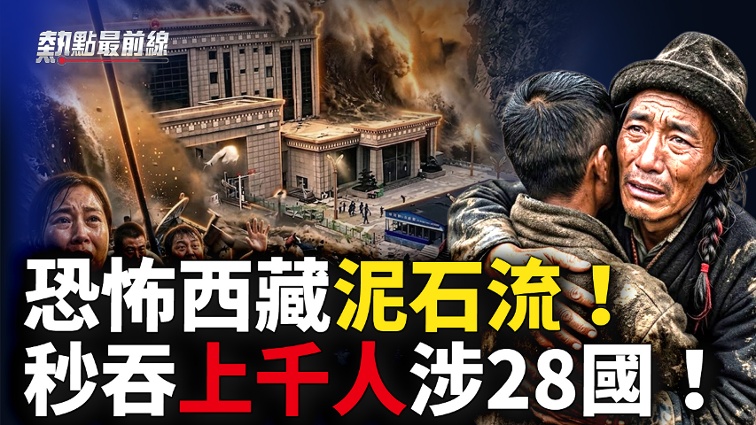
Surveillance footage captured the moment of the disaster as Jilong Port was engulfed by a mudslide (video)
[People News] On August 26, shortly after 10 a.m., a landslide disaster struck Jilong Port in Shigatse City, Tibet. Black muddy water surged down the valley like a tsunami, instantly destroying and engulfing everything in its path, including villages, roads, bridges, supermarkets, power stations, the joint inspection building of the Communist Party of China at Jilong Port, buses, and large groups of fleeing people.
Meteorological and border data show that the flood peak first severely impacted the border port of the Communist Party of China. Subsequently, within about 15 to 30 minutes, it flowed into the downstream areas of Nepal, including Timure and Syabrubesi.
Nepal has been continuously updating the casualty figures. As of noon on August 27, the Nepalese police reported that the death toll had risen to 270, with 826 people missing. In contrast, the information from the Communist Party of China has remained unchanged since 8 p.m. on the 26th: 3 people dead and 265 missing. Many are anxiously waiting for news about their missing relatives, but the Communist Party not only fails to release accurate disaster information in a timely manner but also censors related information on domestic networks, creating a stark contrast with the situation in Nepal.
According to netizens, all videos related to the Jilong disaster have been censored on major social media platforms in mainland China, such as WeChat, Douyin, Xiaohongshu, Zhihu, and Weibo, and related images have also disappeared.
Some netizens expressed their outrage, stating, "Many of those who are dead or missing are foreigners from Europe, America, and Southeast Asia. Why should foreign nationals be denied the right to know?" Others remarked, "They only delete information from within the country; what about those from Nepal? Are they afraid to calculate the number of victims?" "Videos disappear faster than people trapped in the mud; what rules have been violated? Are they worried that the shoddy buildings will be exposed again?" "What are they trying to hide?"
According to reports, currently, only videos that have been publicly released by the Chinese Communist Party's (CCP) state broadcaster, CCTV, are permitted to be shared on the mainland internet. Observers believe that the timely and transparent release of information regarding the disaster in Nepal sharply contrasts with the CCP's approach, underscoring the regime's greatest fear: that injured citizens will come together to defend their rights, that the disaster will damage the CCP's image, and that the public may "use the disaster to incite chaos," thereby questioning the legitimacy of the CCP regime...
Historically, the CCP has developed an instinctive response to conceal disaster situations, including floods, wind disasters, earthquakes, and other calamities that have occurred domestically during this period. Even when facts are exposed internationally, the CCP routinely engages in deception. This is due to the fact that the CCP has faced numerous natural and man-made disasters throughout its history, prompting the public to question the social causes behind them. From natural disasters like COVID-19 and avian influenza to man-made tragedies such as the persecution of Falun Gong, the CCP has consistently lied, covered up, and violently suppressed the truth. As one netizen aptly stated, "Just based on this point, it can prove the illegitimacy of the CCP regime."
Furthermore, Parshuram Kaphle, a senior journalist specializing in foreign and strategic affairs in Nepal, publicly criticized the CCP authorities, accusing them of failing to issue timely warnings downstream at a critical moment when floods were known to have broken out upstream.
Nepalese geological experts and coastal media have indicated that the originally 15 to 30 minutes of time difference represents a critically valuable 'escape time' for residents in the basin. However, both Nepalese officials and local residents reported that they did not receive any emergency notifications from the Chinese Communist Party (CCP) at that time. Journalists have expressed strong skepticism regarding the border cooperation mechanism established by the Beijing authorities.
On the other hand, the CCP's state media, CCTV News, claimed in its report on the same day that the mudslide occurred on 'the Nepal side of the port', which led to significant casualties and missing persons in Tibet's Jilong region.
Geological scientists have noted that the flash flood initially destroyed the customs facilities and communication base stations on the CCP side in Zhangmu and Jilong, resulting in severe casualties and missing border personnel. The sudden collapse of communication infrastructure may be the primary physical reason for the complete disruption of cross-border real-time hydrological warnings.
△





News magazine bootstrap themes!
I like this themes, fast loading and look profesional
Thank you Carlos!
You're welcome!
Please support me with give positive rating!
Yes Sure!