
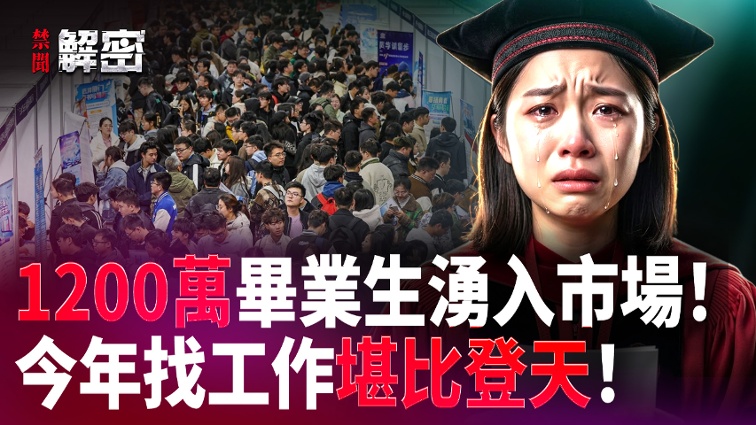
2026 Higher Education Collective Bankruptcy! Where Can the Underprivileged Retreat? (Video)
[People News] Hello, everyone, and welcome to "Forbidden News Analysis." I am Sun Ning.
According to the latest data from the National Bureau of Statistics of the Communist Party of China, the unemployment rate for urban laborers aged 16 to 24, excluding students, reached 17.9% in July 2026! This indicates that one in five young people entering the job market is currently unemployed or looking for work.
However, the criteria for determining "employment" used by the National Bureau of Statistics, which follows the standards set by the International Labour Organization, are quite lenient. If an individual has worked for more than one hour during the survey week, they are classified as "employed" in the statistics. Furthermore, this data only includes urban residents; young people with rural household registration who return to their hometowns are statistically considered to be engaged in agricultural work and are not counted as unemployed.
Professor Zhang Dandan from Peking University has conducted micro-surveys and found that among the 16-24 age group, excluding students, there are about 16 million active youth who are in a state of "living off parents" or "full-time children," which is classified as non-labor force status.
If we were to re-include this group of young people, who have exited the job market due to setbacks or have chosen to "lie flat," in the unemployment statistics, the overall youth unemployment rate in China would soar to 46.5%.
In 2026, the number of fresh graduates from Chinese universities soared to an impressive 12.7 million, marking an increase of 480,000 compared to 2025. However, this figure only represents the tip of the iceberg. When considering the backlog of unemployed graduates from the past two years who failed their postgraduate entrance exams and civil service exams, along with the influx of returnees from studying abroad, the total number of young people seeking white-collar jobs in the market this summer is conservatively estimated to exceed 15 million. This number already surpasses the total population of many medium-sized countries.
Confronted with such a massive influx of graduates, the official response in recent years has not focused on job creation but rather on an 'expansion policy'—encouraging postgraduate studies, promoting doctoral programs, and advocating for second degrees. Economically, this approach does not address employment issues; instead, it postpones the employment crisis by extending the education period by 2 to 3 years. However, by 2026, this reservoir has completely overflowed. Higher education has transformed into an assembly line of 'collecting fees, issuing certificates, and delaying unemployment.' In the summer of 2026, the backlog of master's and doctoral students from years of expansion collided with the 12.7 million fresh graduates, resulting in the most severe talent stampede in Chinese history.
Previously, we believed that a 17.9% unemployment rate was merely a refuge for those from less prestigious colleges, those with high aspirations but low skills, or those who did not exert enough effort. However, in the summer of 2026, a harsh social myth was shattered—top students from 985 and 211 universities also began to be 'returned' in large numbers by the job market.
The youth unemployment rate reaching a new high is not just an individual tragedy; it represents a deliberate squandering of national productivity.
When society's brightest minds are compelled to squander their most creative, energetic, and ambitious years on tedious and repetitive public examination essay memorization, or to fritter them away in low-value flexible jobs, the entire economy's potential for innovation risks facing an irreversible 'mass necrosis'.
The unemployment rate of 17.9% does not reveal the weakness of young people; instead, it highlights the harsh realities of macroeconomic planning, educational supply, and the profound dysfunction of the economic system. In this harsh winter, it is not the elite university graduates who are tirelessly revising their resumes late into the night who are unwell; rather, it is the very structure that is systematically undermining the future of the youth.
That concludes today’s discussion. If you enjoyed our program, please like, subscribe, and activate the notification bell. We also welcome your thoughts on the challenges faced by Chinese youth in securing employment in the comments section. We look forward to seeing you in the next episode!
(‘Forbidden News Decoded’)
△







News magazine bootstrap themes!
I like this themes, fast loading and look profesional
Thank you Carlos!
You're welcome!
Please support me with give positive rating!
Yes Sure!