
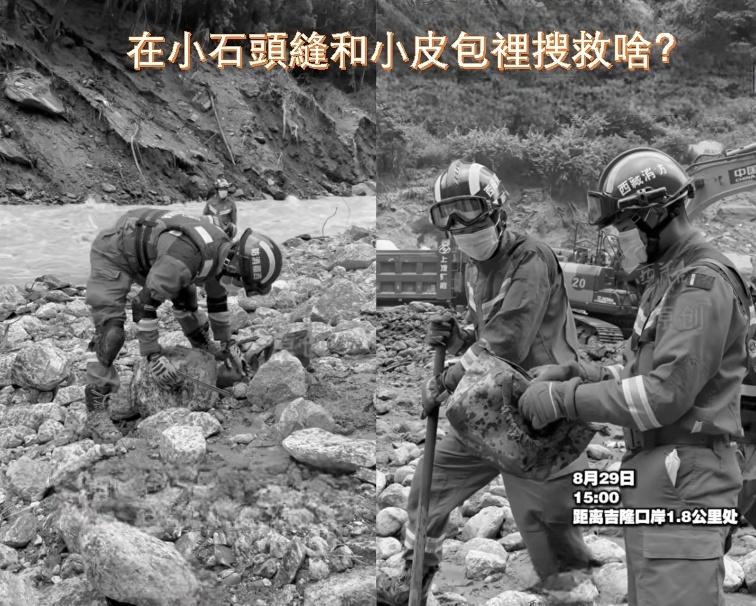
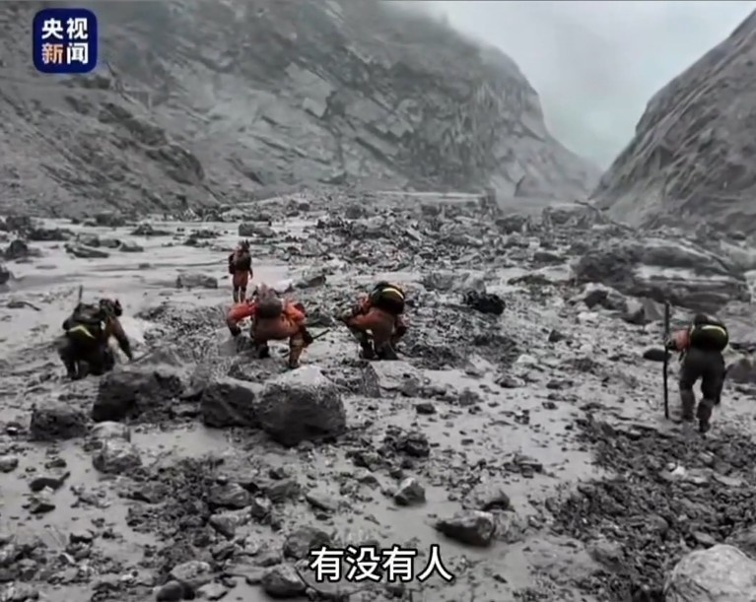
Members of the rescue teams dispatched by the CCP are in the disaster-stricken area of Jilong Town, feeling the crevices of stones and rummaging through bags for 'rescue' efforts. (Video screenshot)
[People News] On September 2, Chinese state media reported that the Tibet government held its first press conference regarding the mudslide that occurred in Jilong County on August 26. The conference featured key figures including Gama Zeden, the overall commander and chairman of the autonomous region; Ren Wei, the executive deputy commander and executive vice chairman; and Wang Haitao, the head of the Tibet Fire Rescue Corps. Notably, no military personnel attended the event.
Despite the Chinese authorities acknowledging the significant casualties and the global shock caused by this tragedy, the Communist Party of China (CPC) opted not to hold a press conference in Beijing, as it did following the 2008 Wenchuan earthquake, in an effort to minimize public scrutiny. As with previous press conferences, the CPC focused on its own actions while remaining vague about the number of casualties and the conditions of the disaster victims.
It is important to note that Gama Zeden stated that after the disaster, the autonomous region government "implemented Xi's important instructions and the spirit of the Central Political Bureau meeting, following the decision-making arrangements of the Party Central Committee and the State Council," outlining the actions taken. Similar remarks were echoed by Wang Fanghong, the secretary of the Shigatse Municipal Committee, during the press conference.
This suggests that local officials are likely aware of Xi's diminished power and the current "collective leadership system"; otherwise, it would be unusual to see Xi's directives mentioned alongside the "spirit of the Central Political Bureau meeting," which represents over 20 other senior CPC Politburo officials. Particularly noteworthy is that the typically low-profile Li Qiang personally visited the disaster area, further supporting this observation.
According to information revealed at the press conference, the Chinese Communist Party deployed 24 helicopter flights to transport rescue personnel and equipment to the core area, involving over 2,300 rescue workers, more than 400 rescue vehicles, over 8,000 sets of rescue equipment, over 800 drone flights, and 5.43 tons of airdropped supplies. However, it appears that no one was rescued during these efforts.
Official photos and videos indicate that the helicopters and some of the rescue personnel were sourced from military units. A report from the PLA Daily on September 2 noted that the Western Theater Command Air Force continued to deploy drones for aerial reconnaissance, while a unit from the Shigatse Military Sub-district in Tibet organized soldiers to conduct road clearing and other tasks in the disaster-stricken core area at the port. Armed police from the Shigatse detachment and a unit from the Second Mobile Corps of the Armed Police participated in search and rescue and debris clearance operations. Additionally, the Tibet Military Region General Hospital dispatched medical personnel primarily for epidemic prevention, disinfection, and psychological support. The report did not mention any successful rescues.
Data indicates that there are over 50,000 troops stationed in Tibet, equipped with modern assets such as plateau-type main battle tanks, long-range rocket artillery, large-calibre guns, and air defense systems. The total number of helicopters in the Western Theater Command Air Force is estimated to be between 200 and 300.
In other words, following the mudslide disaster in Tibet, the rescue personnel and helicopters sent by the Chinese Communist Party (CCP) military were extremely limited. In contrast, Nepal, which also faced the disaster, has mobilized over 21,000 security personnel, including military, police, and armed police forces, as reported by the Nepal Disaster Risk Reduction and Management Authority (NDRRMA). Among these, the military consists of more than 10,000 personnel, and the Nepalese army is continuously reinforcing its presence in heavily affected areas such as Rasuwa and Nuwakot.
The extensive mobilization of the Nepalese military and the images of rescue operations in hydropower station tunnels, steep slopes, or collapsed buildings have made the Chinese public acutely aware of what the CCP claims to uphold as 'people first, life first.' In reality, the CCP has merely been issuing slogans and misleading the populace.
This stark contrast makes it clear that the CCP military is not actively engaged in disaster relief efforts. As for the passive involvement of the Western Theater Command and the Tibet Military District in disaster response, the reasons remain uncertain. Firstly, the ongoing arrests of high-ranking military officials have created a climate of fear. The commander of the Tibet Military District, Wang Kai, did not appear during Xi's visit to Lhasa last year and has been missing since, leading his subordinates to adopt a 'do less rather than more' approach. Secondly, there is widespread dissatisfaction within the military at all levels, and central and local officials may struggle to effectively command the military.
Interestingly, when Li Qiang was present at the disaster site in Tibet, he was not accompanied by any senior military officials, despite the military being the primary force in disaster relief efforts. Additionally, Li Qiang seems skilled at avoiding suspicion and lacks the courage to confront or reprimand the military. This alone suggests that he is not an official genuinely concerned about the welfare of the people, especially when compared to former Premier Wen Jiabao, who was known for his willingness to criticize the military in the past.
According to WikiLeaks, after the Wenchuan earthquake in May 2008, Wen Jiabao sharply criticized the airborne troops for their delayed arrival at the remote disaster site due to adverse weather conditions. He pointed out that, despite knowing the disaster's severity and the urgent need to rescue hundreds of thousands of victims from the rubble, the Chinese military did not deploy the expected 300,000 personnel for rescue operations, but instead sent only 130,000 troops, most of whom arrived 72 hours later to recover bodies.
Reports from Chinese state media indicate that by the end of the critical 72-hour period following the earthquake, the military had deployed only 20 helicopters to the vast disaster area, and fewer than 1,000 troops had entered the epicenter of Wenchuan County.
It is reported that Wen Jiabao told the military that such delays were 'unacceptable' and emphasized, 'The People's Liberation Army must remember who it serves - the Chinese people.' He also reportedly slammed the phone down in anger.
A telegram from the U.S. Embassy in Beijing to Washington, D.C., on July 17, 2009, noted that Liu Yawei, brother of Liu Yazhou, deputy political commissar of the Air Force of the People's Liberation Army, stated that Wen Jiabao's sharp criticism had infuriated the military leadership.
In light of the military's disarray, one must wonder: does Li Qiang have the courage to take action?
The press conference not only revealed the inefficiency of the Chinese Communist Party's (CCP) military and the incompetence of local governments, but also once again shifted the blame for the disaster onto local geological conditions. It stated that "the geological structure is complex, the high-cold climate is significant, and under the influence of global warming, regional glacial melting has intensified. Coupled with the unique border location, geological disaster prevention and control faces multiple challenges," and that "monitoring emergency conditions is limited." This essentially sets the stage for those responsible to evade accountability.
The issue is that a similar situation occurred in the area last year; why is reconstruction still taking place in the most dangerous locations? Additionally, isn't the series of hydropower projects constructed by the CCP in the Himalayas, which disrupts nature, a major factor contributing to landslides and glacial collapses? Clearly, the CCP is reluctant to acknowledge this, as doing so would require them to accept responsibility.
(First published by the People's Daily)△








News magazine bootstrap themes!
I like this themes, fast loading and look profesional
Thank you Carlos!
You're welcome!
Please support me with give positive rating!
Yes Sure!