

2 Million for a Border Inspection 'Iron Rice Bowl' - Jilong Landslide Shatters in an Instant (Video)
[People News] Hello, dear viewers, and welcome to 'Decoding Zhongnanhai'. I am Sun Ning.
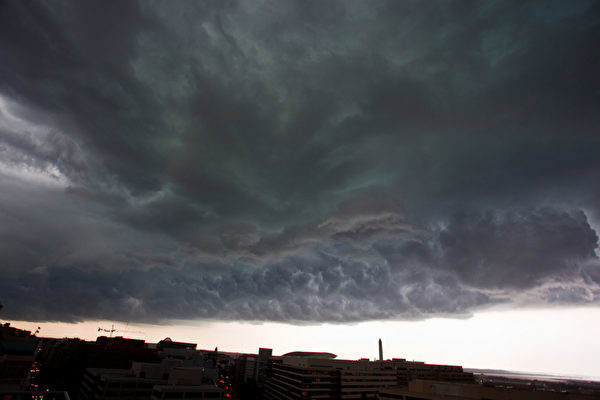
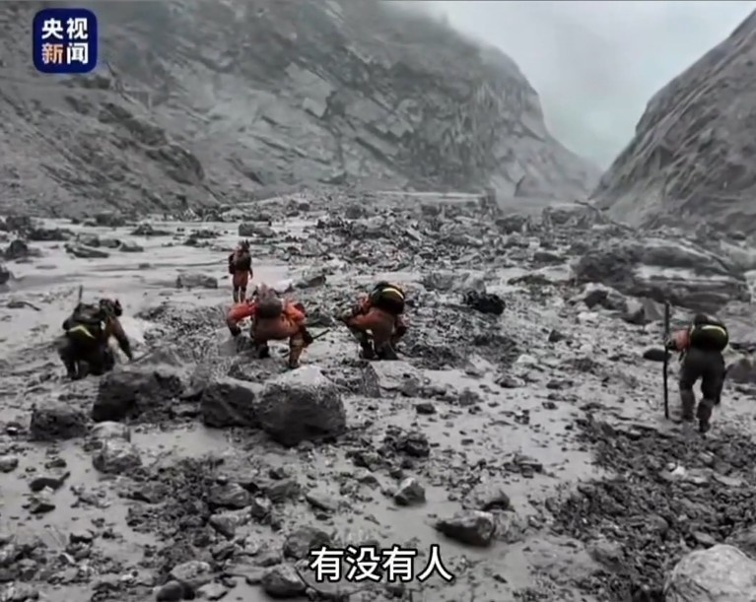
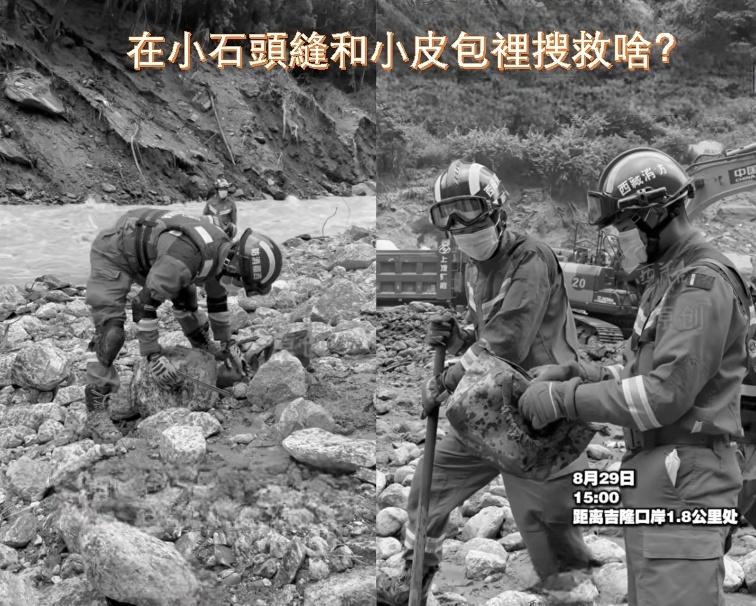
Nature's iron fist can strip away humanity's most delicate facades. In the early hours of August 26, 2026, the vital artery of the China-Nepal border - Tibet's Jilong Port - was obliterated in an instant by a massive landslide triggered by a glacier collapse. Hundreds of people went missing and lost their lives, turning the once-bustling port into a chaotic heap of rubble.
Yet, while rescue helicopters hovered over the wreckage, a chilling and heart-wrenching accusation emerged from the dark corners of the internet, more horrifying than the natural disaster itself. The wife of a missing police officer posted online: 'Husband, there is not a single word about you; the three kids are waiting for you to come home! The government will take full responsibility, with compensation of two thousand a month. Initially, I spent 2 million to secure this position, with a promise of a comprehensive salary of 500,000 a year. It has only been a year since I started, and now he is buried under the cold landslide; the government now offers a meager two thousand a month in compensation. How am I supposed to live with three kids?
Two million bought a position; a promised annual salary of five hundred thousand; just a year into the job, and the person is buried under the cold landslide; and now the government's compensation is merely two thousand a month.
Is this a story about natural disasters? No. What this woman is describing is a magical realism tragedy of 'system worship' in contemporary China. Today, let us examine the chaotic pricing of positions behind the massive landslide at Tibet's Jilong Port, and the 'landslide' of the system that is consuming the lives of countless ordinary people.
The Special Treatment of China's Border Inspection
When people hear the phrase '2 million to buy a position,' many friends living in the mainland or abroad initially respond with disbelief: how is this possible? Is this a scam? In the current Chinese system, spending a staggering 2 million to secure a grassroots police position in the desolate, oxygen-deficient border of Tibet, where cold winds blow, seems like a bad deal. However, if you truly grasp the economic collapse currently unfolding in China, the plight of civil service exam candidates who have run out of options, and the high, distorted 'invisible benefits' at border ports, you will understand that this absurd transaction not only exists in contemporary China but that countless individuals are eager to grab this 'high-priced ticket,' even if it means taking on massive debts.
Amid a significant economic downturn in the mainland, with companies collapsing left and right, 'positions' have transformed from ordinary jobs into the only 'Noah's Ark' that can provide salvation in this storm. For this so-called 'absolute sense of security,' countless families are willing to risk everything, going into debt for millions, to take part in this gamble.
So, what kind of allure does the formal position at Jilong Port possess that enables intermediaries of power to quote an exorbitant price of 2 million, and makes ordinary citizens willing to pay for it? This leads us to the Chinese border inspection system—commonly referred to as 'border inspection'—which, following its reform and transfer in 2019, offers alarmingly high special treatment.
Before the establishment of China’s National Immigration Administration in 2019, the country’s border defense forces were part of the People’s Armed Police. After the restructuring, they shed their military uniforms, put on police uniforms, and were fully incorporated into the People’s Police system—that is, they became formal civil servants. Within the broader civil service, the compensation system for China’s border inspection personnel has always been considered above average.
At Jilong Port, the base salary of official police officers or customs personnel—including position and rank pay—is roughly on par with inland regions, at about 72,000 RMB per year. However, as members of a disciplined force, they receive additional allowances such as rank stipends, duty allowances, and overtime pay for 24-hour shift work. Combined with year-end performance bonuses and a 13th-month salary, this portion of basic cash income can reach as high as 132,000 RMB annually.
Jilong Port is located in a high-altitude, harsh, and remote area, and thus receives significant policy-based financial support. Public employees are entitled to high-altitude hardship subsidies, border defense allowances, and “Category I” remote-region hardship stipends. For a newly hired grassroots police officer or junior customs official, these subsidies alone can amount to around 12,000 RMB per month—totaling another 144,000 RMB per year.
Beyond wages and allowances, there is also an attractive form of “hidden wealth” within the system—the housing provident fund. In Tibet, both the contribution rate and the calculation base are set at the legal maximum, with a combined employer-employee contribution rate of up to 24%. Crucially, the calculation base includes all the aforementioned frontier subsidies. As a result, approximately 8,000 RMB is deposited monthly into an employee’s housing fund account—adding up to 96,000 RMB per year. After several years, even an ordinary junior officer can accumulate enough in their housing fund to cover a down payment on a home in a provincial capital city.
At the same time, to retain talent in frontier regions, new recruits receive installment-based relocation grants and talent recruitment subsidies in their early years. They are also entitled to extended annual family leave—often lasting several dozen days—with round-trip airfare fully reimbursed by the state. These policy benefits alone are worth at least another 80,000 RMB per year.
In addition, frontline port staff are provided with free police housing, eliminating rent and utility expenses, while well-equipped canteens offer free, nutritious meals. Altogether, this can save an individual at least 48,000 RMB annually in living costs.
Adding these five components together, a comprehensive annual compensation package of 500,000 RMB is easily within reach.
For those in inland regions who cannot even find a job paying 3,000 RMB per month—and who may have families with multiple children to support—the promise of “500,000 RMB annual income, breaking even in four years, and achieving upward mobility for the entire family” makes the 2 million RMB price tag seem less like a fantasy and more like a once-in-a-lifetime opportunity worth risking everything for.
The Enchanting Contrast on Both Sides of the Himalayas
Given that Jilong Port is considered a lucrative 'plum job', one might wonder how many government-dependent personnel are stationed here. Based on public recruitment and budget data from the Tibet Autonomous Region and Lhasa Customs, we can clearly illustrate the bloated bureaucratic structure behind this border gateway.
At this valley port, which remains hidden deep within the Himalayas throughout the year, the number of permanent administrative and fixed establishment personnel ranges from approximately 250 to 280. Additionally, behind these nearly 300 established civil servants, there is a substantial number of non-established personnel—hundreds of low-paid coordinators, labor-dispatched logistics staff, auxiliary police, cleaning staff, and property management personnel. When combined, nearly 500 staff members operate around that narrow port building each day.
So, what does the scene look like across that narrow border line?
Across the river from China's Jilong Port lies Nepal's Rasuwagadhi Port. According to data from Nepal's Ministry of Home Affairs and Ministry of Finance, on the opposite side of this international trade artery, the total number of officially deployed civil servants and security personnel in Nepal is only about 80 to 90.
Just a bridge apart, with the same trade volume and customs checkpoint, the manpower costs and bureaucratic redundancy on the Chinese side are astonishingly five times that of neighboring Nepal!
This stark contrast reveals the core anxiety of the Chinese Communist Party's (CCP) stability maintenance system. Nepal, functioning as a normal country, operates its ports merely as 'economic gateways and trade ports,' utilizing minimal administrative costs and streamlined personnel to handle tax collection and clearance. In contrast, the CCP views every border port as a 'political frontline, stability maintenance fortress, and ideological outpost.'
They have erected grand, palace-like inspection buildings, cramming customs, border inspection, public security, and foreign exchange management into these structures, all equipped with the most rigorous surveillance cameras. Their intention is not to facilitate trade, but to monitor the Tibetan region comprehensively, prevent 'foreign infiltration,' and display 'great power muscles' to South Asia.
This distorted approach of 'militarizing, stabilizing, and politicizing' the ports is a bottomless pit that squanders the hard-earned resources of ordinary citizens during peacetime. When nature takes a serious turn, this reckless accumulation of population transforms the Chinese side into a vast and tragic scene of human lives being consumed.
In their planning, bureaucrats focus solely on grand political objectives, completely ignoring natural laws and showing no concern for the lives of ordinary people. The geographical location of the Jilong port is inherently unscientific. It is situated in the V-shaped valley where the Jilong Zangbu River and the Donglin Zangbu River converge, upstream filled with glacial lakes that could burst at any moment, and flanked by towering landslide zones that are prone to large-scale collapses. It is a struggle against floods for space, a contest with death for territory.
In the face of political fanaticism, science takes a backseat. A significant number of young elites in China, who dream of stable jobs and high salaries, have been densely packed into this terrifying 'Valley of Death' under the direction of the system.
Knowing that there are tigers in the mountains, yet still heading towards the tiger's mountain.
Given the dangers of this place, and the fact that these grassroots personnel are essentially dancing on a time bomb, shouldn't everyone be trying to steer clear? How could a rational person knowingly head towards a tiger's mountain?
Yet, the most absurd and heartbreaking social reality is found here. In a society governed by the Chinese Communist Party, the phenomenon of 'involution' has reached a pathological level. In the annual national civil service examination, this high-altitude, low-oxygen, crisis-ridden border checkpoint at Jilong has not only remained popular but has repeatedly ranked among the most fiercely competitive in the country.
According to data from the official website of the Chinese civil service examination, the ratio of applicants to positions at the Jilong border inspection station and the Lhasa customs office stationed in Jilong has repeatedly surpassed the staggering ratio of 1900:1, even exceeding 2000:1!
Over two thousand people are vying for a single position. What is behind this? It indicates that the civil service examination candidates from the mainland have reached a dead end. To attract applicants, these remote positions often lift restrictions on household registration, cancel party membership requirements, and do not limit grassroots work experience. Consequently, countless students from less popular majors, with humble backgrounds, and those who have faced significant challenges in the mainland view the border positions in Tibet as their last glimmer of hope. They approach it with the mindset of 'Tibet is too harsh, surely no one will apply, I’ll go and seize the opportunity,' and rush in, transforming this Valley of Death into one of the most challenging battlegrounds in the Chinese civil service examination.
In this intense competition of two thousand to one, the most heartbreaking and suffocating story is that of a girl named Li Lei Yang.
If the phrase 'defying fate' truly exists, Li Lei Yang is its perfect representation. Born in an extremely impoverished village in northern Anhui, she had no family background or social resources. To escape her lowly fate, this girl dedicated herself to studying day and night for twenty years. Her starting point was very low; she initially enrolled in an ordinary vocational college—Anhui Vocational and Technical College. However, she refused to accept her fate; she fought hard to upgrade to a bachelor's degree and successfully entered an undergraduate program. During her undergraduate years, she studied diligently, creating miracles once again by gaining admission to one of China's top 985 universities—China Agricultural University—for her master's degree, majoring in Resource Utilization and Plant Protection.
On the day she received her master's diploma, she and her rural parents believed that their twenty years of hard work would finally pay off. In search of stability, she immersed herself in the civil service examination process. With her impressive test-taking skills, she triumphed in the fierce competition at Jilong Customs, where the odds were two thousand to one, successfully securing a position as a 'Level 4 Plant Quarantine Officer.'
This is a classic inspirational story of a 'problem-solver' becoming a civil servant; she is the pride of her village in northern Anhui and the greatest pride of her parents. Reviewing her chat records from her lifetime, this young girl was filled with pure patriotic sentiments, sharing dreams with her friends about making a difference in the border areas of her motherland and using her expertise to 'guard the national borders.'
Filled with boundless hope for the future, Li Lei Yang arrived at Jilong Customs on August 21, 2026, weary but ready to officially start her job.
However, no one could have predicted that the grand narrative of a powerful nation would not offer this girl from a modest background a life of happiness through social advancement, but instead lead to a devastating disaster. Just five days after starting her job, in the early hours of August 26, a mudslide surged into the river valley, burying this young master's student, who was just in her twenties and at the beginning of her life journey, alive under the cold mud and sand.
As her brother heartbreakingly stated online after the tragedy: "Who would have thought that the first month's salary would turn out to be a compensation payment?" She had faced all of life's challenges, passed every test, and secured a coveted position among two thousand competitors. She believed she had finally achieved success, only to find that the system had prepared a cold grave for her at the finish line.
Also resting eternally at the bottom of the river valley was another young border guard named Yang Shizi. In subsequent reports by the Chinese Communist Party, they sought to emphasize his patriotism by releasing his correspondence with friends. However, this backfired, as these letters became powerful evidence of the system's disregard for life.
In one of his letters, Yang Shizi wrote: "Our camp is built right next to the riverbank. The geological conditions here are poor, with mountain floods and mudslides occurring frequently. Every night, I fall asleep to the sound of the river waves, and sometimes when it rains all night heavily, with the mountains roaring and the valleys echoing, I think to myself that perhaps one day a disaster will strike, and I too will rest here forever."
Who could have imagined that this offhand remark would ultimately become a chilling prophecy!
Li Lei Yang and Yang Shizi do not come from families that can easily produce 2 million yuan. They are among the most honest, diligent, and exceptional problem solvers in China. They believed that if they worked hard enough and heeded the system's call to 'go to the places where the motherland needs them most,' they could secure a lifetime of peace and happiness.
Yet, from the system's perspective, they have never been seen as tangible lives that require protection; instead, they are merely interchangeable figures, regarded as 'high-grade consumables' meant to fill the gaps in maintaining stability at the borders.
Under the Iron Fist, All is Dust
While natural disasters that take lives represent the cruelty of nature, the functioning of this system in the aftermath starkly illustrates the chilling essence of totalitarianism.
Li Lei Yang has died, Yang Shizi is missing, and the police officer who borrowed 2 million to secure a position is also unaccounted for. The initial promise of a 500,000 annual salary has been reduced to rubble in the mudslide. What remains for their families? They are left with debts exceeding a million, orphans and widows in desperate need, and the cold, meager compensation from the authorities—around 2,000 yuan per month.
Can 2,000 yuan sustain three children in today’s mainland? Can it settle the 2 million debt incurred from purchasing an official position?
The families have been utterly devastated. Faced with overwhelming despair, any notions of patriotism or the rise of a great nation become nothing but hollow lies! They began posting on Xiaohongshu and Weibo to seek assistance, hoping to draw social attention and secure a bit more compensation.
However, what awaited them was not the state’s special consolation or the warm inquiries from officials, but rather the most advanced and refined technique of the Chinese Communist Party—known as “gagging and silencing.”
Traffic restrictions, speech bans, post deletions, and account blocking ensued. On September 2, a suspected account of Li Lei Yang sent out its final message, consisting of nine desperate words: “Cannot send, the platform has blocked it.” Following this, the account was completely silenced, and reports emerged that the family had received warnings to remain quiet, effectively sealing their mouths.
On the overseas social media platform X, a user left a particularly harsh and somewhat cold-blooded comment after witnessing this tragedy. He remarked: 'Spending 2 million to buy an official position, taking a 2000-to-1 exam to serve as a stability machine for a dictatorial regime, aiming to become a vested interest, only to be bitten back by the iron fist of the system—this is what we call karmic retribution, and it is not worthy of sympathy.'
This comment is one that silences. However, in my opinion, Li Lei Yang and the police officer who borrowed money, while they have unwittingly served as gatekeepers of the system, are also the most tragic victims of this cannibalistic structure.
Within the illusion of a 'great nation' crafted by the Chinese Communist Party through lies and fear, ordinary people at the bottom have been successfully brainwashed into believing that as long as they work hard enough, strive to pass the civil service exam, and invest money to buy their way into the system's firewall, they can secure a share of the benefits and achieve absolute safety.
Yet, the landslide at Jilong Port brutally stripped away the last layer of pretense. It conveys a stark message to all young people in China: in the face of a cold totalitarian regime and the merciless laws of nature, the position you purchased for 2 million is as fragile as a piece of waste paper.
The system has never considered you as its 'child'. While you are alive, you are expected to passionately venture into the most dangerous places to serve as cannon fodder, as expendable resources, or as mere components; once you die, you lose your value in terms of maintaining stability and production for the system, and you and your family will, in an instant, be relegated to the 'primary target for stability maintenance' that sparks a public opinion crisis. They will use the harshest standards to dismiss your life and silence your family's cries with a brutal iron fist.
If a system can exploit and deceive even the 'gatekeepers of the national gate'—those it has lured with grand narratives and high salaries—and then not allow even a single cry to be heard after their death, then the credibility of this system has already been completely bankrupted from within.
That concludes today’s content. If you enjoyed our program, please give us a thumbs up, subscribe, and turn on the notification bell. If you have any thoughts on purchasing a position for 2 million, feel free to leave a comment in the comment section. We’ll see you in the next episode!
(‘Decoding Zhongnanhai’)
△




News magazine bootstrap themes!
I like this themes, fast loading and look profesional
Thank you Carlos!
You're welcome!
Please support me with give positive rating!
Yes Sure!