
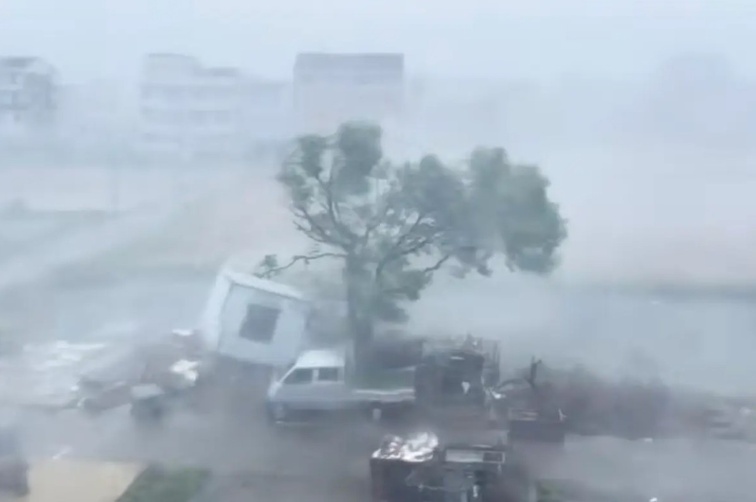
Typhoon'Bai Dolphin'made landfall twice on the evening of August 9 in Yuhuan, Taizhou, Zhejiang, and Wengang Street, Yueqing City. This typhoon traveled an impressive distance of 6,000 kilometers, setting a record for oceanic typhoons making landfall in China. (Video screenshot)
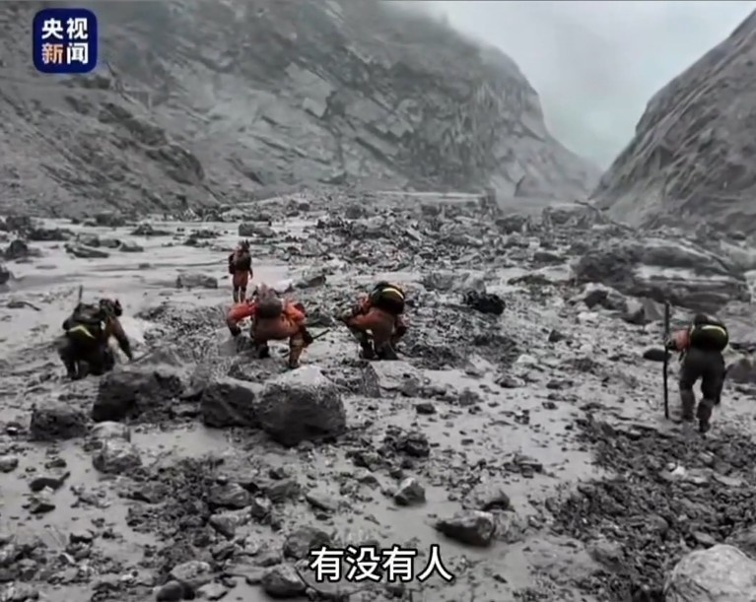
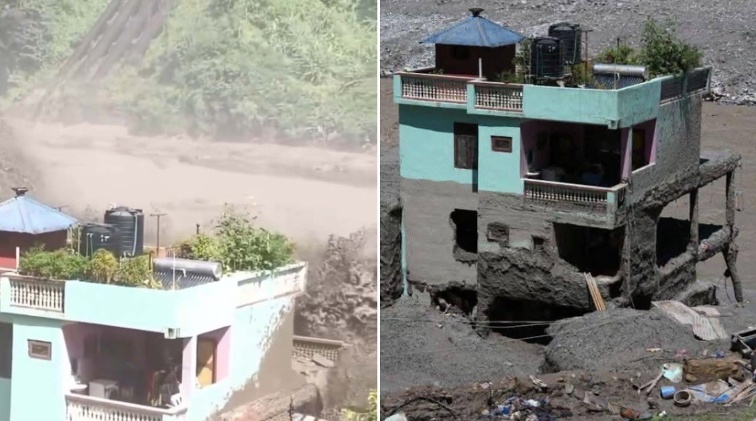
[People News] As September begins, disasters such as landslides, ice avalanches, mudslides, and floods continue to plague the territory governed by the Chinese Communist Party (CPC). In early to mid-September, a significant avalanche occurred at the No. 2 glacier of Mount Muztagh in Xinjiang, while felt earthquakes were reported in Xilin Gol League of Inner Mongolia and Jiyuan, Henan. Additionally, flooding affected the streets of Chengdu, Sichuan... Notably, on September 5, a landslide event in Suichuan County, Ji'an, Jiangxi, resulted in multiple disaster sites. Comprehensive media reports indicate that there were casualties in areas such as Zuo'an Town, Guatang Village, and Huangjin Village, with the death toll in Gaoping Town alone reaching 16. Furthermore, due to the impact of Typhoon 'Shadell', mountain floods and landslides in cities like Chenzhou and Shaoyang in Hunan were particularly severe. According to reports from CPC state media, as of September 5, over 10,000 people in Guidong County, Chenzhou City were affected, with reports of casualties emerging from various locations. Meanwhile, the flood damage in Putian, Ningde, and Quanzhou in Fujian has yet to be fully detailed by the CPC.
In traditional Chinese belief, mountains and land are the foundation of the state. Landslides, ground subsidence, and floods are seen as signs of instability in the national foundation and are omens of a dynasty's downfall.
Historically, signs preceding the fall of dynasties include frequent natural disasters and a declining population. All indicators of the potential collapse of the CPC regime have already surfaced, including a surge in displaced persons, loss of public support, deteriorating living conditions, economic collapse, rampant corruption, and the breakdown of social morals, culture, and order, alongside the prevalence of falsehoods and violence…
Some internet users may argue that they have heard numerous predictions about the downfall of the Chinese Communist Party (CCP) for quite some time, so why hasn't it collapsed yet? Various branches of the CCP are still preparing to celebrate 'October 1st.' When will its regime face a catastrophic collapse?
In reality, the CCP regime resembles a 'dangerous mountain' full of holes. Some experts in metaphysics suggest that the landslide in Suichuan has already marked the beginning of its downfall.
This article examines an alternative model of CCP governance. For the CCP to fall, its foundational support must first disintegrate. Analyzing these deeply hidden and often neglected methods and structures of governance is essential. The author will not reiterate others' analyses of specific policies implemented by the CCP but will instead explore another scenario of the CCP's foundational 'mountain collapsing and the earth cracking,' in hopes of attracting external attention.
The CCP misleads the international community with a deceptive facade.
Regarding the CCP's governance model, many people only recognize that the dictatorial regime maintains very tight control over society, monopolizing all social and natural resources, which creates an impression of being 'strong' and seemingly invulnerable to short-term collapse. This observation is not entirely incorrect. From the perspective of the CCP's top leadership, no party secretary in any society (country) would also serve as the state president and the chairman of the military commission while simultaneously holding various other leadership positions. The CCP asserts that the party must lead everything, which effectively means that the party decides and executes all matters related to both international and domestic affairs.
The international community is aware of this issue, yet it is curious that even prominent figures in Taiwan are adopting the rhetoric of the Chinese Communist Party (CCP) regarding state structure. This was evident at the recent BRICS summit in India, where leaders from various nations referred to President Xi Jinping as 'Chairman Xi' and China as 'China.' Meanwhile, the CCP secretly laughed behind the 'Chairman,' asserting, 'Wrong, it’s all about the state, great and righteous, it’s all about the Party.' This is akin to the CCP masquerading as a legitimate entity on the global stage.
It is important to note that the CCP is not synonymous with China; the abbreviated name of the CCP state is not China. The name includes the character '共' (meaning 'common' or 'shared') from 'Republic,' while only the Republic of China has the abbreviated name 'China.' This distinction cannot be overtly emphasized; dismantling the CCP would be a challenging endeavor among civilized nations. This has created a conducive environment for the CCP internationally.
The CCP infiltrates civil society to sustain its regime.
Within China, the CCP engages in extensive propaganda to brainwash the populace, leveraging a robust 'civil society' as the bedrock of its enduring power. This foundation is reflected in:
1. Tens of millions of representatives at various levels of the National People's Congress and members of the Chinese People's Political Consultative Conference.
2. More than 7 million civil servants and tens of millions of personnel from enterprises, institutions, and administrative bodies (state-funded personnel), along with over 100 million Party members.
3. A significant number of media reporters, technical staff from science and technology enterprises, and internet commentators.
4. Community workers and social information personnel (including community defense organizations such as Chaoyang Aunts, Xicheng Uncles, Shanghai Aunts, Wulin Mamas, Old Yang's community workers, and Guangzhou neighborhood groups).
5. Youth and students.
Among these groups, some individuals are intellectuals or industry elites who interact directly with the grassroots. Each year, they provide the Chinese Communist Party (CCP) with substantial insights into social sentiment, advice, and intellectual strategies for maintaining stability. By appeasing these individuals, the CCP manages to stabilize the grassroots. Some of these individuals are not part of the official system and do not receive financial benefits, yet they feel a sense of superiority and believe they have the Party's backing, allowing them to exert influence over others. Even as volunteers, they are willing to serve the Party without compensation.
Historically, the Chinese populace has developed a mindset of obedience and fear towards authority and officials, leading many to believe that what 'officials' say and do is always right. This is reflected in the approximately three million people who take the national civil service examination each year. Despite an increasing awareness of the CCP's malevolent regime, many still pursue fame and fortune, often at the expense of their moral principles. When including those taking provincial civil service exams, the number of candidates is even larger.
The CCP tells young students, 'You are the successors.' Consequently, most children begin to see themselves as little masters, resolutely deciding to follow the Party and forming waves of 'little pinks.'
The CCP extracts wisdom, strength, and the essence of life from these citizens, employing a strategy aimed at dumbing down the populace, which has become a crucial method for maintaining power. This is also why the CCP has consistently emphasized its grassroots foundation.
In 1999, one of the justifications used by the Chinese Communist Party (CCP) to persecute Falun Gong was the claim that there were too many practitioners, asserting that they were 'competing for the mass base with our party.' This highlights the CCP's deep fear of losing its foundational support. Furthermore, one of the CCP's most nefarious strategies for maintaining power involves initiating various political movements, accompanied by seemingly credible slogans that provoke infighting among the populace. This pattern has been evident throughout history, from the Three Anti and Five Anti campaigns to the Anti-Rightist Movement and the Cultural Revolution, culminating in the current persecution of Falun Gong. Tactics such as armed conflict, ideological struggle, and denunciation are employed, while the CCP remains in the shadows, positioning itself as the leader profiting from the ensuing chaos.
The CCP has been perceived as a devil by the public.
Indeed, among our elders, particularly those from our grandparents' generation and older, the historical public perception of the CCP in China has been overwhelmingly negative. During the 1930s, when the CCP was pursued by the Kuomintang during the so-called 'Long March,' the Chinese populace would 'flee at the mention of the Communist Party,' with rumors depicting communists as red-eyed, fanged, and bearded devils who engaged in murder, kidnapping, and robbery...
Interestingly, nearly a century later, a book titled 'The Ultimate Purpose of Communism' explicitly identifies the CCP as a devil. This book repeatedly asserts that the essence of communism is an evil spirit... fundamentally a snake, with its outward appearance being a red dragon... it destroys thousands of years of glorious civilization... it brazenly corrupts human morality... ultimately seeking the annihilation of humanity.
Today, as we reflect on the route map of the Chinese Communist Party (CCP) Red Army's 'Long March escape,' which serves as the foundational red map of the CCP, we are astonished to find that the path from Ruijin in Jiangxi to Yan'an in Shaanxi resembles a 'red snake' winding through the heart of China, specifically a snake with its head and neck held high like a venomous viper. This snake has traversed the Yangtze and Yellow Rivers, both of which are celebrated as the 'dragons of China.' This situation illustrates how, after the CCP seized control of China's mountains and rivers, it could use 'development' as a pretext to dam rivers and eliminate the Chinese dragon, thereby destroying the nation's natural and cultural heritage.
However, as noted at the beginning of this article by a metaphysics expert, the CCP has become an empty, precarious mountain, poised to collapse at any moment. This is particularly evident in the landslide incidents that occurred in early September in Suichuan and Hujiao Gorge, which have initiated the countdown to the CCP's downfall.
(Originally published in People News) △






News magazine bootstrap themes!
I like this themes, fast loading and look profesional
Thank you Carlos!
You're welcome!
Please support me with give positive rating!
Yes Sure!