
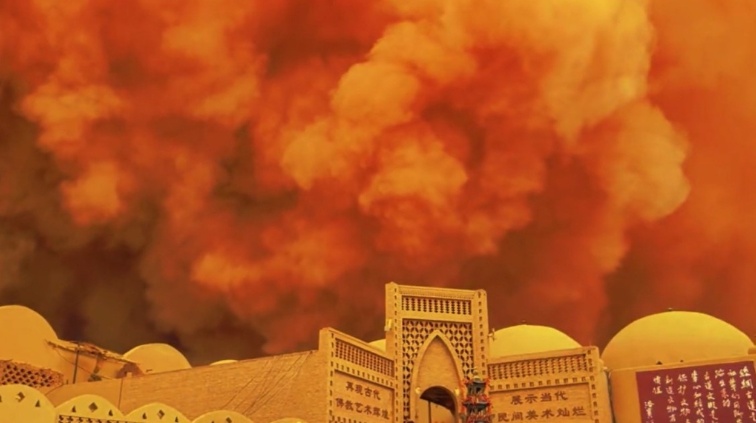
On May 25, 2026, a severe sandstorm struck the area near the Wanfo Palace at Flame Mountain in the Gaochang District of Turpan, Xinjiang. (Video screenshot)
[People News] In July 2026, various parts of China faced multiple disasters, with residents in Guangxi, Hubei, Gansu, and other areas struggling to survive amid floods, tornadoes, and landslides. Meanwhile, the highest leadership of the Communist Party of China shifted its focus to the Bohai Sea, conducting a prominent test launch of submarine-launched strategic missiles.
Neither Xi Jinping nor any of the six other standing committee members visited the disaster-stricken areas to offer support or comfort, while the military showcased its nuclear capabilities under international scrutiny. This stark contrast not only highlights the distorted logic of the Communist Party's social governance but also reflects the precarious situation and challenges faced by the Communist Party system in addressing the current multiple crises.
From July 4 to 6, the remnants of Typhoon 'Maysak' caused the Liulan Reservoir and Yunbiao Reservoir in Hengzhou City, Guangxi, to experience overtopping and breaches in the dams. The Liuwang Reservoir in Binyang County also overflowed. The flood surged rapidly downstream, instantly submerging villages in towns such as Xiaoyi and Yunbiao. Residents had no time to evacuate and were trapped on rooftops, with some reported missing. Official reports claimed that local authorities quickly raised flood prevention responses to Level 1 and organized rescue and evacuation efforts, but in reality, the chaos caused by the flood disaster had already resulted in casualties and significant property losses.
Simultaneously, eastern Hubei, including Huangshi, Huanggang, Ezhou, and Xianning, experienced extreme convective weather, with 53 towns facing thunderstorms and winds of levels 8 to 13, along with localized tornadoes causing destruction. As of the evening of July 6, approximately 14,600 people were affected, with multiple fatalities and hundreds injured, and thousands of houses collapsed or damaged. Although rescue personnel have assembled, the pressure for disaster verification and subsequent resettlement remains immense.
On July 7, a landslide struck Rencang Village in Nanhe Town, Dangchang County, Longnan City, Gansu Province, burying 33 individuals. As of now, 5 have been confirmed dead, and 12 remain trapped. While these disasters may seem to stem from unusual summer weather and appear to be natural calamities, they are actually indicative of the weak local infrastructure under the Chinese Communist Party (CCP) and rampant corruption among officials, resulting in substandard construction projects. When a major disaster occurs, emergency response and rescue operations often descend into chaos due to bureaucratic red tape, leading to man-made tragedies. The CCP's persistent issues, such as safety hazards in reservoirs, delayed early warning systems, and inadequate grassroots response capabilities, have once again been thrust into the limelight.
Disasters are not only happening far away; cities like Tianjin and Beijing are also issuing warnings, facing significant pressure for flood prevention. Many citizens have taken to social media to seek help, hoping for attention from higher authorities and government action. However, the CCP's response is largely superficial; the top leadership is not prioritizing the welfare of the people but is instead focused on a different scenario that should raise alarms worldwide.
Amidst the peak of the disaster, on the afternoon of July 6, the People's Liberation Army Navy successfully launched a submarine-launched strategic missile from a strategic nuclear submarine in the Bohai Sea. The missile, equipped with a training simulation warhead, accurately struck a designated area in the South Pacific. This test launch, which has a range of thousands of kilometers, was officially described as an 'annual routine military training,' with assurances that relevant countries had been informed in advance.
However, the choice of timing and the intensity of the propaganda have led to widespread interpretations. Some analysts suggest that this move is intended to showcase the 'nuclear counterattack' capability to the international community, particularly to stakeholders in the Taiwan Strait, thereby enhancing deterrence. The ability to launch from the Bohai Sea threatens distant targets, signifying a notable advancement in sea-based nuclear capabilities. Countries like Japan and those in Europe have expressed significant concern, while the Chinese Communist Party (Zhōnggòng) has dismissed these worries as a 'sovereign internal affair,' showing little regard for external criticism and acting without shame.
On one hand, multiple disaster situations are unfolding simultaneously, causing significant suffering among the public; on the other hand, the Chinese Communist Party (CCP) is intentionally showcasing its nuclear deterrent capabilities, arrogantly flexing its muscles to the world, which creates a stark contrast between the two scenarios. Xi Jinping, who serves as the General Secretary of the Central Committee of the Communist Party, President of the State, and Chairman of the Central Military Commission, along with six other members of the Standing Committee—Li Qiang, Zhao Leji, Wang Huning, Cai Qi, Ding Xuexiang, and Li Xi—have not made any appearances on the front lines following the disasters. Official reports indicate that Xi Jinping has issued 'important instructions' calling for comprehensive efforts to organize disaster relief, medical care for the injured, and resettlement of affected communities. The State Council and local leaders have acted based on these directives; however, the collective absence of the highest leadership from inspections in the disaster-stricken areas has become a focal point of public discourse. Since Xi Jinping assumed power, he has consistently remained out of sight during natural disasters and calamities, while Cai Qi has taken charge of media coverage for disaster relief efforts. The Xi administration's reliance on a rhetoric of being close to the people has led to widespread controversy and criticism both at home and abroad. In contrast, during previous administrations, Hu Jintao and Wen Jiabao frequently visited disaster areas after floods to comfort the public and oversee relief efforts, thereby establishing a more credible image of being connected to the people. The current approach of 'instruction-based governance' has resulted in a formalization of the system, revealing the highest leadership's priorities in national governance, which starkly contradicts the CCP's commitment to serve the people.
In contrast to the Hu-Wen era, the governance approach of the Communist Party of China (CPC) under Xi Jinping clearly prioritizes authoritarianism over the welfare of the people. The focus is on maintaining the core authority of the Party Central Committee and achieving national security strategic goals, rather than addressing immediate livelihood concerns. Following disasters, the propaganda apparatus swiftly shifts to positive reporting, highlighting rescue efforts and the leadership role of the Party, while rarely engaging in accountability or reflecting on mistakes. Issues such as the overflowing reservoir gap reveal potential engineering quality or management problems, the timeliness of tornado warnings during severe weather, and the thoroughness of geological hazard assessments in landslide-prone areas. These should be fundamental aspects of governance capability, yet the CPC leadership appears indifferent. Instead, Xi Jinping is fixated on a long-planned military display, while civil affairs, public welfare, and emergency management are consistently sidelined.
A deeper issue arises from the political signals related to resource allocation and strategic priorities. In recent years, the CPC has aggressively pursued military modernization, with military expenditures consistently rising. Even during an economic downturn, military spending has increased at a rate exceeding GDP growth by 40%, leading to significant advancements in strategic weapons like nuclear submarines and missiles. The recent test launch in the Bohai Sea starkly reveals the CPC's global military ambitions. Xi Jinping leverages this event to showcase deterrence in the Taiwan Strait while simultaneously suppressing political dissent and anti-Xi factions domestically, aiming to silence officials from making reckless comments about the Central Committee through achievements in military strength. However, the high-profile display of military power amidst public suffering from disasters not only raises concerns within the international community and heightens regional tensions but also highlights the imbalanced shortcomings in the CPC's resource allocation. There is widespread skepticism regarding whether disaster relief funds and rescue equipment are inadequate due to the pressure of military spending, and whether the grassroots emergency response system has been weakened by the diversion of political tasks.
The military action is accompanied by secret power dynamics within the upper echelons. According to revelations from overseas social media figure Lao Deng, Xi Jinping revealed the circumstances surrounding the investigations of Zhang Youxia and Liu Zhenli during a secret speech before promoting two generals. The two were seen as betraying the Party Central Committee due to their differing views on the military unification of Taiwan. Zhang Youxia, as Vice Chairman of the Central Military Commission, had practical combat experience and was believed to have an objective assessment of the risks associated with an attack on Taiwan, while Liu Zhenli was responsible for joint operations. On January 24, 2026, it was officially announced that both were under investigation for 'serious violations of discipline and law.' The details of these revelations seem to underscore a core issue that the international community is closely monitoring regarding the situation in the Taiwan Strait: Xi Jinping's position on 'military unification' with Taiwan has become an unyielding strategic red line, and any potential dissent will be physically eliminated.
As the 21st National Congress approaches, the outside world will be watching to see if Xi Jinping can successfully secure a fourth term. Under Xi Jinping's leadership, the Communist Party of China emphasizes a 'holistic national security outlook,' placing military security at the forefront. However, this cannot change the grim political landscape the Communist Party faces, characterized by 'multiple governance crises.' The economy is in decline, the deflationary spiral is worsening, unemployment remains high, social disorder is prevalent, officials are collectively adopting a laid-back attitude, and military loyalty has plummeted. Xi Jinping can only rely on a Stalin-style purge to maintain control over the Party and the military. The policy towards Taiwan is hardening, and preparations for military unification are accelerating. However, it remains uncertain whether Xi Jinping truly has the courage to initiate a war in the Taiwan Strait. A pressing question is, when the military's guns and ammunition are unified, will the generals prioritize taking Taiwan or will they first target Xi Jinping himself?
In July 2026, coinciding with the 105th anniversary of the founding of the Communist Party of China, the Party is confronted with a dual narrative of disasters and military adventurism. This situation is likely to not only hinder the optimization of Xi Jinping's unification agenda but also intensify social conflicts, creating further political risks.
(First published by People News) △





News magazine bootstrap themes!
I like this themes, fast loading and look profesional
Thank you Carlos!
You're welcome!
Please support me with give positive rating!
Yes Sure!