
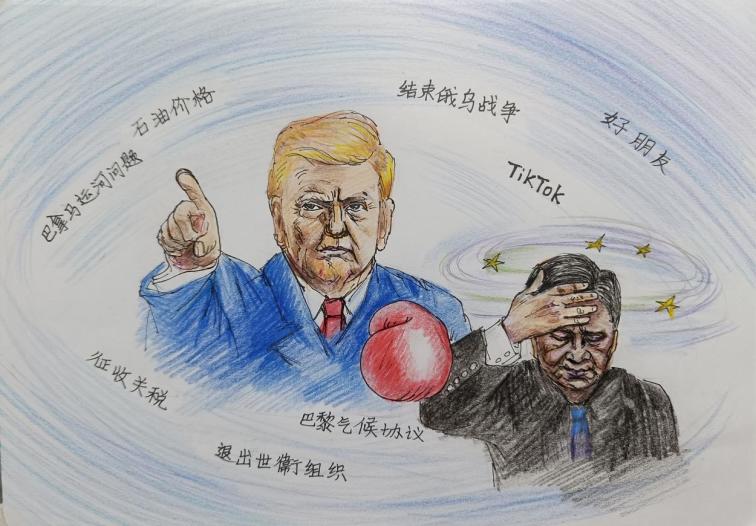
Trump's soft and hard tactics leave the CCP disoriented. (Image by Qing Yu / People News)
[People News] On September 18, the White House revealed the schedule for the anticipated meeting between U.S. President Trump and Chinese Communist Party General Secretary Xi Jinping.
Xi Jinping and his wife, Peng Liyuan, are set to arrive at Andrews Joint Base, located just outside Washington, D.C., on September 23. Trump will welcome Xi at the military airport, and the two leaders will participate in a welcome ceremony together. On September 24, the Trump couple will host a welcome ceremony for Xi and Peng at the indoor area of the White House's State Floor (the first floor of the White House residence). Following this, Trump and Xi will review the honor guard in the White House Rose Garden before commencing their bilateral discussions. Meanwhile, First Lady Melania Trump and Peng Liyuan will attend a separate event in Washington.
That evening, the Trump couple will hold a state dinner in the East Room of the White House for Xi and the Chinese delegation. Both Trump and Xi will deliver speeches at the beginning of the dinner. On September 25, the Trump couple will host Xi and Peng for a private tea gathering at the White House. They will then visit the National Archives in Washington to view the founding documents of the United States. Afterwards, Xi and Peng will depart for Andrews Joint Base.
It has been reported that the guests expected to attend the dinner on the evening of the 24th will primarily include high-ranking executives from the technology and finance sectors, such as Amazon's Jeff Bezos, Tesla and SpaceX's Elon Musk, Google's Sundar Pichai, Dell Technologies' Michael Dell, NVIDIA's Jensen Huang, OpenAI's Sam Altman, Citigroup's Jane Fraser, and Tim Cook, who recently stepped down as CEO of Apple, among others.
However, what concerns the outside world more is what will be discussed at the Trump-Xi meeting and what effects it may have.
According to a report by Radio France Internationale today (19th), U.S. officials indicated that Washington and Beijing might be preparing to ease tariffs on certain non-strategic goods. "This move could involve a limited range of products and benefit both parties."
A senior U.S. official stated that the U.S. is not expected to relax export controls to allow more rare earth minerals—essential components for various products—to enter the global market. The two sides will discuss how the Chinese side (the Communist Party) can maintain an acceptable supply of rare earth minerals, but it is unlikely that the U.S. will use the relaxation of export controls as a bargaining chip.
Recently, Trump mentioned that he would discuss "almost all issues" with Xi Jinping.
Dan Wang, head of China affairs at the Eurasia Group, predicted that the tariff issue would be a "major topic." Previously, the Ministry of Commerce of the Communist Party of China stated that Beijing and Washington are negotiating a tax reduction framework involving $30 billion worth of goods from each side. The Trump administration hopes that the Communist Party of China will commit to purchasing more U.S. agricultural products, particularly soybeans.
Analysts believe that another sensitive topic may arise: the Communist Party's trade and diplomatic support for Tehran. In the ongoing U.S.-Iran-China conflict, several U.S. soldiers have already lost their lives, and the Communist Party has repeatedly expressed its willingness to defend Iran's "legitimate interests." Additionally, several media reports indicate that Tehran has obtained high-resolution satellite images of the U.S. military base in Jordan from various Chinese entities, where three American soldiers were killed in an attack in July.
The Chinese Communist Party and the United States are currently engaged in a fierce technological competition, particularly regarding the dominance of artificial intelligence. Last week, the U.S. accused leading Chinese AI companies of extensively stealing American AI models. This issue is expected to be addressed in the upcoming Xi-Trump talks.
Despite this, many experts anticipate that the meeting will not yield significant progress and may largely be a formality, with no open confrontation expected between the two parties.
Jonathan Chin, a researcher at the Brookings Institution, referred to this visit as 'a farce' and told AFP that he does not expect any remarkable actions from Xi Jinping during this trip. The Xi-Trump meeting at the White House is likely to replicate the previous meeting in Beijing, focusing more on the superficial relationship between the two leaders rather than on substantive issues.
△






News magazine bootstrap themes!
I like this themes, fast loading and look profesional
Thank you Carlos!
You're welcome!
Please support me with give positive rating!
Yes Sure!