
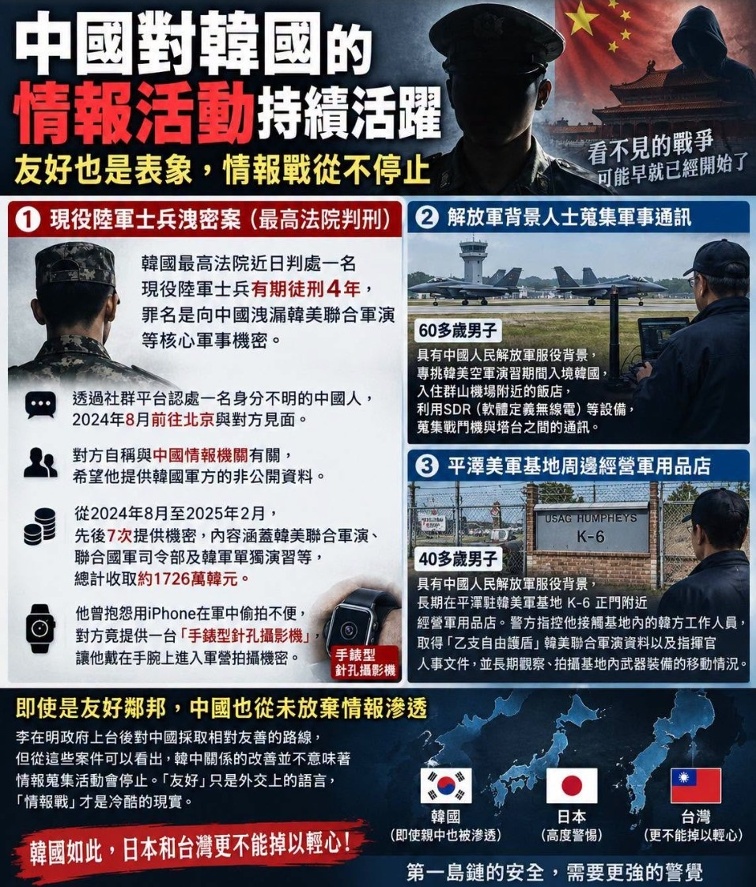
Shibata Akio highlighted that the recent improvement in South Korea-China relations does not imply a halt to intelligence-gathering activities. The term 'friendship' is merely diplomatic rhetoric, whereas 'intelligence warfare' represents an entirely different realm. (Image / Screenshot from Shibata Akio's Facebook)
[People News] On the 19th, Shibata Akio, Executive Director of the Indo-Pacific Strategic Institute, shared on Facebook that the South Korean Supreme Court has recently upheld a verdict in a spy case. An active-duty soldier was sentenced to four years in prison for leaking military secrets related to the South Korea-U.S. joint military exercises to China.
The CCP's strategy involves bribing South Koreans to betray their country and steal intelligence
Shibata Akio described how this soldier met an unidentified Chinese individual through a social media platform. In August 2024, he even traveled to Beijing to meet this person. The individual claimed to have connections with Chinese intelligence agencies and requested that he provide non-public information from the South Korean military. The soldier agreed. From August 2024 to February 2025, within just six months, he provided confidential information on seven occasions, including details about the South Korea-U.S. joint military exercises, the United Nations Command, and information regarding the South Korean military's independent drills, receiving a total of approximately 17.26 million won (around $12,470).
Shibata Akio noted that the most surprising aspect of this case is the method used to steal intelligence. The soldier had previously expressed to the individual that it was quite inconvenient to secretly photograph documents in the military using an iPhone. To his surprise, the individual provided him with a 'watch-type pinhole camera,' which he could wear on his wrist to sneak into the military camp and secretly record military secrets.
Shibata Aki pointed out that it is important to note the recent series of similar incidents occurring in South Korea. In August alone, South Korean police arrested two suspects with backgrounds in the Chinese People's Liberation Army. One suspect, a man in his sixties, deliberately entered South Korea during the Korea-U.S. Air Force exercises, staying at a hotel near Gunsan Airport. He used equipment such as Software Defined Radio (SDR) to intercept communications between fighter jets and the control tower.
Another man in his 40s has been running a military supply store near the main gate of the K-6 U.S. military base in Pyeongtaek for many years. The police have accused him of exploiting his location to connect with South Koreans working at the base, allowing him to obtain information about the 'Eulji Freedom Guardian' joint military exercises between South Korea and the U.S., as well as personnel documents of commanders. He has also been observing and photographing the movement of weapons and equipment within the base over an extended period.
Shibata Akio noted that these cases should be considered collectively. The methods range from contacting active-duty military personnel and bribery to providing specialized covert recording equipment; from long-term activities near military bases to employing professional equipment for gathering military communications. The tactics are becoming increasingly varied and sophisticated.
Yabuki pointed out that since the Lee Jae-myung administration took office, there has been a relatively 'relationship improvement-focused' approach towards China. However, based on the cases that have already come to light, the improvement in South Korea-China relations does not imply that intelligence-gathering activities will come to a halt. International politics is quite pragmatic. The recent revelations of infiltration and espionage cases by various countries' counterintelligence agencies serve as a stark reminder to Lee Jae-myung's 'pro-China fantasy.' While 'friendliness' is a term used in diplomacy, 'intelligence warfare' exists in an entirely different realm. If South Korea is facing such challenges, Japan and Taiwan must also remain vigilant.
Engaging with a devilish partner can lead to misfortune.
Since taking office, Lee Jae-myung has shown excessive deference to the Chinese Communist Party, a regime that sustains its power through violence and fear, all under the pretense of 'improving South Korea-China relations.' He has frequently extended goodwill towards Beijing in pursuit of economic benefits, hoping to find a strategic balance amid the U.S.-China rivalry. However, in reality, Lee Jae-myung is effectively 'giving the green light to the devil,' and this naive optimism is nothing more than a politically perilous gamble.
In the lexicon of the Communist Party, the notion of 'reciprocating kindness' does not exist.
Politicians in democratic nations often operate under a habitual assumption: 'If I demonstrate goodwill and adopt a softer approach, the other side will temper their threats and reciprocate with benefits.' Yet, this reasoning falls flat when confronted with the authoritarian nature of the Communist Party.
From the perspective of the Chinese Communist Party (CCP), managing national security views and foreign intelligence strategies, diplomatic 'friendliness' serves merely as a facade to lower the other party's defenses and infiltrate their lines (referred to as the 'strategic opportunity period'). The more the opposing party promotes friendliness, eases security checks, and relaxes counter-espionage measures, the more the CCP's intelligence agencies (such as the Ministry of State Security and the Joint Staff Department of the Central Military Commission) can operate freely.
When Li Zaixing's government shifts its policy to 'prioritize improving relations,' the domestic environment for counter-espionage, security reviews, and vigilance against Chinese investments and technology theft will inevitably relax. This 'green light' political signal objectively creates an ideal environment and protection for the CCP's spies and agents to infiltrate.
What was once a one-sided wishful pragmatism has now transformed into a 'pleasing strategy.'
Li Zaixing and his team may consider themselves astute pragmatists, believing that softening relations with China could bring two significant benefits: revitalizing the South Korean economy and persuading Beijing to help manage North Korea's nuclear ambitions. However, reality has shown that this is merely a form of 'self-deception,' as the Chinese populace has long recognized a fundamental truth: trust the Communist Party, and you will inevitably face dire consequences.
Previous incidents such as the THAAD deployment and various restrictions on South Korea have already demonstrated that the CCP's market can be weaponized as a political bargaining tool at any moment. Simply accommodating the CCP, this 'devilish lover,' has not only failed to ensure market safety for the high-tech sector but has also increased South Korea's vulnerability to supply chain disruptions and technology theft.
The more the Lee Jae-myung administration aligns itself with Beijing and adopts an ambiguous 'non-interference' stance regarding the Taiwan Strait and South China Sea issues, the more Beijing diminishes South Korea's strategic importance. In the view of the Chinese Communist Party (CCP), a South Korea that seeks to be friendly is not seen as a 'respected equal partner,' but rather as a 'soft persimmon' that can be easily divided and manipulated.
A Warning for Taiwan, Japan, and the Democratic Alliance
In a recent post, Shibata Akio raised alarms for Japan and Taiwan, stating: 'If South Korea is facing such challenges, Japan and Taiwan must not be complacent.' Even South Korea, which has no direct territorial disputes with China and enjoys significant economic complementarity, cannot escape the intense intelligence activities from China. Thus, the pressures that Japan and Taiwan face are on a different scale altogether.
Japan has long been at the forefront of CCP intelligence infiltration and maritime grey zone coercion. Witnessing South Korea's serious intelligence security threats even after diplomatic softening, both the ruling and opposition parties in Japan are likely to become even more resolute in strengthening anti-espionage laws and enhancing substantive security cooperation with the U.S. and South Korea. They will not easily trust Beijing's diplomatic overtures.
For Taiwan, the CCP's infiltration and cognitive warfare represent a fundamental threat to its survival. The situation in South Korea serves as a cautionary tale for Taiwan: any political narrative suggesting 'concessions to the CCP for peace or softening for benefits' is fundamentally ignorant of the CCP's authoritarian ambitions. The intelligence war and military preparations do not pause for diplomatic niceties; if democratic nations retreat even slightly on security matters, the CCP's intelligence operations and grey zone aggression will advance significantly.
In recent years, Taiwan has seen a series of significant national security incidents involving both active and retired military personnel being bribed by intelligence organizations of the Chinese Communist Party (CCP) and leaking military secrets. This clearly shows that the CCP is unyielding in its approach towards Taiwan. The CCP mainly employs tactics such as online infiltration, using retired veterans as intermediaries, or leveraging peripheral organizations and specific media personnel as 'white gloves' to lure grassroots and mid-level military officers into leaking secrets through small incentives, virtual currencies, or debt negotiations, and even demands the production of 'pro-communist videos'.
The government of Li Zaiming (Li Tsai-ming) mistakenly believes it is engaging in business negotiations with a 'friendly' partner that can be warmed by 'affection', when in fact, it is dealing with an authoritarian regime that considers 'all domains as battlefields'.
The notion of 'friendliness' is merely an illusion presented in news broadcasts, while 'infiltration and information warfare' represent the harsh reality that the CCP has never abandoned. If political figures choose to give a 'green light' to authoritarianism for the sake of short-term political gains or diplomatic fantasies, they will ultimately find that they have not only failed to secure genuine peace and dignity but have also put their own national security and democratic institutions at risk, turning them into sacrifices on the devil's dining table.
(First published by People News)
△



News magazine bootstrap themes!
I like this themes, fast loading and look profesional
Thank you Carlos!
You're welcome!
Please support me with give positive rating!
Yes Sure!