

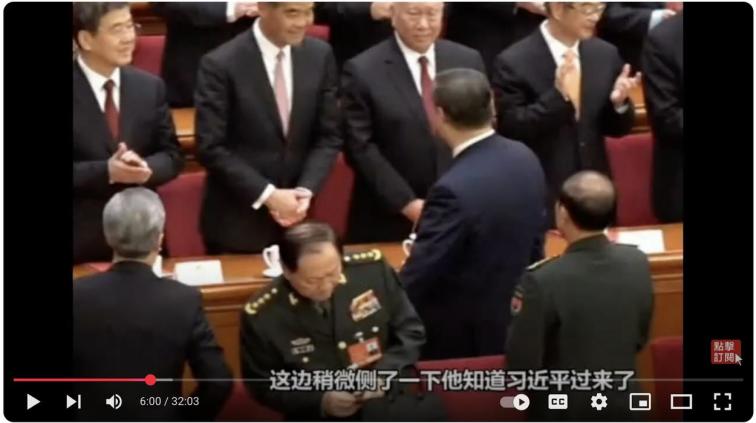
The Central Military Commission of the Communist Party of China originally consisted of 7 members, but now only Xi Jinping and Zhang Shengmin remain. (Video screenshot)
[People News] On September 21, just before Chinese Communist Party leader Xi Jinping's visit to the United States, Zhang Youxia, the former Vice Chairman of the Central Military Commission, and Liu Zhenli, the Chief of Staff of the Joint Staff Department of the Military Commission, were officially announced to have been expelled from the Party and the military due to 'serious violations of discipline and law,' and were subsequently transferred to military prosecution authorities. Reports from overseas sources suggest that this decision was originally intended to be announced around the time of the Central Committee meeting on October 5, but Xi appears to have been very eager to disclose it before his trip to the U.S. What is Xi afraid of?
It is important to note that while the tone of this official announcement remains stern, stating that the two 'seriously violated political discipline and political rules,' the charge mentioned in the January Military Report editorial, which accused them of 'seriously trampling and undermining the responsibility system of the Chairman of the Military Commission,' has notably vanished.
Equally peculiar is the editorial published on September 23 on the front page of the Chinese Communist Party's Military Report, titled 'Unwaveringly and Comprehensively Strictly Govern the Party and the Military.' This editorial, primarily directed at the entire military and also intended for external audiences, similarly omits the phrase 'seriously trampling and undermining the responsibility system of the Chairman of the Military Commission.' Furthermore, although the article concludes with the customary 'two-four-four-two' loyalty expression, an unusual detail within the article deserves mention.
The editorial begins by addressing the official announcement regarding Zhang and Liu, urging the entire military to 'resolutely support the decisions of the Party Central Committee and the Central Military Commission, and consciously maintain a high degree of consistency in thought, politics, and action with the Party Central Committee led by Xi as the core, and resolutely obey the command of the Party Central Committee, the Central Military Commission, and Chairman Xi.' It is noteworthy that this statement emphasizes the need to follow Xi's 'command of the military.'
In discussing the Party's leadership over the military, the editorial asserts that since the 18th National Congress of the Communist Party of China, the military has been able to self-purify under the strong leadership of the Party Central Committee, the Central Military Commission, and Chairman Xi Jinping. This serves to reassure the outside world that the military remains "trustworthy." It is important to note that Xi is still positioned to "lead" the military in this context.
However, the editorial quickly changes its tone, stating that the "global situation, national conditions, Party conditions, and military conditions are undergoing complex and profound changes." The Communist Party of China faces "four major tests" and "four types of dangers" that have persisted over time. The Chinese military is "facing complex political tests," which necessitates that it "must unify thoughts and actions with the decision-making and deployment of the Party Central Committee and the Central Military Commission." This presents a peculiar contradiction in the editorial, as it indicates that Chairman Xi is once again unable to participate in the "decision-making and deployment."
This peculiarity arises from an editorial published on January 25 of this year in the Military Daily, titled "Resolutely Winning the Tough and Protracted Overall Battle Against Corruption in the Military." In that piece, there are affirmations of "consciously maintaining a high degree of consistency in thought, politics, and action with the Party Central Committee with Xi as the core," a directive to "resolutely obey the command of the Party Central Committee, the Central Military Commission, and Chairman Xi," and references to the strong leadership of the Party Central Committee, the Central Military Commission, and Chairman Xi since the 18th National Congress. It also emphasizes the commitment to "resolutely implement the major decision-making and deployment of the Party Central Committee, the Central Military Commission, and Chairman Xi."
In just eight months, the military has instructed the entire armed forces to change their focus from 'resolutely implementing the major decision-making deployments of the Party Central Committee, the Central Military Commission, and Chairman Xi' to 'must unify thoughts and actions with the decision-making deployments of the Party Central Committee and the Central Military Commission.' This indicates that 'Chairman Xi' has been excluded from the 'decision-making deployments.' What has transpired within the Chinese Communist Party (CCP) and its military?
This exclusion of 'Chairman Xi' from the 'decision-making deployments' is not a new development, as noted in an official report. On September 11, the CCP's military newspaper and military network published a report titled 'Persisting in Advancing National Defense and Military Modernization with a Correct View of Achievements,' which already exhibited a similar anomaly. The report stated, 'resolutely and effectively implementing the major decision-making deployments of the Party Central Committee, the Central Military Commission, and the important directives of Chairman Xi.'
A similar oddity was observed in an editorial released on August 1 by the CCP's military network and military newspaper. The editorial mainly emphasized the importance of 'the Party commanding the gun.' While it acknowledged 'fundamentally relying on Chairman Xi's leadership and guidance from Xi Jinping Thought,' the final paragraph included a loyalty phrase ', two four four two.' However, a notable change occurred in one section of the article: 'The entire military must unify thoughts and actions with the decision-making deployments of the Party Central Committee and the Central Military Commission,' without any mention of 'Chairman Xi.'
A few days ago, the author examined this anomaly in an article titled 'Is Chairman Xi No Longer Involved in Decision-Making Deployments?'. The analysis highlighted that since Xi Jinping (Xi Jinping) assumed power in 2012, particularly at the peak of his authority, the military's language typically included phrases like 'resolutely implementing the decision-making deployments of the Party Central Committee, the Central Military Commission, and Chairman Xi' and 'the entire military must align its thoughts and actions with the major decision-making deployments of the Party Central Committee, the Central Military Commission, and Chairman Xi'. Occasionally, references to the 'Central Military Commission' were omitted, but 'Chairman Xi' was always a constant presence. Furthermore, there are also expressions that elevate 'Chairman Xi' above the Military Commission.
The author provided several examples, which will not be detailed here, but it is particularly important to note that even after the news of Xi Jinping suffering a stroke in July 2024, the Communist Party of China, in an attempt to obscure the truth, still superficially afforded Xi some respect. This was evident in the military newspaper's editorial on August 1, 2025, which stated, 'The entire military must resolutely implement the decision-making deployments of the Party Central Committee, the Central Military Commission, and Chairman Xi'.
Since at least August, Xi Jinping has been excluded from 'decision-making deployments' in three significant military reports. What does this convey?
One interpretation suggests that following the removal of Zhang and Liu, the high-level power struggle within the Communist Party of China (CPC) ultimately reached a consensus on 'centralized unified leadership,' resulting in Xi's 'one supreme' status being entirely revoked. In recent months, senior officials like Li Qiang have adopted a more prominent and expressive stance than before. Defense Minister Dong Jun highlighted in his 'August 1' speech the importance of 'listening to the Party and following the Party,' and the military's 'Pictorial' has removed Xi and others from its cover for four consecutive months, all of which lend credence to this assessment. Xi's position within the military is similarly diminished; since he is already a member of the Central Military Commission, there is no need to mention him separately.
Another interpretation posits that while Xi can outwardly lead and command the military, issue directives, and make statements for public learning, he has been stripped of the power to engage in 'decision-making deployments.' This raises the question: who is truly in control behind the scenes?
Regardless of the interpretation, the author believes that Xi's power status is evidently weakening. Even if he wishes to exert control over the political landscape, his health issues hinder his ability to do so. This situation bears resemblance to the later years of Emperor Zhenzong of the Song Dynasty, who suffered multiple strokes, leading to fluctuating health. Ministers took advantage of this to seize power, resulting in chaos within the court. It was only after Zhenzong's death and the ascension of Emperor Renzong that the court disputes finally subsided.
Thus, what 'surprises' can we anticipate from Xi, who is unable to participate or cannot participate as 'Chairman Xi' in the 'decision-making deployments' at the Fifth Plenary Session?
(People News first published) △





News magazine bootstrap themes!
I like this themes, fast loading and look profesional
Thank you Carlos!
You're welcome!
Please support me with give positive rating!
Yes Sure!