

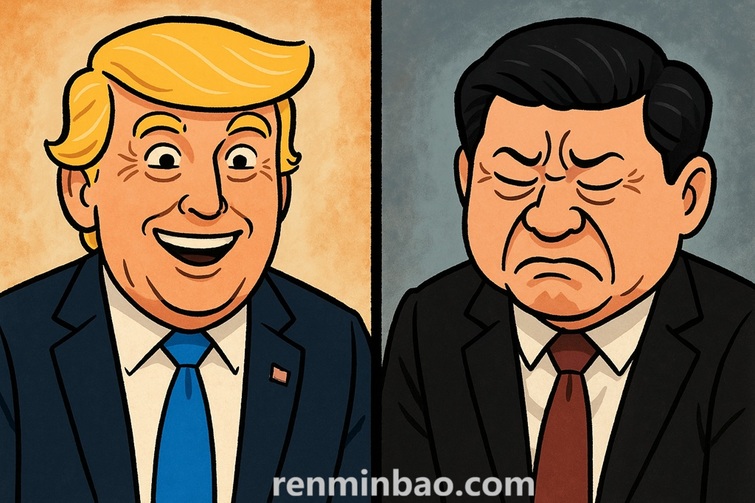
On September 19, 2025, during a phone call between Trump and Xi, Trump came away with a double win, while the CCP’s wolf warrior diplomacy was left deflated. (Image by People News)
[People News] One of the key objectives for Chinese Communist Party leader Xi during his visit to the United States was to utilize the coverage of mainstream American media to generate global support for the CCP and himself. However, the unexpected joint suspension of live broadcasts of presidential activities by the five major American television networks has thwarted Beijing's most desired goal of achieving "international television live broadcast propaganda."
On the eve of Xi's visit, President Trump announced a ban on three media organizations—CNN, MS NOW, and Politico—from entering the White House, accusing them of spreading "fake news." This action sparked a strong backlash from American media, leading the five major television networks—American Broadcasting Company (ABC), Columbia Broadcasting System (CBS), CNN, Fox News, and National Broadcasting Company (NBC)—to collectively decide to suspend the live coverage by the press pool assigned to report on presidential activities.
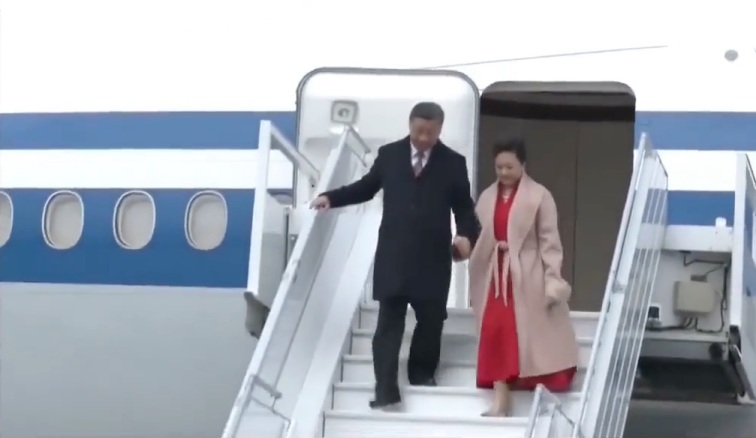
This collective media boycott coincided with Xi Jinping's state visit. On the evening of September 23, the arrival of Xi Jinping and his wife at Andrews Joint Base, where they were received by the Trump couple, along with the White House welcome ceremony and bilateral meeting on September 24, were not broadcast live by any of the five major U.S. television networks. According to CNN, this left Chinese officials feeling quite uneasy, as Beijing had hoped to widely broadcast these carefully crafted images through U.S. television networks, portraying Xi as a global leader on par with the U.S. President.
In response, the Chinese Embassy in the U.S. urgently contacted several American television networks to understand and express concern about the impact of the media ban on the coverage of the visit. Despite the Chinese state media sending a large reporting team of over a hundred people, Wu Xinbo, a consultant at the Chinese Ministry of Foreign Affairs, candidly stated in an interview with CNN on September 25 that the failure to present these images widely to the American public was a 'regrettable matter.'
For Beijing, every aspect of a head of state's visit is meticulously calculated, and the endorsement from the host country and international media is central to its 'external propaganda legitimacy.' However, aside from returning with diminished media presence, Beijing also fell short on nearly all of its core strategic objectives at this summit.
Substantial Policy 'Four Major Failures'
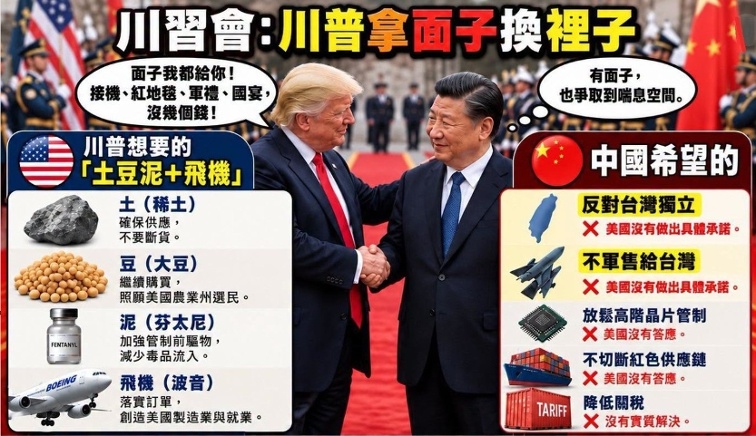
According to reports from major international media, Beijing initially hoped to achieve significant breakthroughs in tariffs, Taiwan Strait geopolitics, external propaganda image, and high-tech sectors through this high-profile summit, but ultimately left Washington with multiple setbacks:
I. Tariff Negotiations: Only a 'Short-term Extension' Achieved, No Long-term Exemption
Beijing had initially hoped to fully eliminate punitive tariffs or at least secure a long-term stable tariff suspension agreement (Tariff Truce) to provide some relief for China's economy, which is facing significant downward pressure. However, the U.S. only agreed to a short-term extension of the trade ceasefire agreement for two months (until early next year) and postponed all core issues—including tariff measures, rare earth supply, agricultural procurement, and technology restrictions—into future negotiations, thereby continuing to exert strategic pressure on the Chinese economy.
II. Taiwan Policy: Unable to Force the U.S. to 'Stop Arms Sales' or Alter Its Position
During the meeting, Xi Jinping referenced the 1982 'August 17 Communiqué' and strongly urged the U.S. to halt arms sales to Taiwan, particularly calling for the freezing or cancellation of recent arms deals worth hundreds of billions of dollars. He also requested that the U.S. elevate its language from 'not supporting Taiwan independence' to 'clearly opposing Taiwan independence.' In response, both the White House and the U.S. Congress firmly stated that the U.S. legal stance on providing self-defense weapons to Taiwan under the Taiwan Relations Act would remain unchanged. Furthermore, the U.S. did not adopt China's unilateral claim of 'opposing Taiwan independence' and maintained its long-standing 'One China Policy' framework.
III. High-tech Sector: Failed to Overcome 'Small Courtyards and High Walls' and the Chip Blockade
Xi Jinping has suggested that the U.S. and China should 'jointly manage and maintain human control' in the realm of artificial intelligence (AI). This proposal aims to alleviate U.S. export restrictions on high-end chips (like Nvidia and AMD) and semiconductor equipment by establishing a global governance framework for AI. While Trump invited tech leaders such as Huang Renxun, Sam Altman, Zuckerberg, and Musk to join him at the state banquet, the U.S. firmly stated its intention to 'maintain its absolute lead in the field of AI', showing no inclination to ease its technological restrictions.
IV. International Sanctions: Failure to Exchange Fentanyl Cooperation for Lifting Reviews
China is seeking to leverage 'cooperation in combating the fentanyl raw material supply chain' as a bargaining tool to negotiate the complete lifting of international sanctions imposed by the U.S. on relevant Chinese entities and individuals. Although the U.S. has welcomed limited cooperation regarding fentanyl, it has not ceased its stringent reviews and legal accountability concerning the supply chains of Chinese companies.
This meeting, while achieving a high standard of diplomatic protocol (such as Trump personally greeting guests at the airport and hosting a state banquet at the White House), met Beijing's desire for 'great power dignity (face)'. However, in terms of 'substantive policy (content)', the U.S. displayed a highly pragmatic and astute strategy—' exchanging courtesy for substance'.
On critical issues such as tariffs, arms sales to Taiwan, and technological blockades, the U.S. made virtually no concessions, offering only a short-term 'tactical pause'. This left Beijing's hopes of completely reversing its strategically passive position through a high-level meeting utterly dashed. △




News magazine bootstrap themes!
I like this themes, fast loading and look profesional
Thank you Carlos!
You're welcome!
Please support me with give positive rating!
Yes Sure!