
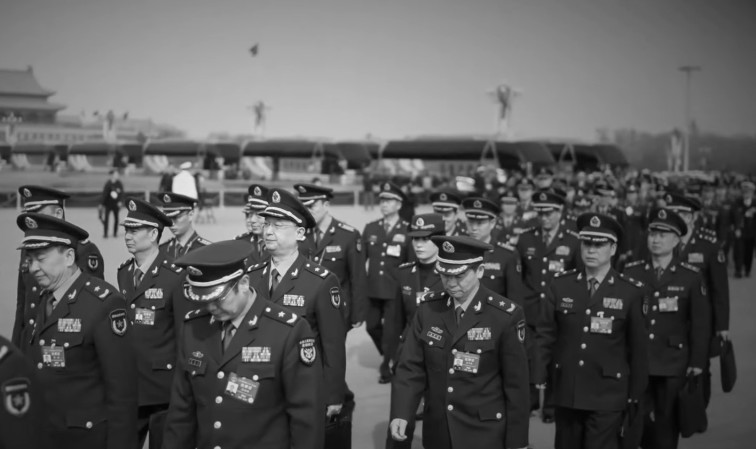
The new prophecy mentions that Xi will face a rebellion from the military and local warlords. The image shows the representatives of the Chinese military attending the Two Sessions in Beijing. (Video screenshot)
[People News] Following the conclusion of the Fifth Plenary Session of the 20th Central Committee of the Communist Party of China, a communiqué was issued detailing that 34 individuals are under investigation for "serious disciplinary and legal violations." Among these, 16 are affiliated with the Central Military Commission. When including 6 high-ranking officials from the military industry and aerospace sectors, the total number of military-related individuals purged rises to 22, all of whom have been expelled from the Party. This reflects the Communist Party's current stringent control over the military.
Examining the list of these individuals reveals several noteworthy aspects. Many were promoted by Xi Jinping, including key figures among his trusted aides, such as Fang Yongxiang, the former director of the Central Military Commission's General Office, and Zhong Shaojun, the former director of the General Office and former political commissar of the National Defence University. Additionally, there are individuals who may be less familiar to the public, with some being listed for the first time, such as Zhao Xiaozhe, the deputy director of the Central Military Commission's Science and Technology Committee, Fang Yongxiang, the deputy minister of the Ministry of Veterans Affairs, Wang Peng, the minister of the Central Military Commission's Training Management Department, Liu Qingsong, the political commissar of the Eastern Theatre Command, Yang Cheng, the political commissar of the Xinjiang Military District, and Zhang Hongbing, the political commissar of the Armed Police.
Moreover, some of those who have been dismissed include leaders from the military industry sector, which appears to be linked to Zhang Youxia. This group includes Wang Renhua, the secretary of the Political and Legal Committee of the Central Military Commission, Li Wei, the political commissar of the Strategic Support Force, Zhang Lin, the minister of logistics support, Lei Fanpei, the former chairman and party secretary of China Aerospace Science and Technology Corporation, Wen Gang, the former chairman of China Shipbuilding Group Corporation, Yu Jianfeng, the former chairman of China National Nuclear Corporation, Yuan Jie, the chairman of China Aerospace Science and Industry Corporation, Zhang Zhongyang, the general manager of China Aerospace Science and Technology Corporation, and Huang Ming, a former commander of the Northern Theater Command and a former subordinate of Zhang Youxia in the Shenyang Military Region.
Analysts suggest that Zhang Youxia, who hails from the General Equipment Department and oversees equipment research and development, is currently in Xi Jinping's crosshairs as he seeks to eradicate corruption within the entire military-industrial complex. There is a pervasive distrust of the military and its industrial system, particularly towards figures like Zhang, Liu, He, and Miao, who have undermined the accountability of the Chairman of the Central Military Commission. The lingering effects of their actions must be completely eliminated. Notably, former Western Theatre Command commander Wang Haijiang is an associate of He Weidong and Miao Hua, while former Eastern Theatre Command political commissar Liu Qingsong is also linked to He Weidong. Their recent downfalls clearly reflect Xi's deep-seated suspicions regarding the high-ranking military officials who have been ousted.
On the 30th, the People's Liberation Army Daily published a commentary asserting that the military must embody the systematic deployment of strict party governance across all aspects of military strengthening, adhering to the accountability system of the Chairman of the Military Commission. It stressed the importance of 'resolutely following the commands of the Party Central Committee, the Central Military Commission, and Chairman Xi,' and 'focusing on the fundamental issue of obeying the Party's command and political loyalty.'
This raises the question: When did this corruption originate? Which areas does it affect, and will it continue to produce further issues?
Over the past three years, 46 senior generals within the Communist Party have been publicly dismissed from their roles as representatives of the 14th National People's Congress, including 22 full generals, 18 lieutenant generals, and 6 major generals. During the Fifth Plenary Session, the absent personnel and the high-ranking officials who faced consequences included dozens of senior generals; among them, 9 full generals were expelled from the Communist Party, and over ten full generals were absent. The military's alternate Central Committee members have been frozen, underscoring that the CCP's military purge is still unfolding, and Xi's military power crisis remains unresolved.
From the perspective of the CCP's military media, it is clear that corruption is merely a superficial issue, while disloyalty is the root cause. For the CCP, without oversight and checks on power, disloyalty and anti-corruption efforts are boundless.
(First published by People News) △





News magazine bootstrap themes!
I like this themes, fast loading and look profesional
Thank you Carlos!
You're welcome!
Please support me with give positive rating!
Yes Sure!