
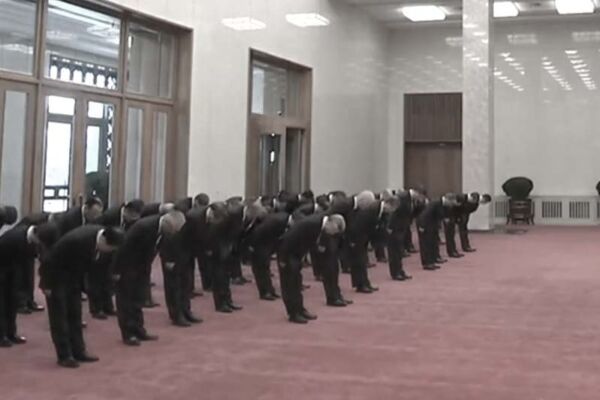
"Paying Respects" Is Actually a Tactic for "Drawing Vital Energy" (Photo: On December 26, 2023, members of the CCP Politburo Standing Committee and senior officials in Beijing bowing to the statue of Mao Zedong. Screenshot from a video.)
[People News] According to established practice, on January 8 the CCP Politburo Standing Committee held an all-day meeting, listening to work reports from the Standing Committee of the National People’s Congress, the State Council, the National Committee of the Chinese People’s Political Consultative Conference, the Supreme People’s Court, and the Supreme People’s Procuratorate, as well as a work report from the Central Secretariat. Xi Jinping presided over the meeting and delivered a speech.
As with the previous two occasions, the report is also divided into six natural paragraphs, respectively covering: the convening of the meeting, the significance of holding the meeting, the performance of the five major Party leadership groups over the past year, the performance of the Central Secretariat over the past year, the requirements for the five major Party leadership groups in the new year, and the requirements for the Central Secretariat in the new year.
Judging from the official media report, it appears similar to the wording of the previous two years, but there are still subtle differences.
In this year’s report, the phrase “the centralized and unified leadership of the Party Central Committee” appears a total of three times. The specific formulations are as follows: the CCP Central Committee’s hearing of reports and briefings from these Party leadership groups is described as “an important measure to uphold and improve the Party leadership system and to implement the centralized and unified leadership of the Party Central Committee across all fields, aspects, and links of national governance”; it affirms that over the past year the five major Party leadership groups “firmly upheld the authority of the Party Central Committee and its centralized and unified leadership”; and for the new year, the five major Party leadership groups are required to take “Xi Thought” as guidance, “earnestly implement the deployments of the Fourth Plenum, and uphold the centralized and unified leadership of the Party Central Committee,” followed by the “two establishes, four safeguards” loyalty formula, and the requirement to “maintain a high degree of consistency with the Party Central Committee with Comrade Xi Jinping as its core.”
At the same meeting held in January 2025, the report mentioned “the centralized and unified leadership of the Party Central Committee” a total of four times. In the second paragraph, when discussing the significance of convening the meeting, it was mentioned twice: namely, that “upholding the centralized and unified leadership of the Party Central Committee is the fundamental reason we continuously achieve victories,” and that it “is an important institutional arrangement for upholding and strengthening the Party’s overall leadership and the centralized and unified leadership of the Party Central Committee.” The fact that it was mentioned twice in a single paragraph precisely underscored the importance attached to this system. What it conveyed to the outside world was that since July 2024, when reports emerged at the Third Plenum that Xi Jinping had suffered a stroke, changes have been taking place within the CCP, Xi’s power has been weakened, and the collective leadership of the Hu era has been gaining the upper hand.
Subsequently, the report also affirmed that over the past year the five major Party leadership groups “firmly upheld the authority of the Party Central Committee and its centralized and unified leadership”; and for the new year, the five major Party leadership groups were required to take “Xi Thought” as guidance and implement the spirit of several plenary sessions. Only after mentioning the “two establishes, four safeguards” did it then refer to “upholding the centralized and unified leadership of the Party Central Committee as the highest political principle.”
In the report on the same meeting held in January 2024, when Xi had not yet encountered trouble, “the centralized and unified leadership of the Party Central Committee” was mentioned only twice, respectively when affirming the work of the five Party leadership groups over the past year and when putting forward requirements for the new year. In setting out those requirements, the sequence was that the five Party leadership groups should take “Xi Thought” as guidance, deeply understand and strengthen the “two establishes, four safeguards,” fully implement the spirit of the plenums, and “uphold the centralized and unified leadership of the Party Central Committee as the highest political principle.” When discussing the significance of convening the meeting, it only stated that this was “an important institutional arrangement for upholding and strengthening the Party’s overall leadership.”
Clearly, the meetings in both 2025 and 2026 were held after Xi had encountered trouble. Both emphasized collective leadership and included the formulation “firmly uphold the authority of the Party Central Committee and its centralized and unified leadership.” In contrast, in 2024 collective leadership was clearly downplayed: there was no wording about “firmly upholding the authority of the Party Central Committee and its centralized and unified leadership,” only that one must “uphold the centralized and unified leadership of the Party Central Committee as the highest political principle.” The difference in degree between “uphold” and “firmly uphold” is entirely significant.
In addition, compared with 2025 and 2026, in the 2024 report “Xi Thought” was immediately followed by the “two establishes, four safeguards,” then by implementing the spirit of the plenums and “centralized and unified leadership,” highlighting that Xi’s status as the “one supreme authority” ranked above that of the “Party Central Committee.”
By 2025, what followed “Xi Thought” became the implementation of the spirit of the plenums, with the status of the “two establishes, four safeguards” declining.
In the 2026 report, an additional subtle change appears: after taking “Xi Thought” as guidance comes “upholding the centralized and unified leadership of the Party Central Committee,” and only afterward the “two establishes, four safeguards.” The fact that the “Party Central Committee” stands above Xi is no longer concealed, and the Politburo Standing Committee members’ performance over the past year was also quite good, receiving “affirmation.”
Undoubtedly, this subtle difference is telling the outside world that after more than a year of maneuvering, the CCP leadership has now fully restored the system of “collective leadership,” further confirming that Xi’s status as the “one supreme authority” is no longer, and that his Party power has long since been weakened.
As for the work of the Central Secretariat over the past year, led by Cai Qi, the Standing Committee affirmed that it had “done a great deal of work” in implementing the Party Central Committee’s decision-making and deployments, and expressed the hope that in the new year it would “high-quality complete the various assigned tasks.”
The 2025 wording was similar. In 2024, however, the affirmation was that it had “done a great deal of effective work,” “improved the level of deliberation and handling of affairs … and continued to complete the assigned tasks well.” Does this suggest that although the Secretariat did a great deal of work, much of it was not actually effective?
Through these subtle changes in the CCP Politburo Standing Committee, can one glimpse the inside story of Zhongnanhai?
(First published by People News)
△



News magazine bootstrap themes!
I like this themes, fast loading and look profesional
Thank you Carlos!
You're welcome!
Please support me with give positive rating!
Yes Sure!