
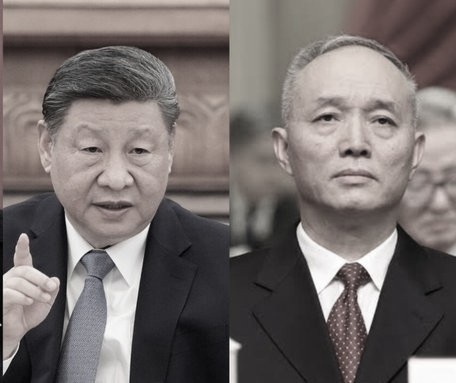
Cai Qi (right) and Xi Jinping (left)
[People News] At the beginning of 2026, as the United States demonstrated strong capabilities in “decapitation strikes” and “regime change” in Venezuela and the Middle East, this has also produced far-reaching chain reactions for the Taiwan Strait situation. Under the dual pressure of a complex international environment and domestic economic downturn, the Chinese Communist Party (CCP) has significantly adjusted its Taiwan strategy, shifting from high-profile “military deterrence” to deeper and more covert “social infiltration” and “cognitive disintegration.” Against this backdrop, historical details alleging that top CCP leader Xi Jinping once acted as a “spy” and participated in probing Taiwan intelligence in his early years have been re-examined, drawing widespread attention.
Xi Jinping Once Used the Alias “Bai Yu” to Probe Taiwan Politics
CCP party chief Xi Jinping comes from a “red second-generation” background. Under the protection of his father Xi Zhongxun, his official career advanced smoothly. In his early years, he served as a secretary in the General Office of the Central Military Commission. In 1983, he became Party Secretary of Zhengding County, Hebei Province. In 1985, he moved south to Fujian to serve as a member of the Xiamen Municipal Party Committee and Executive Vice Mayor. In 1990, he became Party Secretary of Fuzhou City, Fujian Province, and in 1999, Deputy Secretary of the Fujian Provincial Party Committee and Acting Governor. He served in Fujian for as long as 17 years.
Independent commentator Du Zheng recently wrote in Taiwan’s Up Media that while Xi was serving in Fujian, he once used an alias to probe Taiwan’s political situation, which was highly unusual.
On the eve of Xi’s rise to power in 2012, Japan’s Asahi Shimbun revealed that during his tenure in Fujian, Xi had a period of “spy career” involving probing Taiwan’s political situation. In the spring of 1988, Yao Limin, then an associate professor at National Sun Yat-sen University in Taiwan, attended a cross-strait relations symposium held in Xiamen, Fujian Province. He was informed that a businessman wished to meet him—someone highly influential on the government side. In a lounge room, Yao met a man who handed him a business card printed with an unfamiliar company name and the man’s name: “Bai Yu.”
At that time, Taiwan’s internal democratization movement was gaining momentum. In a low voice, this “businessman” mentioned the names of several Taiwanese democracy activists and asked Yao about their political positions. For example, he asked how the Democratic Progressive Party, formed by these activists, would interact with mainland China if it were to seize political power in Taiwan. The man showed strong interest in these issues.
Two years later, Yao Limin saw the man again on Taiwanese television news. The news reported that the Vice Mayor of Xiamen had been promoted to Party Secretary of Fuzhou City. “Isn’t that Mr. Bai?” Yao realized that the newly appointed secretary Xi Jinping looked exactly like the mysterious man. Only then did Yao suddenly understand that the name “Bai Yu” on the business card was a decomposition of the traditional Chinese character for “Xi.”
According to Asahi Shimbun’s analysis, in Fujian Province—which has close interactions with Taiwan—Xi Jinping likely undertook important tasks related to analyzing the Taiwan situation.
Cai Qi Personally Probed Taiwan
Du Zheng’s article also mentions that Xi Jinping’s close confidant Cai Qi personally probed Taiwan, and did so openly.
Cai Qi has relatives in Taiwan. His only visit to Taiwan took place from July 6 to July 12, 2012. At the time, he was a Standing Committee member of the Zhejiang Provincial Party Committee and head of the Organization Department. He entered Taiwan under the name of a civic organization, but Taiwanese authorities received him according to his actual identity. His trip lasted seven days, and his main activities included visiting his second uncle (nearly 90 years old at the time) living in the Zuoying military dependents’ village in Kaohsiung, meeting a large number of Taiwanese political figures, inspecting multiple locations and institutions, and visiting grassroots organizations.
After returning, Cai Qi published Taiwan Travel Diary in mainland media, detailing his reflections. However, after Cai was promoted to the Politburo Standing Committee in 2022, the article was quickly deleted. Some say this was done by CCP authorities to protect his network of contacts in Taiwan.
Hong Kong media at the time reported that “through this trip, Cai Qi traveled non-stop from south to north and from west to east, conducting an almost carpet-style investigation of Taiwan’s political and social conditions.” From the contents of Cai’s diary, one of his key focuses was the basic operations of Taiwan’s grassroots organizations.
It is worth noting that Cai Qi’s wife, Lin Chengsheng, previously worked in the Fujian system handling Taiwan affairs. After Cai Qi transferred to work in Zhejiang, Lin Chengsheng also went to Zhejiang to serve as Deputy Director of the Provincial Taiwan Affairs Office. Lin visited Taiwan twice, in November 2012 and April 2014, in her capacity as Deputy Director of the Zhejiang Taiwan Affairs Office, and later served as Deputy Secretary-General of the Mainland side of the Cross-Strait Entrepreneurs Summit.
Du Zheng stated that through Lin Chengsheng’s involvement, Cai Qi maintained frequent contacts with Taiwanese political and business figures and gained access to extensive networks in Taiwan.
He pointed out that although Cai Qi is only ranked third as Vice Chairman of the CCP’s National Security Commission, the two Vice Chairmen ranked above him, Li Qiang and Zhao Leji, are merely figureheads. Cai Qi is the CCP’s real intelligence chief. Unlike the two overt lines of the CCP’s military and Taiwan Affairs Office systems, the national security system is in fact a covert line in the CCP’s Taiwan strategy. The so-called CCP “fifth column” is controlled by Cai Qi.
Taiwan Must Be Vigilant Against the CCP’s “Cognitive Warfare”
According to the latest assessments released in January 2026 by Taiwan’s national security agencies and academic circles, the CCP’s Taiwan strategy has entered a phase in which “technology-driven cognitive disintegration” and “deep social infiltration” are highly intertwined. As Taiwan’s local elections scheduled for November 2026 approach, the CCP has fully activated an infiltration network operated by “national security czar” Cai Qi, attempting to dismantle Taiwan’s democratic defense mechanisms from within.
According to a report released by Taiwan’s National Security Bureau in January 2026, the CCP is comprehensively infiltrating Taiwanese society and media opinion through five major methods: analyzing public opinion dynamics through data analysis, building multiple channels to disseminate controversial information, using abnormal accounts to infiltrate discourse, employing AI-generated realistic audio-visual content, and hacking or stealing citizens’ online accounts. The strategic goals are to “intensify internal divisions within Taiwan,” “weaken the public’s will to resist,” and “gain acceptance of the CCP’s positions.”
At the same time, the CCP’s “fifth column” infiltration of Taiwan is no longer limited to traditional espionage activities. Instead, it systematically establishes “local collaborator networks” within Taiwanese society. Targets include temples, farmers’ and fishermen’s associations, local hometown associations, alumni associations, and village chiefs’ systems. The CCP is using long-established personal connections (such as those with a “Fujian faction” background), along with hospitality, financial inducements, or economic and trade exchanges, to conduct carpet-style infiltration of large numbers of grassroots organizations in Taiwan.
The CCP’s black hand has also reached Taiwan’s critical infrastructure.
According to warnings from Taiwan’s national security agencies, the infiltration targets of the “fifth column” have expanded to include grassroots outsourced personnel in key infrastructure sectors such as electricity, water, communications, and transportation. The objective is to carry out internal sabotage during conflicts or blockades in order to paralyze societal operations.
The CCP has also approached retired Taiwanese military officers or grassroots non-commissioned officers, using debt problems or financial inducements to obtain military secrets. Some cases even involve filming “surrender pledge” videos. At the same time, gang members have been recruited to prepare for potential social unrest or armed actions.
The year 2026 is a critical year for defense in the Taiwan Strait. The CCP’s Taiwan strategy has shifted from military intimidation under the concept of “ending the war with the first battle” to deep infiltration aimed at “unification without fighting.” The outcome of Taiwan’s defense will no longer depend solely on missile interception rates, but on whether society as a whole can see through cognitive traps, cut off infiltration chains of local collaborators, and ultimately dismantle the CCP’s infiltration network of “internal and external pincer attacks.”
△






News magazine bootstrap themes!
I like this themes, fast loading and look profesional
Thank you Carlos!
You're welcome!
Please support me with give positive rating!
Yes Sure!