
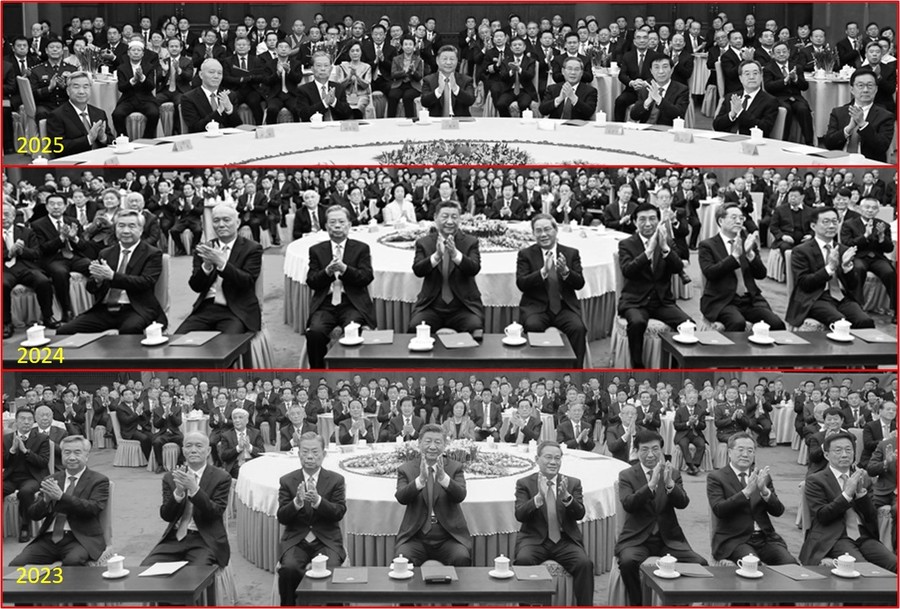
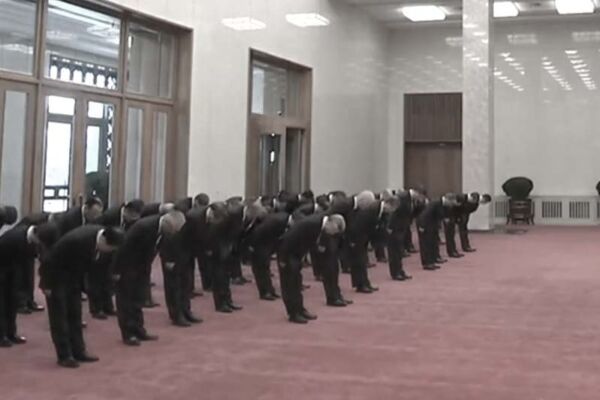
Group photo of CCP party chief Xi Jinping with the other Standing Committee members
[People News] The Fifth Plenary Session of the CCP Central Commission for Discipline Inspection (CCDI), which concluded on January 14, underwent yet another major change compared with the past. Not only did the number of participants shrink, but the work plan for 2026 also changed. The plenary communiqué continued to downplay the CCP party chief; the previously emphasized “political supervision” and “anti-corruption” were, to some extent, weakened. Two “new situational tasks” became the maintenance of “unity” and locking power “into a cage.” The CCP military newspaper also immediately published an article titled “Locking Power into a Cage.” So whose power might be “locked into a cage” in 2026?
The CCDI Is Repositioned
From January 12 to 14, 2026, the CCP CCDI held its Fifth Plenary Session. When the communiqué discussed the 2026 work plan, at least two unusual formulations appeared.
First, it stated the need to “deeply grasp the higher requirements that achieving the goals and tasks of the ‘15th Five-Year’ period places on maintaining the Party’s unity and cohesion.”
Second, it stated the need to “deeply grasp the higher requirements that achieving the goals and tasks of the ‘15th Five-Year’ period places on locking power into the institutional cage.”
These two points were described as “new situational tasks” determined by the “Party Central Committee.” The original “anti-corruption” work was placed after these two items.
A year earlier, the communiqué of the Fourth Plenary Session of the CCDI, when discussing 2025 work, had listed the tasks as “strict governance of the Party” and “advancing rectification of conduct, discipline, and anti-corruption in depth.”
One year later, the CCDI’s main work no longer focused on “strict governance of the Party”; instead, the primary task became “maintaining the Party’s unity and cohesion,” an unexpected major turn.
Previously, the CCDI was known as the so-called “sharp sword” of “strict governance of the Party,” equivalent to an “imperial sword” hanging over the necks of officials at all levels. It held the power of life and death to purge political opponents and those potentially disloyal, and could easily ruin the careers and reputations of targeted officials.
Now, the CCDI’s primary task is no longer “strict governance of the Party,” seemingly losing considerable power. At the same time, it is required to maintain “unity,” appearing to halt the practice of frequent purges. Anti-corruption can basically no longer serve the CCP party chief personally.
Beijing’s political situation remains in a period of turbulence. Such wording should profoundly reflect internal CCP concerns, seemingly aiming to cool down ruthless infighting within the officialdom as much as possible. However, Ma Xingrui’s absence from the CCDI plenary session, without any official announcement of his downfall, could still turn into a political time bomb at any moment.
At the Politburo meeting on December 25, 2025, it was proposed that in 2026 the Party should “advance comprehensive strict governance of the Party with higher standards and more concrete measures,” but no one knew exactly what that meant. The CCDI plenary session at the beginning of 2026 seems to have provided an explanation: the CCDI can no longer arrest people at will; maintaining “unity” and jointly protecting the Party comes first.
After the CCP’s 20th National Congress, the CCDI’s main task had been “political supervision,” to ensure loyalty of officials at all levels to Xi Jinping. Although this plenary communiqué continued to mention “political supervision,” it was no longer listed among the “new situational tasks.” Instead, the “new situational tasks” proposed locking power “into a cage.”
Under the requirements of the “new situational tasks,” the CCDI has effectively been repositioned and should have lost its former power to arbitrarily investigate and punish officials.
The CCDI’s Power Is “Locked into a Cage”
After the CCP’s 18th National Congress in 2012, then-CCDI Secretary Wang Qishan quickly became Xi Jinping’s biggest helper, launching fierce crackdowns on officials of the former Jiang faction. The CCDI’s power kept rising, instilling fear in almost all officials.
At the CCP’s 20th National Congress, after Xi Jinping secured another term, he still wanted the CCDI to remain his instrument of intimidation, repeatedly emphasizing “political supervision.” The communiqué of the Third Plenary Session of the CCDI in January 2024 had claimed that, in accordance with “Xi Thought,” it was necessary to “strengthen political supervision” and shoulder the major political responsibility of the “Two Upholds.”
But as the CCP party chief lost power, the CCDI’s power was gradually constrained. The formulations from the Third Plenary Session communiqué were no longer mentioned in the Fourth Plenary Session communiqué in January 2025.
By the time of the Fifth Plenary Session in January 2026, in addition to the “new situational tasks” of maintaining “unity” and locking power “into a cage,” the communiqué also proposed that “the National Supervisory Commission report special work to the Standing Committee of the National People’s Congress, proactively accept supervision, and resolutely prevent ‘darkness under the lamp.’” The CCDI’s work must report to the NPC. This may be a new kind of “institutional cage.”
CCDI Secretary Li Xi was personally promoted by Xi Jinping. After Xi lost power, Li Xi’s expressions of loyalty to Xi remained the most high-profile within the Politburo. Locking the CCDI’s power “into a cage” means Li Xi’s power should be formally weakened. In 2026, internal CCP struggles over the CCDI’s power seem to have reached an initial outcome.
The CCP Party Chief’s Power Is “Locked into a Cage”
No one truly believes the CCP will lock its privileges “into a cage,” but internal power struggles can lead to certain people’s power being restricted—essentially an internal transfer of power. An expanded Politburo meeting has already locked the CCP party chief’s power “into a cage,” and the CCDI communiqué seems to be publicly unveiling this “institutional cage.”
Politburo meetings throughout 2025 have already shown that Xi Jinping has lost his original decision-making power. Although he is still called the “core,” he can no longer be the sole authority.
At this Fifth CCDI Plenary Session, Xi Jinping delivered a speech as usual, but Party media coverage shrank again. The communiqué also continued to downplay the party chief’s speech.
The communiqué of the Third CCDI Plenary Session in January 2024 had stated that Xi’s speech “clearly put forward the practical requirements of advancing self-revolution through the ‘nine withs’… condensing rich practical experience and major theoretical achievements of comprehensive strict governance of the Party in the new era, and uniting the Party around a high degree of consensus.” It also said CCDI Standing Committee members would “study Xi Thought with heartfelt dedication and deep understanding,” and “unswervingly” shoulder the major political responsibility of the “Two Upholds.”
These flattering and loyalty-pledging phrases did not appear in the Fourth Plenary Session communiqué in January 2025, nor in the Fifth Plenary Session communiqué in January 2026.
The Third Plenary Session communiqué in January 2024 had also claimed that since the 18th Party Congress, Xi had led the entire Party to “creatively propose a series of original and landmark new concepts, new ideas, and new strategies… opening up a new realm of self-revolution,” representing “new achievements in theoretical innovation,” a “new chapter” of “Xi Thought,” and an understanding that had “reached a new height,” calling on officials to “study deeply with deep emotion, firm faith, and a strong sense of mission.”
Such nauseating language disappeared in the 2025 communiqué and likewise did not appear in the 2026 communiqué. Over the past year or so, officials at all levels have basically stopped deliberately flattering Xi Jinping.
However, when the Fourth Plenary Session communiqué in January 2025 mentioned Xi’s speech, it still said he had “profoundly analyzed the current situation of the anti-corruption struggle, clearly clarified erroneous understandings, dispelled ideological confusion, and put forward clear requirements for resolutely winning the tough battle, protracted battle, and overall battle against corruption,” and described the speech as “facing problems head-on and sounding a deafening alarm.”
A year later, the Fifth Plenary Session communiqué in January 2026 contained none of this. Although the CCP party chief continued to speak, he could no longer “put forward clear requirements” for the CCDI’s work. The CCDI now needs to follow the “new situational tasks” determined by the “Party Central Committee.”
On January 14, the day the CCDI plenary session ended, the CCP military newspaper published an article titled More Scientifically and Effectively Locking Power into the Institutional Cage—Second Commentary on Earnestly Studying and Implementing Chairman Xi’s Important Speech at the Fifth Plenary Session of the 20th Central Commission for Discipline Inspection. Although the article quoted Xi Jinping, it also stated that leading cadres must “set an example themselves and lead from the top,” locking power “into the institutional cage,” and that the “exemplary role” of leading cadres is particularly important.
The CCP military newspaper once again openly “overstepped,” appearing to point directly at the top leadership. The article also stated, “Without rules, individuals perish; without rules, the Party falls into chaos.” This goes beyond the military’s authority and beyond the scope of “anti-corruption.”
Where Is “Anti-Corruption” Heading?
In 2025, CCP officials continued to fall, especially senior military generals. In January 2025, 131 CCDI members attended the Fourth Plenary Session, with 247 observers. A year later, at the Fifth Plenary Session in January 2026, the number of CCDI members dropped to 120, while observers increased to 265, indicating a shift in discourse power.
Changes in the CCP officialdom continue. “Anti-corruption” may still be a tool for factional struggle. But this plenary communiqué merely stated “following the path of anti-corruption with Chinese characteristics,” no longer mentioning “the still grave and complex situation of the anti-corruption struggle,” nor reiterating “firmly winning the protracted anti-corruption battle.”
On January 8, before the CCDI plenary session, Xinhua published an article titled Not Stopping for a Single Step, Not Retreating Even Half a Step! Continuously Eliminating the Soil and Conditions for Corruption. The article said that in 2025, 65 centrally managed officials had been publicly announced as having fallen, with December seeing “nine tigers taken down in one month,” serving as strong proof of “not stopping for a single step, not retreating even half a step.” It named cases including Jiang Chaoliang, Jin Xiangjun, Lan Tianli, Liu Hui, and Yi Huiman, and concluded by reiterating “resolutely winning the tough battle, protracted battle, and overall battle against corruption.”
Although CCP media and CCTV continue to broadcast the TV special Not Stopping for a Single Step, Not Retreating Even Half a Step, something unknown to outsiders seems to have occurred at the CCDI plenary session. The January 14 communiqué sent a different signal than before, appearing to cool down “anti-corruption,” with CCP officialdom’s “anti-corruption” giving way to maintaining “unity.”
The CCP military’s direction of continued purges under the banner of “anti-corruption” seems unchanged. The CCDI has no authority over the military; the CCP’s “anti-corruption” in the military and in the civilian officialdom may be heading down different paths.
On January 14, the same day the CCDI plenary session ended, the CCP military newspaper published another article titled Not Stopping for a Single Step, Not Retreating Even Half a Step—A Series of Discussions on Continuously Deepening Political Rectification and Advancing Rectification of Conduct and Anti-Corruption in Depth (32). The article still stated that “corruption is the greatest threat facing our Party, and anti-corruption is the most thorough self-revolution,” and warned that “any hesitation, wavering, slackness, softness, or halfway abandonment in the anti-corruption struggle would constitute a subversive error.”
This sharply contrasts with the tone of the CCDI communiqué. The military newspaper article also stated that anti-corruption “is a tough battle, a protracted battle, and an overall battle… there can be absolutely no room for compromise or retreat… investigate and punish as many as are discovered, with no quotas and no upper limit.” It also said, “Maintain high pressure in punishing corruption, thoroughly dispelling expectations of downgrading or changing the tone, lucky thinking based on supposed clever tactics, and delusions of muddling through.”
The CCP leadership and the military still appear unable to align, or rather, their contradictions remain irreconcilable.
Conclusion
The CCDI plenary session deliberately released a signal of maintaining “unity” and repositioned the CCDI, likely to preserve the Party as much as possible in extraordinary times. At the same time, calling for locking power “into the institutional cage” more likely reflects helplessness and a lack of options, forcing maintenance of the status quo and minimizing turbulence. The military, however, seems to be heading down a different path.
In 2026, Zhongnanhai may still not want to rashly break the stalemate. But if the CCP party chief’s health cannot hold up, the situation could be entirely different. Nor can it be ruled out that the CCP military may again force the issue.
The sudden change in tone of the CCDI plenary communiqué reflects internal CCP weakness far exceeding what outsiders know. As a result, the CCDI plenary session had to make certain adjustments—perhaps a kind of compromise in internal struggles. But human calculations cannot match Heaven’s will.
U.S. actions toward Venezuela have brought new variables; Iran may also undergo change, while the CCP is powerless to respond. The world is in the midst of dramatic transformation, but not the “great changes unseen in a century” that the CCP hoped for. Instead, it is a transformation in which the CCP watches internal and external decline advance on all fronts, irreversible. In the new year, people have reason to hope that 2026 will be the CCP’s end.
— The Dajiyuan
△



News magazine bootstrap themes!
I like this themes, fast loading and look profesional
Thank you Carlos!
You're welcome!
Please support me with give positive rating!
Yes Sure!