
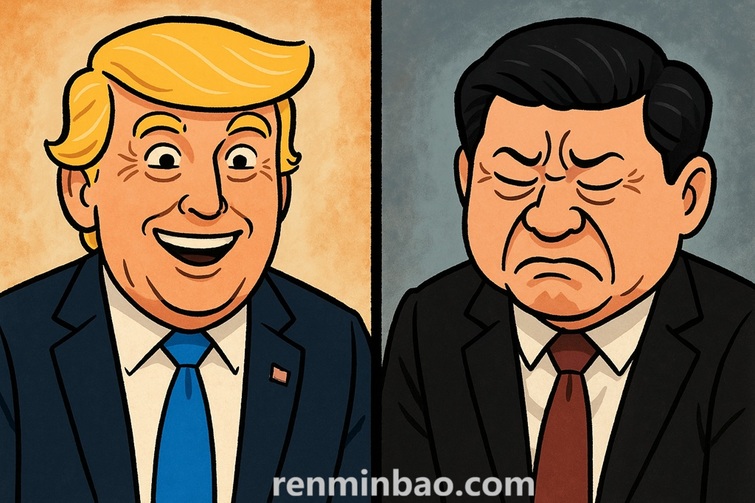
Thinking about taking action against Taiwan? Trump: You are free to think about it, but what are you actually going to do? (People News/AI-generated image)
[People News] The most striking news worldwide in recent days has been the military operation in the Middle East, codenamed 'Operation Epic Fury.' This operation not only devastated Iran's air defence system but also transformed a term that once carried a hint of irony into reality—one that Chinese Communist officials are all too familiar with: 'Let the leaders go first.' This time, however, the leaders who went first included dozens of high-ranking Iranian officials, including Supreme Leader Khamenei. This has sent chills down the spine of the Xi Jinping regime in Beijing, as it contemplates its own future.
'Decapitation' Becomes the New Normal: Let the Leaders Go First
The most shocking element of this operation occurred on February 28, when the US-Israeli coalition accurately 'physically removed' dozens of key military and political figures, including Khamenei. This approach has been humorously referred to by netizens as 'the most civilised war'—essentially, 'let the leaders go first.'
The logic behind this is straightforward: utilise high-precision intelligence to directly eliminate the decision-making tier, avoiding harm to innocent civilians and preventing ordinary soldiers from being sent to the front lines as cannon fodder. For dictatorial regimes that typically hide in the rear while sending their citizens to the front, this represents a significant nightmare. In the age of high-precision intelligence, no one can guarantee that hiding deep within a bunker ensures safety. This transition from 'physical removal' to 'psychological deterrence' has left Beijing feeling an unprecedented chill.
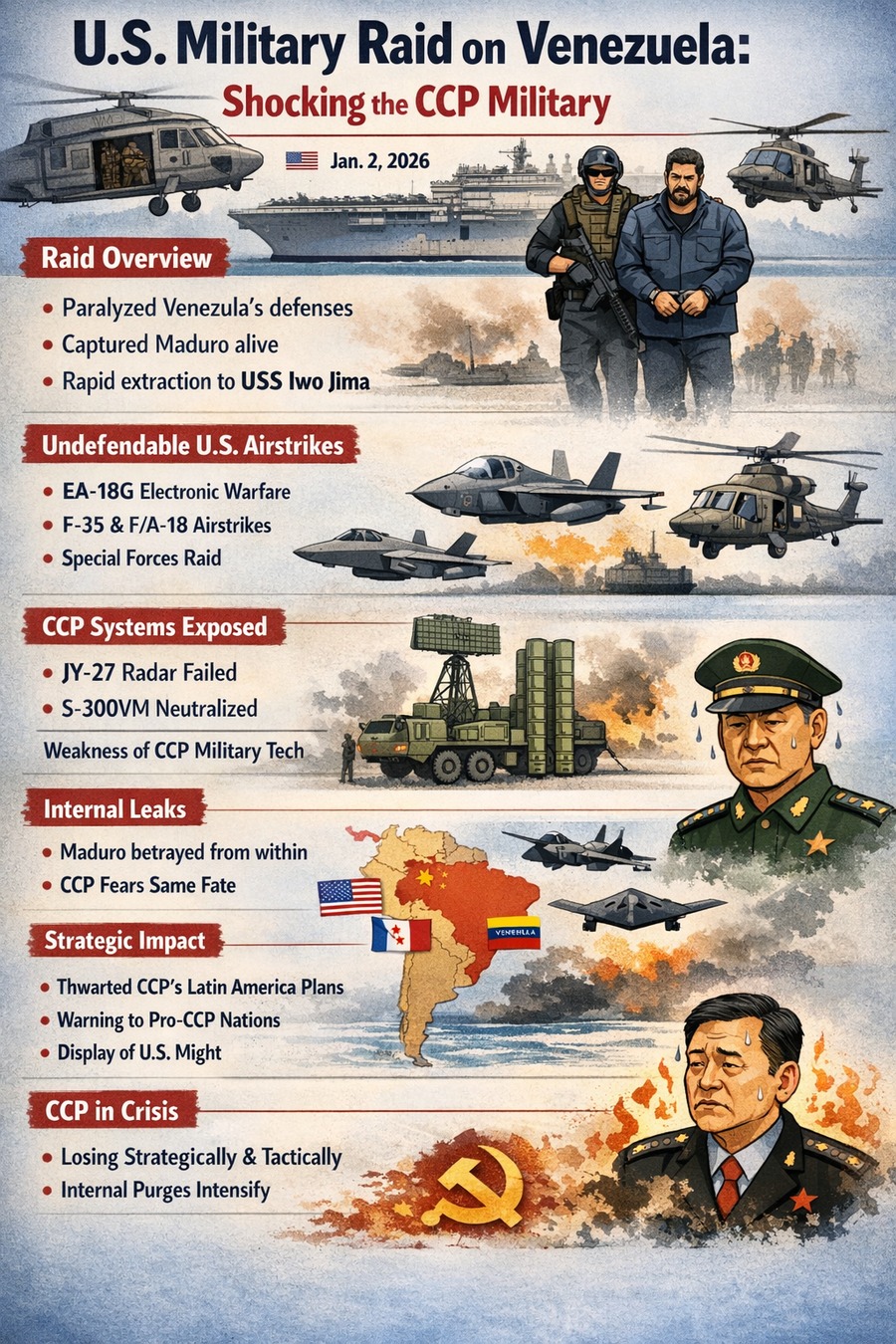
Recently, Chinese military experts and supporters of the Communist Party claimed that 'the United States would not dare to attack Iran,' only to be swiftly proven wrong. Earlier this year, after the U.S. captured Venezuelan strongman President Maduro, Li Yi, a prominent military unification scholar and self-proclaimed 'national master' of the Chinese Communist Party, was so furious that he choked up and even slapped himself. In a recent commentary on the situation in Iran, he shockingly 'admitted' that Taiwan had effectively achieved independence back in 1996.
As netizens watched Li Yi's dramatic display, they joked that it would be more entertaining to see him slap himself. Some even remarked that the Communist Party would never be able to reclaim Taiwan in eight lifetimes. Given Khamenei's fate, Professor Li is certainly putting Xi Jinping in a tough spot!
This isn't the first time such a situation has occurred—previously, Venezuelan President Maduro was forcibly taken from his bed by U.S. troops in the middle of the night, and before Beijing could recover, Khamenei was ousted in less than two months.
Both Maduro and Khamenei are close allies of Xi Jinping, representing Beijing's significant strategic interests in Latin America and the Middle East. The messages from these two consecutive events are crystal clear: when the United States decides to act, the situation can change dramatically in a very short time. This undoubtedly instils fear in Beijing.
Epic Fury Operation: The Collective Silence of Beijing's Hongqi-9B
Why is Beijing so anxious? To find out, we can refer to a commentary by Dr Rebecca Grant, Vice President of the Lexington Institute, published on the Fox News website. Her article, titled 'Epic Fury Operation: How U.S. Air Power Dismantled the Iranian Terror Regime,' sheds light on the matter.
Dr Li Beika analyses that the actions taken by the US-Israel coalition this time go far beyond merely bombing factories in the traditional sense. This operation represents a systematic and coordinated effort that integrates air, sea, land, and cyber forces.
Consider this: the US military deployed B-2 stealth bombers, the most advanced fifth-generation fighter jets, and a vast fleet of drones. However, the true unsung heroes behind this operation are the satellite systems of the Space Force. These satellites function like the 'Eye of God,' providing precise guidance and battlefield surveillance throughout the mission. What surprises military experts the most is that the US military achieved 'synchronous offence and defence': while launching a fierce attack, the 'THAAD' system at sea and the 'Patriot' system on land had already established their defensive networks, intercepting nearly all of Iran's retaliatory missiles mid-air. This level of efficient cross-service integration showcases a formidable 'systemic crushing' capability.
What likely embarrassed Beijing the most during this operation was the complete collapse of Iran's air defence system. For years, Iran has claimed that its air defence network is impenetrable, boasting equipment like Russia's S-300 and the CCP's pride, the Hongqi-9B (HQ-9B). However, in real combat, these so-called 'ace systems' were rendered nearly ineffective against the US military's electronic warfare suppression and low-altitude infiltration, with radar and command systems quickly incapacitated, leaving even the most advanced missiles as nothing more than costly ornaments.
The final signal from the United States: Does Beijing see a reflection of itself in Iran?
Dr Grant explicitly states at the conclusion of her article that while Beijing is not the direct target of the 'Epic Fury Operation,' these aggressive strikes should be sufficient to intimidate the CCP.
She notes that this operation has sent three significant signals to Beijing:
First, the United States demonstrates a strong cross-regional integration capability. It has been confirmed that the U.S. military can conduct sustained precision strikes from thousands of miles away, which is a crucial factor in future great power competition.
Second, the U.S. exhibits strong logistical resilience. The intensive mobilisation of C-17 transport aircraft, along with the functioning of its maritime supply system, showcases America's ability for rapid troop deployment and sustained military operations.
Third, what is most unsettling for Xi Jinping is that the United States is swiftly undermining Iran, effectively reallocating resources to focus on its true long-term competitor—Beijing.
In fact, Chinese military vessels stationed near the Strait of Hormuz have witnessed these developments firsthand. For Beijing, this is not merely news; it serves as a clear reflection. It reminds the leadership in Beijing that power is not inherently secure, and Iran represents tomorrow's 'self'.
(First published in People News)
△





News magazine bootstrap themes!
I like this themes, fast loading and look profesional
Thank you Carlos!
You're welcome!
Please support me with give positive rating!
Yes Sure!