
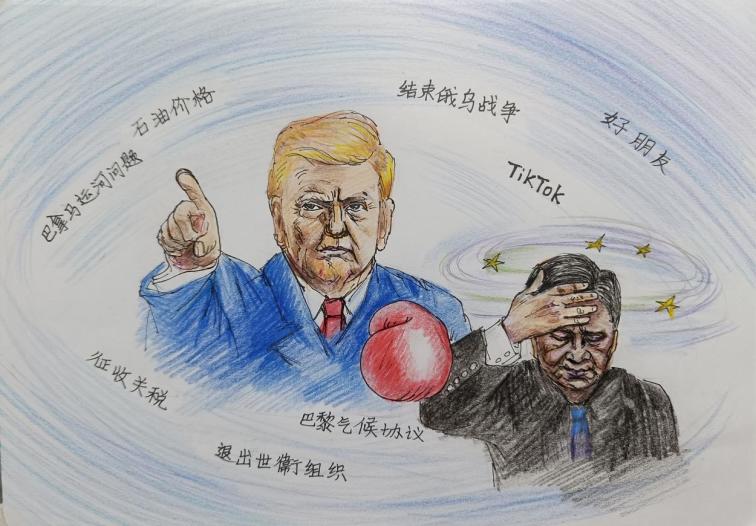
Trump's soft and hard tactics leave the CCP disoriented. (Image by Qing Yu / People News)
[People News] The White House has confirmed that the U.S. President will visit Beijing at the end of March. The beheading of Khamenei by the U.S.-led coalition could directly impact the content of the Trump-Xi meeting that was originally planned. The Chinese Communist Party (CCP) is aware that Trump may adjust the topics of his visit. Even if he does not make any changes, the CCP will still need to adapt. Consequently, the upheaval in Iran not only alters the dynamics in the Middle East but also completely derails Beijing's meticulously planned summit negotiations.
Impact on the Trump-Xi Meeting at the End of March
As reported by the Liberty Times, Beijing has long aimed to utilise "chip diplomacy" to leverage the Taiwan issue in exchange for greater economic and geopolitical advantages. However, the recent U.S. military actions have posed a significant challenge to Beijing's calculations.
Analysts suggest that Beijing's original strategy was based on the premise that the U.S. is currently dealing with issues in the Middle East, Ukraine, and the Korean Peninsula, and would likely require the CCP's assistance in addressing these challenges. Additionally, with Trump's tariff policies facing obstacles, the White House may be in urgent need of substantial diplomatic successes to rectify the situation.
However, the unexpected beheading of Khamenei and other high-ranking Iranian officials prior to the summit has completely transformed the negotiation landscape, drastically reducing the "negotiation space" that Beijing had anticipated.
In recent years, Beijing has been playing a dual strategy regarding the Iran issue. Publicly, it supports certain sanctions in international forums and advocates for de-escalation, while privately, it continues to engage closely with Tehran in areas such as energy, trade, and technology. This includes electronic components, air defence systems, and related technology exchanges, which many observers believe have helped Iran sustain its military capabilities.
However, this time the United States has directly resorted to military force, rapidly altering the situation and eliminating any room for negotiation or mediation.
Shen Mingshi, a researcher at the Taiwan National Defence Security Research Institute, noted: "If the conflict results in the elimination of Iran's senior leadership or even triggers a regime change in Iran, Xi Jinping will find his bargaining power diminishing. Trump can capitalise on the military strength of the United States, and the various air defence systems that the Chinese Communist Party has provided to Iran will prove ineffective, ultimately giving Trump greater leverage to pressure China."
Shen Mingshi further stated: "Trump may seize this opportunity to warn Xi Jinping against taking military action towards Taiwan. Such a warning would come across as more assertive and would likely be more effective."
Prior to the presidential election, Trump had declared that if the Chinese Communist Party dared to act militarily against Taiwan, he would bomb Beijing after winning. Now, following the demonstration of U.S. military strength in Venezuela and Iran, Xi Jinping must contemplate whether his own security would be assured if he were to attack Taiwan.
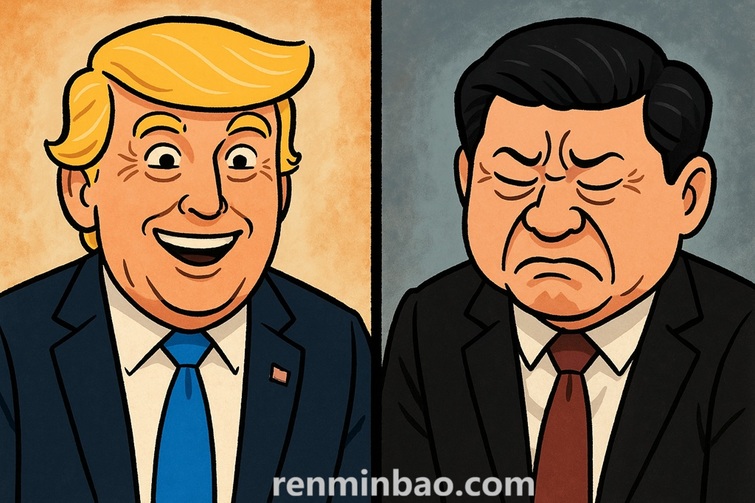
Veteran commentator Chen Pokong remarked that Trump's visit to Beijing to meet Xi Jinping at the end of March was largely a matter of appearances. Trump needs to first stabilise relations with Beijing to prevent it from causing ongoing disruptions behind the scenes. Additionally, he must consider the economic development of the United States and the income of its citizens, which necessitates continued engagement with Xi Jinping. However, as the Chinese Communist Party's affiliates in Venezuela, Cuba, and Iran are dealt with, Xi Jinping will likely feel quite embarrassed. Trump approaches Beijing as a victorious leader, and the terms of negotiation between the two parties are entirely different.
Chen Pokuang analyses that Xi Jinping is currently experiencing a comprehensive defeat on the international stage, with the Belt and Road Initiative's lifeline being obstructed. More critically, he is preoccupied with internal power struggles, focused on consolidating his authority, and has lost the support of the people, the military, and officials. Chen believes that during this meeting, Xi Jinping is seeking something from Trump. He needs Trump to endorse him, signalling that the U.S. President and Western leaders acknowledge his position, as he aims to solidify his standing within the party. However, in reality, regarding the situation in Iran, the outcome of the Xi-Trump meeting is becoming increasingly clear.
The developments in Iran and their implications for the CCP's future political affairs
Senior media figure Shibata Akio also remarked that with Khamenei and others being eliminated by the U.S.-Israeli coalition, the CCP's previously celebrated image as a 'great power that guides countries worldwide' has been dismantled. For Iran, a strategic ally and subordinate that has consistently followed the CCP, the latter lacks both the courage and the capability to provide protection. Thus, on what grounds can the CCP assert its strength to the world? The air defence systems and strategic plans that the CCP supplied to Iran were easily overwhelmed by the U.S. military, and the long-promoted myth of their defence capabilities was once again debunked by reality after a prior embarrassment in Venezuela. Many Southeast Asian nations will likely reevaluate whether it is still worthwhile to invest in weapons from the CCP.
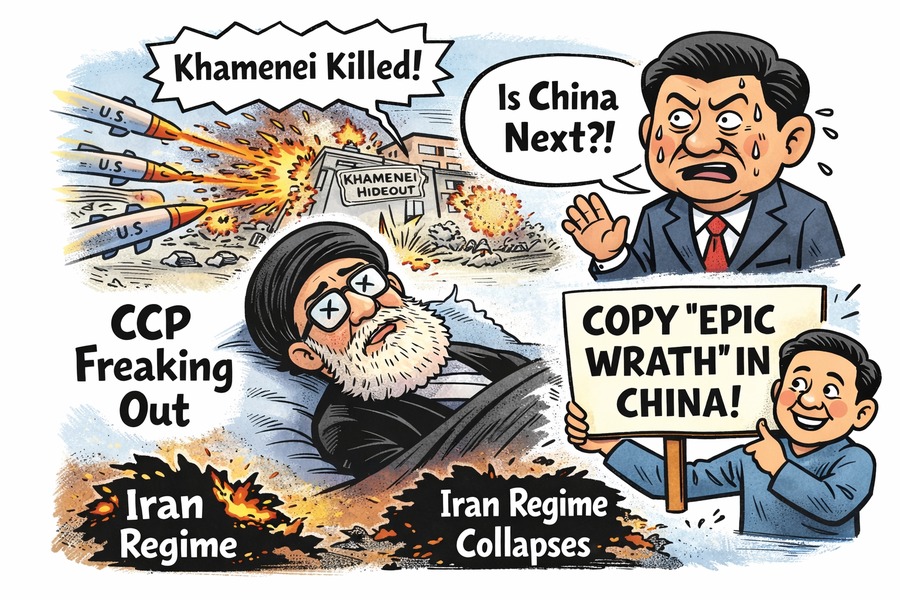
Moreover, the most uncomfortable aspect is that Xi Jinping's personal sense of security has been compromised. Shibata Akio stated, 'Trump's visit to Beijing is not about discussing sentimental topics. Before the negotiations, he aims to make the other side confront the reality: do you still dare to stand against the United States?'
Regardless of the circumstances, the U.S. 'decapitation' operation has undoubtedly instilled both hatred and fear in Zhongnanhai. The entire socialist alliance is shifting, with Cuba on the brink of change under U.S. pressure, and Vietnam making significant strides in opening up, as evidenced by the recent arrival of Starlink in the country. This gives the impression that Trump aims to eliminate all of the CCP's allies, isolating the CCP as a lonely entity. Even the self-media in mainland China openly discuss that if the Iranian regime is ultimately overthrown, the CCP will face multiple crises.
Chinese Douyin blogger 'Silk Road Old Yang' analyses that if Iran is defeated, China will confront three major crises: First, there will be a sharp increase in China's oil and commodity prices.
Second, investments amounting to hundreds of billions may be lost.
Third, the U.S. will intensify its encirclement of China. After securing the Middle East, the U.S. will quickly pivot back to the Asia-Pacific region. Iran serves as a crucial strategic buffer for us. The saying 'when the lips are gone, the teeth are cold' has always held true.
Khamenei is harmed by the CCP.
On February 28, following the U.S. and Israeli attacks on Iran, Iran promptly announced the closure of the Strait of Hormuz. Real-time data from the international tanker traffic monitoring system indicates that the sailing speed of tankers in the waters surrounding the Strait of Hormuz has generally dropped to zero, with many vessels ceasing operations to avoid risks.
Bloomberg noted that if Iran blocks the Strait of Hormuz, the first to react with panic may be Beijing.
Some netizens assert that Khamenei and Iran have been harmed by the CCP. The CCP not only provides defence support but also offers technical and economic assistance, making it difficult to believe that the CCP has not assured Khamenei during this period: 'You can boldly engage with American imperialism; I will have your back.'
Consequently, Iran is pursuing nuclear weapons; during the negotiations between the US and Iran, the Iranian side has fluctuated between wanting and not wanting to reach an agreement. This has emboldened Iran to act boldly, shooting at unarmed civilians like the opponents of the Chinese Communist Party and launching missiles at the US, Israel, and Arab nations... The President of Venezuela, who placed his trust in the Chinese Communist Party, is now preparing to serve a prison sentence in the United States. Meanwhile, North Korea's Kim Jong-un has also been swayed by the Chinese Communist Party, recently threatening to continue its nuclear weapons program. Thus, it is possible that, following Khamenei's downfall, there may be a period of quiet.
(First published in People News)
△






News magazine bootstrap themes!
I like this themes, fast loading and look profesional
Thank you Carlos!
You're welcome!
Please support me with give positive rating!
Yes Sure!