

Xu Xianping, a former member of the Party Leadership Group and Deputy Director of the National Development and Reform Commission of the Communist Party of China, recently appeared in an anti-corruption documentary. (Video screenshot)
[People News] On January 12, Xu Xianping, a retired vice-ministerial official of the Communist Party, was featured in the anti-corruption documentary, where he repeatedly aligned with the authorities' narrative. He expressed remorse over themes such as 'retiring but not resting' and 'greed harms people,' concluding with statements like 'the world is truly wonderful, only after retirement do I realise' and 'ultimately, I lost the most precious thing—freedom.'
Xu Xianping stepped down as Deputy Director of the National Development and Reform Commission in 2015 and officially retired in 2023. In March 2025, he underwent a disciplinary review and supervision investigation by the Communist Party, leading to his expulsion from the Party in November of the same year. His on-screen 'confession' took place prior to any judicial rulings, with the content produced by the Communist Party's official propaganda department and aired on CCTV. In the documentary, Xu is depicted as an example of 'retiring but not resting.' It reveals that after moving to a 'second line' position, he continued to benefit from his previous role's influence, using others to hold assets on his behalf and involving relatives. These details were woven into the documentary, creating a clear narrative: even after retirement, it is challenging to remain uninvolved.
Xu Xianping's televised confession has sparked scepticism among netizens, who argue that since he has been retired for many years and the related allegations have not been subjected to a public trial, it is inappropriate for him to be placed in front of the camera to 'confess' prematurely, which strays from standard judicial procedures. Some commentators have pointed out that without an independent judiciary and public hearings, televised confessions only serve to heighten the risk of power abuse. 'Today it’s him, tomorrow it could be anyone, depending on how those in power perceive it.'
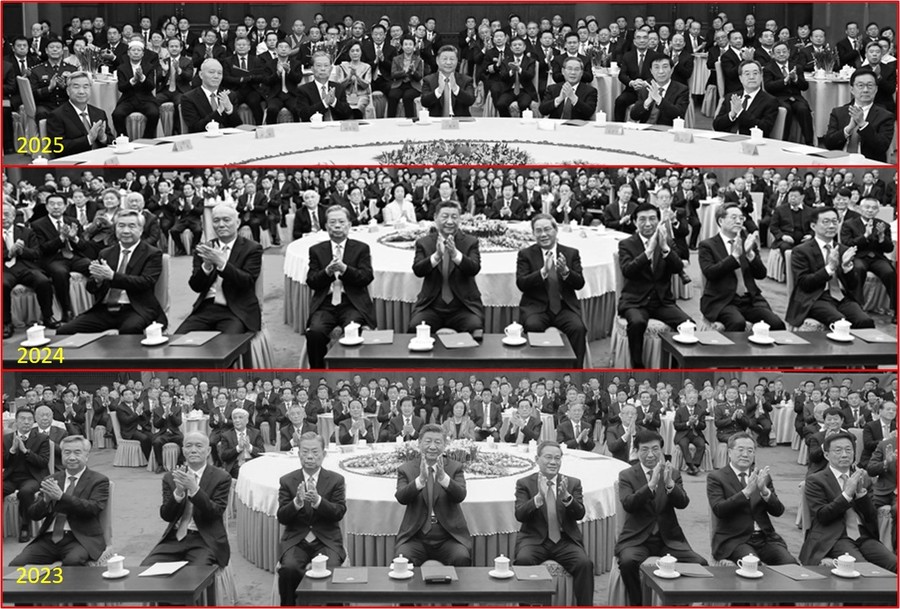
In reaction, a user on platform X, known as 'Lizhizhi', remarked that 'Xu Xianping was set up to confess on camera about the so-called themes of 'retirement without rest' and 'greed harms others', which is clearly a jab at elders like Wen Jiabao. Xu Xianping is simply a pawn in the internal factional battles of the Communist Party. Earlier, several media outlets reported from Beijing that while Xi Jinping appears to be the leader of the Communist Party, the Chairman of the Military Commission, and the President, his authority has been diminished. Several retired elders, along with the current Vice Chairman of the Central Military Commission, Zhang Youxia, are the true power holders behind the scenes, with Zhang Youxia wielding actual military authority. They have become pivotal players in shaping China's political landscape. Even though Xi Jinping participates in various meetings and delivers speeches as a leader, it is merely a performance. When the Communist Party's media covers Xi Jinping's activities, it no longer glorifies his personal achievements as it once did, but instead repeatedly emphasises 'collective leadership' responsibilities, signalling that Xi's 'supreme' status is irretrievably lost.'

Wang Yilin, the former chairman of China National Offshore Oil Corporation, is embroiled in a corruption scandal involving 900 billion yuan. The accompanying image shows Wang Yilin's basement filled with stacks of renminbi. (Video screenshot)
Zhao Xin (pseudonym), a senior media figure, told The Epoch Times that televised confessions often have a more significant impact on officials than formal disciplinary actions. "The essence of this is political intimidation, indicating that it’s not just about punishing you, but also using you to intimidate others."
Senior commentator Cai Shenkun expressed on the X platform that, according to the information released by the authorities, the so-called 'evidence of guilt' regarding Xu Xianping highlighted in the program includes accepting high-priced renovations for his home from businessmen, enjoying services such as water, electricity, gas, and cleaning, receiving an old model Mercedes-Benz, and having relatives hold a small number of company shares on his behalf. In comparison to cases within the Chinese Communist Party (CCP) that often involve large sums of money and systematic power-money transactions, these details are not particularly remarkable.
Cai Shenkun further noted that after Xu Xianping left his position at the National Development and Reform Commission, he continued to serve as a counsellor to the State Council, providing policy advice to Li Keqiang. Following the 20th National Congress, after Li Keqiang stepped down and subsequently passed away, these connections lost their influence, and Xu Xianping was later reactivated for what is termed a 'corruption investigation.'
Beijing scholar Li Yun (pseudonym) told reporters that televised confessions are not simply anti-corruption propaganda, but rather a method of power display with explicit political aims. In a proper rule of law system, whether a crime has been committed is determined by the court through public hearings, not by the propaganda department issuing conclusions beforehand.
He stated, "When a person has not yet completed their judicial trial and is made to 'plead guilty' on national media, it effectively undermines the presumption of innocence. This is not a judicial process; it is a preemptive political characterisation."
Feng Qin (pseudonym), a retired individual from a research institute at the Chinese Academy of Social Sciences, also commented to The Epoch Times that these televised 'confessions' do not constitute normal judicial procedures but are instead a highly politicised public spectacle. This represents a form of political humiliation carried out by the CCP under the pretence of anti-corruption efforts.
Historically, in the CCP's anti-corruption propaganda, those who have been arranged to appear on CCTV to 'plead guilty' have almost exclusively been high-ranking officials or cases involving the highest echelons of power. In 2017, former Politburo member Sun Zhengcai appeared in an anti-corruption documentary, where his 'confession' was primarily directed at political accusations such as 'disloyalty to the Party' and 'excessive political ambition.' In 2019, Lai Xiaomin, the former chairman of China Huarong, also confessed on CCTV's anti-corruption program and was later sentenced to death and executed.
Netizens on platform X are actively discussing this, with comments like: "Any county or town mayor can embezzle tens of millions from the state; how could a provincial governor possibly take less than 100 million?!"
"To put it simply, 2 million isn't even enough to buy a section chief; 15 years ago, the deputy secretary-general of the Guangzhou municipal government spent 50 million trying to remove that 'deputy' title and still couldn't succeed."
It is more accurate to describe the situation as a reckoning rather than anti-corruption. The 'crime' does not stem from corruption itself, but rather from being a former subordinate or close associate of Li Keqiang. This type of selective anti-corruption, which involves 'digging three feet into the ground,' disguises internal party purges as righteous trials. Even those who have been retired for a decade cannot escape the consequences. This is not anti-corruption; it is clearly a ruthless pursuit of dissenters by those in power.
'Before an investigation, everyone appears as a model of integrity like Bao Zheng; after the investigation, they are likened to figures like He Shen or Qin Hui. From village officials to the General Secretary, not a single one is free from corruption; the Communist Party itself is the source of corruption. How can we even discuss anti-corruption?' △



News magazine bootstrap themes!
I like this themes, fast loading and look profesional
Thank you Carlos!
You're welcome!
Please support me with give positive rating!
Yes Sure!