
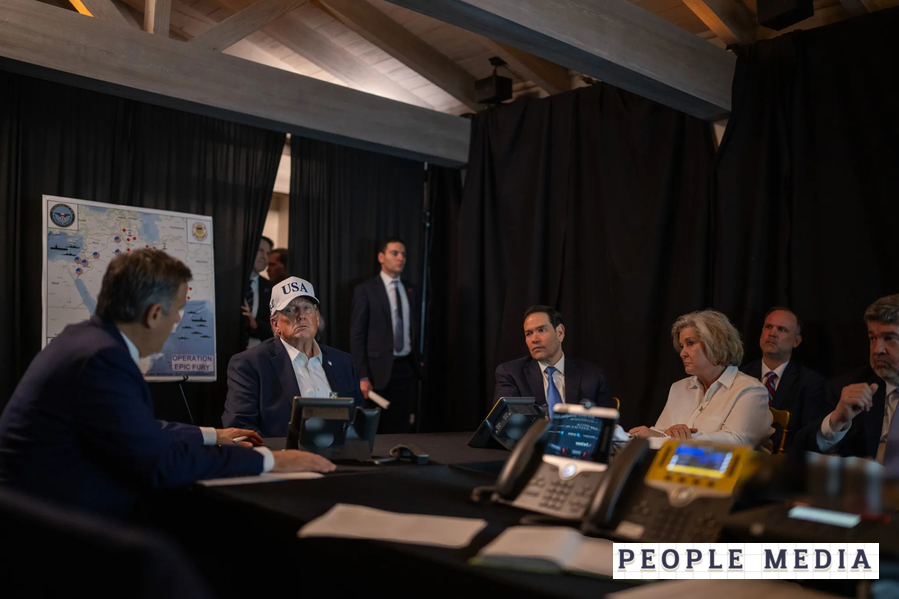
President Donald J. Trump oversees Operation Epic Fury at Mar-a-Lago, Palm Beach, FL, Feb. 28, 2026. (White House photo by Daniel Torok)
[People News] Since the beginning of this year, the United States has taken a series of major actions: in January it captured former Venezuelan president Nicolas Maduro; in February it struck Iran and killed its supreme leader Ali Khamenei; and it has also intervened in the issue of operating rights at ports of the Panama Canal. From the Western Hemisphere to the Middle East and then to the Indo-Pacific strategic corridor, the United States has been advancing step by step.
Experts say these are not isolated events but part of a broader strategic game of indirectly encircling the Chinese Communist Party (CCP)—a strategy that could ultimately push the CCP toward the same fate as the Soviet Union.
“Gradually Removing the CCP’s Peripheral Allies”
According to The Epoch Times, on February 28 the United States and Israel launched a joint military operation against Iran called “Epic Fury,” wiping out much of Iran’s military and political leadership. Earlier, in January, the United States had already arrested Maduro.
Within just two months, two strongman leaders closely tied to Beijing—long regarded as geopolitical pillars and “anti-U.S. outposts” for the CCP—were removed from power, reshaping the global strategic landscape.
American historian and political commentator Victor Davis Hanson said in a YouTube video that Trump’s actions, though appearing “chaotic,” are actually aimed at weakening the CCP and creating divisions between Beijing and Moscow, forcing Russia to reassess the long-term risks of its alliance with China.
Iran and Venezuela have supplied China with relatively cheap energy. Venezuela previously accounted for about 3–4 percent of China’s imported oil, while Iran accounted for 15–23 percent. Trump’s actions therefore weaken a key part of China’s energy lifeline.
Hanson said the United States is shifting its military focus away from “endless overseas policing wars” and toward rebuilding deterrence for great-power competition.
Hsieh Pei-hsueh, a cybersecurity expert at Taiwan’s Institute for National Defense and Security Research, agreed with Hanson’s assessment. In an interview with The Epoch Times, he said:“A direct U.S.–China conflict would be extremely costly, but indirect strangulation costs very little. That is the brilliance of Trump’s strategy.”
He explained that direct military confrontation with China would risk nuclear escalation, economic shocks, and domestic backlash in the United States. In contrast, removing the CCP’s external allies one by one is cheaper, easier to justify politically, and difficult for Beijing to counter.
Su Tzu-yun, director of the Institute’s Strategic Resources Research Center, added that removing Iran would have three effects:
-
China would lose an important geopolitical lever;
-
It would again demonstrate China’s inability to confront the West;
-
China would lose a source of cheap crude oil.
This could also affect the bargaining position ahead of the anticipated Trump–Xi meeting scheduled for late March or early April in Beijing.
Trump Countering Beijing by “Encircling the City from the Countryside”
China expert Gordon Chang said on March 1 in the program American Thought Leaders that Trump is ironically adopting a strategy inspired by Mao Zedong.
Chang explained that Mao once won the Chinese civil war through the strategy of “encircling the cities from the countryside.” Xi Jinping admires Mao and has attempted something similar by using regions such as Ukraine, North Africa, and Israel as geopolitical “countryside” to challenge the United States, the “city.”
But Trump has reversed the concept:“Venezuela and Iran are the countryside—while China is the city.”
Chang believes Xi clearly understands Trump’s strategy but is powerless to stop it. At the strategic level, energy is central. Venezuela provided about 3–4 percent of China’s imported oil, while Iran accounted for 15–23 percent, depending on the year.
Together, they represent a significant portion of China’s oil supply.
Chang said that Chinese factories have long relied on cheap oil. Now that these supplies are disrupted, China will have to pay global market prices for energy.
He also noted reports that 15 to 18 Chinese transport aircraft had entered Iranian airspace and that China had transferred certain radar equipment. However, when Iran activated the radar on February 28, the U.S. military quickly destroyed it.
According to Chang, Chinese-exported military equipment “is ineffective against U.S. electronic warfare measures.”
Dividing China and Russia: A Key Strategic Wedge
Hsieh Pei-hsueh said that driving a wedge between China and Russia is the most crucial element of the strategy.
“As long as Russia distances itself from China, it will receive benefits.”
If this wedge succeeds, China will lose strategic buffers to its north and northwest, as well as access to energy and military technology support. The idea of China and Russia jointly challenging the U.S. dollar system would collapse, and China would lose diplomatic protection in institutions like the United Nations.
Hsieh compared the situation to history: in 1972, President Richard Nixon visited China and used a “wedge strategy” to separate China from the Soviet Union. Now, he says, Trump is reversing that script.
He called the approach an upgraded version of the Cold War containment strategy, but “more aggressive and more executable than in Kissinger’s era.”
Su Tzu-yun analyzed the strategy as a chessboard. He said Trump has consistently emphasized focusing U.S. resources on countering the CCP in the Indo-Pacific. The current actions represent the removal of peripheral threats—including ending the Russia-Ukraine war, eliminating Iran as a Middle Eastern stronghold, and dealing with Venezuela in South America.
National security scholar Shen Ming-shih added that the Trump administration’s National Security Strategy clearly identifies China as the main target. However, the approach is not to confront China directly, but first to eliminate states and forces that support or align with Beijing.
Rising “Survival Struggle” Narrative in the U.S.
Shen Ming-shih said that over the next 10 to 20 years, the greatest challenge to maintaining U.S. global leadership will be the CCP.
Chang went even further, saying the United States is now engaged in a “struggle for survival” with communist regimes.
He pointed out that in May 2019, the CCP’s People’s Daily published an editorial referring to “People’s War,” and in March 2023 the PLA’s newspaper described the confrontation with the United States as “unrestricted warfare.” These statements suggest that Beijing already views the competition as a comprehensive confrontation.
Chang said democracies often respond slowly to threats, but sometimes presidents must take decisive actions to protect the public. He compared the situation to the policy of appeasement before World War II, arguing that the present moment requires courage.
Hsieh Pei-hsueh added that Xi Jinping’s highly centralized rule makes China’s political system more fragile—similar to the Soviet Union in its final years. If political change in Iran triggers a broader “authoritarian collapse effect,” the CCP’s legitimacy narrative could be further weakened.
China is already facing structural economic pressures: a real estate crisis, high youth unemployment, and demographic decline. Hsieh warned that if China’s external strategic partners are dismantled one by one, the returns from the Belt and Road Initiative could collapse as well.
Shen Ming-shih noted that in the 1980s, U.S. President Ronald Reagan launched the Strategic Defense Initiative, triggering an arms race that severely strained the Soviet economy.
If the CCP responds to U.S. pressure by escalating an arms race—expanding aircraft carriers, advanced missiles, and other weapons—it could follow the Soviet Union’s path, where economic strain eventually leads to political collapse.
As dramatic changes unfold in Iran and Venezuela, the U.S. strategy of “peace through strength” is reshaping the global balance of power and narrowing Beijing’s geopolitical space. The international community is watching closely. △




News magazine bootstrap themes!
I like this themes, fast loading and look profesional
Thank you Carlos!
You're welcome!
Please support me with give positive rating!
Yes Sure!