
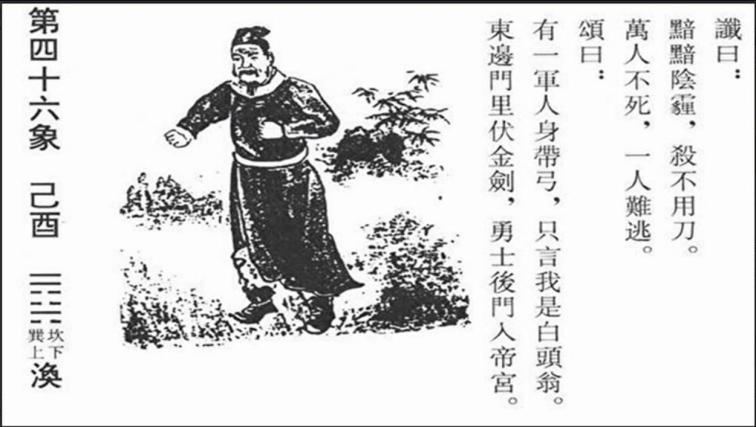
Dajiyuan Version of the Prophetic Image from "Tui Bei Tu" (Source: Dajiyuan)
[People News] The first remarkable book of Chinese prophecy, "Tui Bei Tu," is traditionally believed to have been commissioned by Emperor Taizong of the Tang Dynasty, Li Shimin, to forecast the fortunes of the Tang Empire and to predict the rise and fall of the world. It was created by two astrologers of that era, Li Chunfeng and Yuan Tiangang. The forty-sixth hexagram reads:
There is a soldier bearing a bow, merely stating, 'I am a white-haired old man.'
In the eastern gate lies a concealed golden sword; a brave warrior enters the imperial palace through the back door.
What astonishes everyone is that on January 24, 2026, at 3 PM, the Chinese Communist Party officially announced the downfall of Zhang Youxia, the Vice Chairman of the Central Military Commission, who is "bearing a bow," and Liu Zhenli, the Chief of Staff of the Joint Staff Department of the Central Military Commission, who is "bearing a knife." This event fulfilled the ancient prophecy and turned the rumours of internet influencers into a leading prediction.
From the "Dragon and Snake Transformation" to the "Red Horse and Red Sheep Calamity"
Ancient Chinese believed that during the 'Bingwu' and 'Dingwei' years (the 'Red Horse' and 'Red Sheep' years), various disasters would occur, which is why they referred to this period as the 'Red Horse Red Sheep Calamity'. Throughout Chinese history, many significant turning points have coincidentally taken place in these 'Red Horse Red Sheep' years. The most notable example is the 'Shame of Jingkang'. In 1126, the year of Bingwu, the capital of the Northern Song was invaded by the Jin army; the following year, 1127, the year of Dingwei, saw the capture of Emperors Huizong and Qinzong, marking the end of the Northern Song dynasty. A once-prosperous dynasty collapsed in just two short years, drastically altering the fates of countless individuals. Notably, during the years 1966-1967, which were also 'Red Horse Red Sheep' years, the 'Cultural Revolution' initiated by Mao Zedong uprooted five millennia of traditional culture, resulting in an immeasurable cost to the entire Chinese nation.
The years 2026 and 2027 will once again mark the 'Red Horse Red Sheep Calamity', occurring once every 60 years, and many significant historical events are anticipated, potentially leading to monumental changes. In fact, after entering the 'Nine Purple Leaving Fire' astrological phase in 2024, various signs have already begun to emerge, including the year of Xi Jinping's birth in 2025 (the Year of the Wood Snake), which has shown various omens, such as Xi Jinping's recent extensive reshuffling and purging of military leaders.
Historically, the Son of Heaven has been revered as the 'Sun', shining in all directions. The former Communist Party leader, Mao Zedong, was also celebrated as the so-called 'Red Sun'. In recent years, unusual phenomena such as 'Double Suns Shining Together', 'Three Suns Shining Together', and 'Multiple Suns Shining Together' have been observed across various regions in mainland China.
Ancient beliefs held that if the emperor star appeared dim and was surrounded by malevolent stars, accompanied by the alarming sign of 'two suns contending for brilliance', it indicated intense internal power struggles. This foretold that two or more monarchs would vie for control, a dire omen that could undermine the very foundations of the nation. Furthermore, when 'the Ziwei star dims, and Venus traverses the sky', it signifies the end of an old era and the dawn of a new one, marking the beginning of a dynastic transition.
Historically, following the celestial event known as 'two suns shining together and the golden crow crying blood', many emperors took action against old ministers and high-ranking officials in the court, accusing them of 'colluding with remnants of the previous dynasty'. In recent years, netizens across various regions of mainland China have captured remarkable celestial phenomena featuring two, three, four, and even seven 'suns' in the sky.
The latest occurrence was on January 8, 2026, when a netizen from Heilongjiang shared on social media that they had witnessed an astronomical marvel of 'four suns' at Xingkai Lake in Mishan City.
In April 2025, an individual in Wuzhou, Guangxi, recorded an astonishing sight of 'seven suns', with this particular arrangement being especially unique. The video revealed that one sun was partially obscured by dark clouds below, surrounded by six 'suns' of varying brightness.
In August 2024, a resident of Chengdu, Sichuan, also captured the spectacle of 'seven suns'. At that time, the seven 'suns' were aligned along the cloud layer, with the brightest positioned third.
Ancient texts such as 'Jingfang's Divination', 'Jingzhou's Divination', 'Yisi's Divination', and 'The Book of Jin: Astronomical Records' interpret these signs as follows:
1. The rise of armies and the competition among feudal lords: it foretells the outbreak of war, fragmentation in all directions, 'four lords established', multiple rulers competing, and the emperor's authority being undermined;
2. The fall of the monarch and the chaos created by powerful ministers symbolise the struggle between two lords and the deposition of the emperor, resulting in strong ministers and weak monarchs, frequent rebellions, and national fragmentation.
3. The disorder of Yin and Yang leads to a surge of disasters: this is seen as the scattering of Yang essence and the encroachment of Yin energy, often accompanied by natural calamities such as droughts, floods, and plagues, among others.
From the "Kaiyuan Prosperity" to the "Anshi Rebellion"
During the Tianbao era of the Tang Dynasty, the nation was thriving, filled with songs and dances. In Chang'an, the Hu women danced while the sounds of silk and bamboo resonated, creating an atmosphere where it seemed the entire world was enveloped in endless wealth and tranquillity. Yet, beneath this dazzling facade, a dark undercurrent was quietly brewing.
At that time, An Lushan, who had already become the military governor of the three regions of Fanyang, Pinglu, and Hedong, held multiple high-ranking positions, commanded a formidable army, and was deeply favoured by Emperor Xuanzong. He was even regarded as a foster son by Yang Guifei, enjoying all the luxuries of life. However, it was this An Lushan, who wielded immense power and was second only to the emperor, who ultimately rebelled, shattering the illusion of this prosperous era and plunging the glorious Tang Dynasty into an irretrievable abyss.
Just as many today struggle to understand why Zhang Youxia, the Vice Chairman of the Central Military Commission of the Communist Party, might harbour treacherous thoughts towards Xi, one might ask: why did An Lushan rebel against the Tang?
The answer lies in An Lushan's understanding that there is no such thing as eternal wealth in this world. Only by seizing absolute power can one truly safeguard what one possesses. Otherwise, today's favour could easily turn into a death sentence tomorrow, and today's trust might be discarded like old shoes in the future!
Consequently, An Lushan began to immerse himself in the culture and etiquette of the Han people, continuously trying to decipher the emperor's thoughts. He realised that Emperor Xuanzong enjoyed flattery and preferred to see others bowing before him. To win the emperor's favour and gain the affection of the imperial concubine, he did not hesitate to play the fool. Despite being so overweight that his belly sagged to his knees, he cleverly justified it by saying, 'Loyalty and sincerity lead to a broad heart and a large body,' which elicited hearty laughter from Xuanzong. He even referred to Yang Guifei (Yang Guifei) as his adoptive mother, bowing to her before the emperor and stating, 'Barbarians honour their mothers before their fathers,' which delighted Xuanzong. In reality, all of this was a price he paid for survival and for advancing his position. He traded his dignity and intelligence for the emperor's trust and the court's favour.
Nevertheless, he was always aware that this was not a sustainable path. The emperor's favour was ultimately just a tactic to win over people's hearts. Once he lost his usefulness or became a threat to imperial authority, all those favours would evaporate, leaving him with no place to be buried.
Furthermore, the veteran minister Yang Guozhong was a cousin of Yang Guifei and used their family connection to act with arrogance. These sycophants and flatterers were adept at stirring up trouble and distorting the truth; they could turn black into white and straight into crooked. If His Majesty were to grow old and become senile, believing in slander, An Lushan would be doomed!
In addition, Yang Guozhong repeatedly reported to the court, accusing An Lushan of plotting rebellion, and even sent spies to gather intelligence on military matters, seeking evidence of An Lushan's treachery, while constantly looking for opportunities to eliminate this border threat. The two factions were already in a state of open conflict and covert struggle within the court, akin to fire and water.
In the end, An Lushan issued a proclamation to various military governors under the guise of 'executing a secret imperial edict to attack Yang Guozhong,' alleging that Yang Guozhong was plotting a rebellion. He claimed to have received a secret order from Emperor Xuanzong to come and eliminate corrupt officials from the court.
After declaring himself emperor, An Lushan controlled half of the Tang dynasty's territory. However, as his health worsened, his son An Qingxu, along with his trusted aide Shi Siming and others, began to consolidate more power within the military. They grew increasingly dissatisfied with An Lushan's tyrannical rule. Consequently, An Lushan became suspicious of his son An Qingxu and even considered naming another son as the crown prince.
As a result, An Qingxu began secretly plotting a coup with his confidants. Li Zhuer, a close eunuch to An Lushan, had earned his trust but was also subjected to harsh treatment. Yan Zhuang, a strategist for An Lushan, similarly felt discontent with his tyranny. The three conspired, realising they could no longer remain passive and needed to take decisive action. They resolved to strike on New Year's Eve.
On New Year's Eve in the second year of the Shengwu era (757 AD), in the Luoyang imperial palace, Li Zhuer raised a knife and violently stabbed An Lushan in the abdomen. Following this, An Qingxu and Yan Zhuang rushed into the inner palace, witnessing An Lushan die in agony. A once-mighty tyrant thus fell victim to the blade of his own son.
Since Venezuelan President Maduro was captured alive by U.S. forces, Xi Jinping has become distrustful of everyone around him. The atmosphere has turned tense, with every sound causing alarm and shadows appearing threatening. Fearing a repeat of Maduro's fate, being betrayed by his own confidants, he decided to take preemptive action and quickly apprehend Zhang Youxia, who had been rumoured on social media to be planning a 'military coup.'
It is evident that the "Dragon and Snake Change" of the Red Dynasty bears many striking similarities to the "Anshi Rebellion" of the Tang Dynasty.
From "Xi Commanding the Gun" to "Gun Commanding Xi"
In previous articles, I have discussed how Xi Jinping is reportedly extremely anxious about the widely circulated "Tui Bei Tu" online, to the extent that he struggles to find peace of mind.
"There is a soldier carrying a bow, claiming I am the white-haired old man. In the east gate lies a golden sword, and the brave enter the imperial palace from the back door." In this context, the "bow" refers to the ancient weapon of "bow and arrow," while in modern terms, it signifies the "rocket" used to launch missiles. In 2023, Xi took decisive action against the leaders of the Rocket Force to prevent the military coup foretold in the prophecy.
The phrase "There is a soldier carrying a bow" also subtly alludes to Zhang Youxia, the Vice Chairman of the Central Military Commission, who previously held a position in the General Equipment Department. His surname, "Zhang," translates to "carrying a bow." Consequently, after Xi successfully secured re-election at the 20th National Congress with Zhang controlling military power, he then concealed the bow after the birds were shot, dismantled the bridge after crossing, and pressured Zhang to step down. However, events did not unfold as he intended, and ultimately, Zhang seized the opportunity during Xi's critical illness to take down nine of Xi's trusted generals in the military, including He Weidong and Miao Hua.
The other three generals, Liu Yuan, Liu Yazhou, and Liu Xiaojing, had already been sidelined by Xi. These three share the surname "Liu," and the traditional character for "Liu" contains elements of "gold" and "blade (刂)," which resonates with the phrase "In the east gate lies a golden sword." Furthermore, Xi was apprehensive about the three's influence in the military, fearing their achievements would overshadow his own, leading him to decide before the 19th National Congress of the Communist Party to "not utilise the three Lius."
Xi Jinping's extensive purge related to the 'Rocket Force leak case' has traced back through investigations to Zhang Youxia, the current Vice Chairman of the Military Commission and former Minister of Equipment, who is described as 'a soldier carrying a bow.' At this juncture, Xi Jinping realises that even those he personally promoted and trusts the most may not be dependable. This leads him to believe that the prophecies in the 'Tui Bei Tu' are indeed true, prompting him to be wary of 'double agents' who might strike from behind.
Furthermore, the military today is rife with factions, as numerous as the hairs on a cow, with various groups informing on each other to gain favour with powerful figures, seeking recognition and rewards, forming their own camps, and engaging in both open and covert conflicts, leading to self-destruction.
In a strategy reminiscent of Mao Zedong, he employs a 'dog-eat-dog' approach, causing mutual destruction among rivals so that he can solidify his own position and remain invulnerable. For instance, Mao first sidelined Lin Biao, sending Peng Dehuai to 'resist America and aid Korea'; then he burned the bridge after crossing it, using Lin Biao to eliminate Peng Dehuai, Liu Shaoqi, and Deng Xiaoping; afterward, he manipulated Zhou Enlai to force Lin Biao to flee in a plane; and finally, he discarded the donkey after grinding it, using Jiang Qing and the 'Gang of Four' to 'criticize Lin, criticize Confucius, and criticize Zhou Gong,' targeting Zhou Enlai.
As we can see, among the several vice chairmen of the Central Military Commission, only Zhang Shengmin, who was recently promoted by Xi, remains isolated, and he is also the one who instils fear in Xi, being the 'man carrying a bow.'
In summary, the grand drama of the 'Red Horse and Red Sheep Calamity' has just begun. Whether Zhang Shengmin will be taken down by Xi or Xi will be taken down by Zhang Shengmin remains to be seen, and we invite everyone to stay tuned!
(People News first published) △





News magazine bootstrap themes!
I like this themes, fast loading and look profesional
Thank you Carlos!
You're welcome!
Please support me with give positive rating!
Yes Sure!