

The "PLA Party Building Conference" of the Chinese Communist Party (CCP) was held in Beijing from July 20 to 21. He Weidong, Liu Zhenli, Miao Hua, and Zhang Sheng were seated on the podium. CMC Vice Chairman Zhang Youxia was absent. (Screenshot from CCTV video)
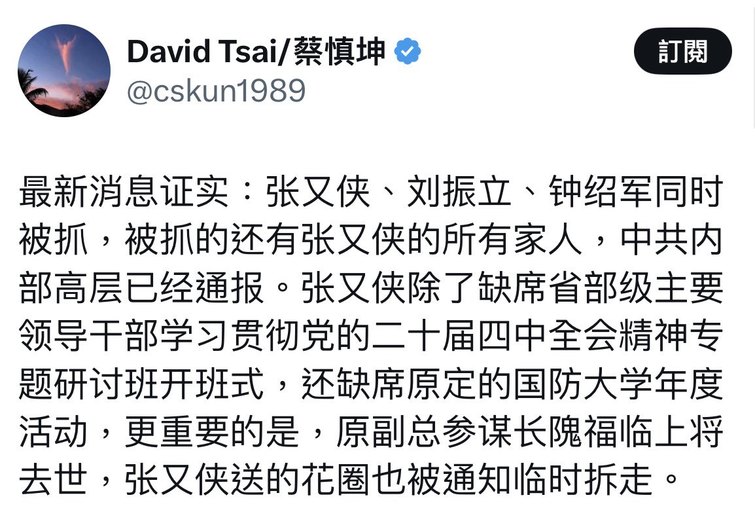
[People News] Only four days after news that Zhang Youxia, a member of the CCP Politburo and Vice Chairman of the Central Military Commission, and Liu Zhenli, a member of the Central Military Commission and Chief of the Joint Staff Department, had been arrested caused shock both inside and outside China, the CCP military website swiftly published a report on the afternoon of January 24 confirming the overseas revelations, stating that Zhang Youxia and Liu Zhenli were “suspected of serious violations of discipline and law and, after study by the Party Central Committee, have been placed under case-filing review and investigation.”
In my analysis yesterday, I expressed doubts about the arrests of the two men, but the latest news can only show that Zhang and Liu were indeed naïve: hesitation at a critical moment inevitably brings future trouble. And given that CCP senior officials are all corrupt, Zhang and Liu would likewise not be clean; being seized upon politically and taken down for political reasons is nothing unusual.
What is noteworthy is that, compared with October 17 last year, when the CCP military website only then published official announcements that nine people—including Central Military Commission Vice Chairman He Weidong, former Director of the Political Work Department Miao Hua, and former Executive Deputy Director of the Political Work Department He Hongjun—who had been missing for more than half a year or nearly a year were under investigation, and directly announced their expulsion from the Party and transfer to military procuratorial organs, this time the speed of the official announcement is indeed much faster.
Moreover, the formulaic language used in the official article announcing the arrests of He Weidong and the other nine stated: “With the approval of the Party Central Committee and the Central Military Commission, the Discipline Inspection Commission and Supervision Commission of the Central Military Commission have successively conducted…” But in officially announcing the arrests and investigations of Zhang Youxia and Liu Zhenli, normal procedures were no longer followed; it was merely stated as “after study by the Party Central Committee,” rather than “with approval,” and the Central Military Commission was excluded altogether. This is clearly inconsistent with procedure and CCP rules.
According to the official wording, the arrests of Zhang and Liu should have followed an abnormal procedure. The use of “after study by the Party Central Committee,” rather than “approval,” reveals that the arrests may not have gone through a Politburo meeting; it is highly likely they were secretly planned by Xi and his confidants such as Cai Qi, but carried out under the banner of the “Party Central Committee.” And is this “Party Central Committee” still the “Party Central Committee” referred to in the “centralized and unified leadership of the Party Central Committee” determined at last year’s Fourth Plenum?
Why such haste in making the arrests? Why such haste in officially announcing and confirming them? Is it to prevent unexpected contingencies? What contingencies? Who is anxious? Does this reflect deep-seated unease on the part of the planners?
After the downfall of CCP generals such as He Weidong, the only remaining members of the Central Military Commission were Zhang Youxia, Liu Zhenli, and Zhang Shengmin, who had just been promoted to Vice Chairman of the Commission. Arresting Zhang and Liu without going through the Commission was also part of the plan. And with the arrests of the two men, the Central Military Commission—now left with only one member—has been completely paralyzed.
Under such circumstances, do Xi and Vice Chairman Zhang Shengmin, who is mainly responsible for discipline inspection, have the ability to suppress dissatisfaction within the military? Do they have the ability to control the former subordinates of Zhang and Liu? Zhang Shengmin, who has taken down many of Xi’s military confidants as well as Zhang Youxia, plays a highly intriguing role. If he assisted Xi in arresting Zhang and Liu, then he would not be popular within the military. Moreover, lacking the real combat experience possessed by Zhang and Liu, whether he can command the generals under him is hard to say.
In addition, according to previous revelations from multiple sources and my own understanding, the CCP military has long been dissatisfied with Xi’s “blind command,” especially mid-level officers who have received higher education. Amid frequent changes at the top of the military, could localized mutinies occur?
In my view, Zhongnanhai should already be in chaos at this time. Xi’s arrest of Zhang Youxia and Liu Zhenli without following normal procedures is instead a dangerous move, because successfully making the arrests is only the first step; what follows is how Xi will face backlash from the military and within the Party.
First, for Zhang Youxia and Liu Zhenli, who have been deeply rooted in the military for many years and have numerous trusted subordinates, how will Xi stabilize their troops? By arrests? That will only trigger more dissatisfaction. By emergency promotions of military officers—but can their loyalty to him be guaranteed? If localized mutinies occur in certain theater commands, which ones will obey Xi’s orders?
Second, Xi’s goal should not be merely to regain control of the military; he should also intend to regain the status of the “sole authority.” This directly challenges CCP elders such as Hu Jintao, Wen Jiabao, and Li Ruihuan, who are rumored to have taken charge of the overall situation after Xi’s reported stroke in 2024; it challenges the central deliberative body rumored to be controlled by these elders; and it also challenges the Fourth Plenum’s consensus to weaken Xi through the “centralized and unified leadership of the Party Central Committee,” as well as the Politburo Standing Committee members and Politburo members who have accepted this and already put it into practice.
Will these people continue to accept Xi’s actions that undermine internal Party rules? If they do not accept them, what methods will Xi adopt to suppress and purge them? And will the anti-Xi faction, for the sake of its own safety, abandon protecting the Party and protecting Xi?
Third, the frequent arrests of top CCP military leaders not only make the regime a laughingstock for the world and the nation’s people, but also cause people to seriously doubt the combat effectiveness of the CCP military. Can an army composed of corrupt generals win a real war?
As I stated in my previous analysis, if Xi exploits the “naïveté” and lapses of Zhang and Liu to successfully arrest them but cannot resolve the subsequent problems within the military and the Party—thereby forcing the military into rebellion—the CCP is destined for chaos from within. Xi’s fate will be extremely tragic, and this will inevitably accelerate the CCP’s disintegration.
Recently, I saw that some netizens observed astronomical phenomena at night and discovered that around January 10 this year, Venus, Mercury, and Mars appeared clustered near the Southern Dipper. The gathering of three stars at the Southern Dipper is an ominous sign. The Kaiyuan Zhanjing, citing Gan Shi, says: “If three stars converge, it is called startling upheaval; travel ceases; there is internal disorder within the state.” It also says: “If the five planets and three or more stars gather in one lodge, that state may become king.” However, in this gathering, the three stars are Venus, Mercury, and Mars; fire overcomes metal, and water insults fire, indicating extremely heavy murderous and warlike energy. The six stars of the Southern Dipper are also called the “Heavenly Temple.” When three stars gather at the Heavenly Temple, it is like a great army entering the temple, an omen of worry for the ruler’s position.
Whether this is so remains to be seen by continuing to observe the CCP political situation; beyond that, one can look up at the starry sky and find the advance warnings given to us by Heaven.
(First published by People News) △





News magazine bootstrap themes!
I like this themes, fast loading and look profesional
Thank you Carlos!
You're welcome!
Please support me with give positive rating!
Yes Sure!