

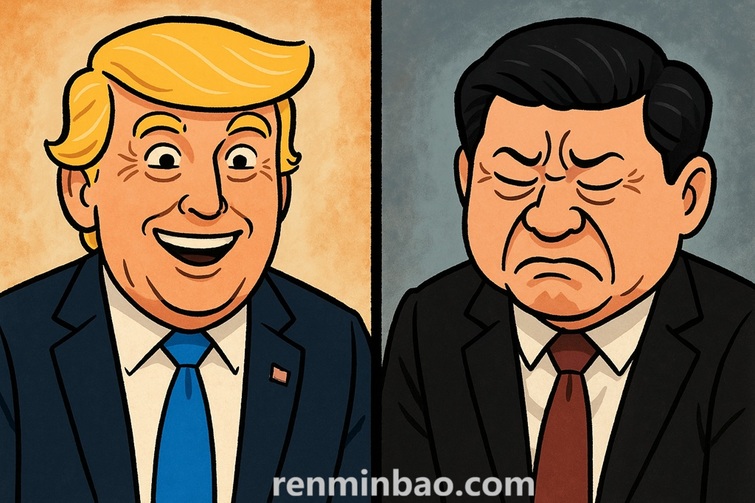
Trump’s “four-arrow strategy” is like a final kick, pushing Xi into the final stage of his rule.
[People News] Currently, there are rumours that Secretary of State Marco Rubio will accompany President Trump on his visit to China, which adds more intrigue and uncertainty to the upcoming Beijing Xi-Trump meeting. This means that Beijing will have to roll out the red carpet for Rubio, who has been labelled 'unwelcome' on two occasions, and treat him as a distinguished guest.
The White House has recently confirmed that President Trump will visit China. Analysts suggest that what was initially intended by Xi Jinping as a 'diplomatic victory' is now turning into a 'diplomatic nightmare' for him. Rubio's participation could become a significant aspect of Xi's 'diplomatic nightmare.'
According to the South China Morning Post, Rubio was initially not very interested in joining Trump on the trip to China and even considered not going, but he eventually changed his mind.
International media are closely watching: if the U.S. Secretary of State, who was once publicly 'sanctioned and banned from entry' by the Chinese Communist Party, walks into the Great Hall of the People or even Zhongnanhai alongside the President, how will the CCP manage to save face? This is likely the most embarrassing and troubling issue for the Beijing authorities.
On the surface, it appears that Rubio, given the significance of this summit, clearly does not want to miss out. His underlying strategy may involve observing how the CCP handles the two sanctions imposed on him.
Rubio, born into a family that fled to the United States due to persecution by the Cuban Communist Party, has a profound understanding of the evils of communism. His inherent anti-communist disposition makes him fundamentally opposed to the Communist Party, positioning him as a staunch anti-communist warrior. He once described China as 'the most powerful and dangerous opponent' of the United States. During the Trump 1.0 era, Rubio was involved in an astonishing 386 anti-China proposals in just 2019, earning him the moniker 'King of Anti-China Proposals.'
As the current U.S. Secretary of State, Rubio was a prominent 'anti-China vanguard' during his time as a federal senator. Over the years, he has crossed nearly every 'red line' in U.S.-China relations:
He supported the Hong Kong 'anti-extradition' movement; advocated for the democratically elected government of the Republic of China (Taiwan); voiced support for the struggles of the people in Xinjiang and Tibet; and strongly backed the U.S.-China trade war, even proposing to eliminate normal trade relations between the U.S. and China, along with suggesting imposing steep tariffs ranging from 35% to 100% on Chinese goods. He opposes American investments in China, frequently condemning China's practices of 'intellectual property theft' and revealing the truth about Huawei as a 'patent rogue.' Rubio has also taken a particularly hard stance on China's behaviour during their attendance at Trump's inauguration.
Furthermore, Rubio has consistently criticised Confucius Institutes in public forums, highlighting the underlying agenda of their infiltration under the pretence of promoting Confucius' teachings for united front work.
Marco Rubio has consistently crossed the red lines established by the Chinese Communist Party (CCP), provoking its ire by addressing sensitive issues. In July and August 2020, the CCP imposed sanctions on then U.S. Senator Marco Rubio on two occasions. On August 10, 2020, the Chinese Ministry of Foreign Affairs announced secondary sanctions against him. The sanctions were justified by his 'poor performance' regarding Hong Kong issues, his promotion of several anti-China bills, and his blatant interference in China's internal affairs. The sanctions included: a ban on him and his family from entering mainland China, Hong Kong, and Macau; freezing all his assets in China; and prohibiting any transactions or cooperation between Chinese entities and him.
On January 20, 2025, Trump officially returned to the White House for a second term and immediately appointed Rubio as Secretary of State. That same day, the U.S. Senate confirmed Rubio's appointment with a unanimous vote of 99 in favour and none against.
Following this, at a press conference on the 21st, a spokesperson for the Chinese Ministry of Foreign Affairs stated: China will firmly protect its national interests, while it is necessary for high-level officials from both China and the U.S. to maintain appropriate contact.' This statement indirectly refuted rumours that the CCP would lift sanctions against Rubio.
In February 2026, Rubio, serving as Secretary of State, met with Chinese Foreign Minister Wang Yi in a closed-door session at the Munich Security Conference to prepare for Trump's upcoming visit to China. Due to the ongoing sanctions, Rubio's visit required a temporary exemption from the Chinese authorities.
If Beijing were to lift the sanctions on Rubio (granting a temporary exemption) before Trump’s visit to China, it would essentially mean that Beijing is admitting its sanctions are nothing more than a worthless piece of paper, lacking both value and dignity. This would suggest that Xi Jinping is once again lowering his stance towards Trump, further reducing the bargaining chips on the Sino-U.S. negotiation table.
On platform X, a user named @Ken_LoveTW posted on March 14, saying, 'Xi Jinping initially invited Trump in hopes that this visit would be seen as a significant diplomatic victory. However, it is now turning into a humiliation.'
As a result of his crackdown on the military, Xi Jinping has nearly eliminated several generals, and after being labelled 'the Emperor of Half-Baked Projects' and 'the Accelerator,' he has now earned the latest nickname 'General Slayer.' His wolf warrior diplomacy has created enemies on all fronts, and with both internal and external challenges, it is said that he has even lost some weight around his midsection.
In contrast, Trump has made notable strides in both domestic and foreign policy during his first year in the White House. Capturing Maduro, sending Khamenei off, and initiating the end of the Cuban regime have all dealt heavy blows to Xi Jinping.
Thus, the Beijing-Xi meeting is destined to be a handshake between a victor and a loser; when Xi Jinping shakes Trump’s hand, he is grasping the very hand that has struck him, and that feeling is truly difficult to articulate.
Furthermore, Rubio's presence adds to Xi Jinping's discomfort. Beijing may now be regretting the sanctions it imposed on Rubio; had they known how things would turn out, why act that way in the first place?
△





News magazine bootstrap themes!
I like this themes, fast loading and look profesional
Thank you Carlos!
You're welcome!
Please support me with give positive rating!
Yes Sure!