
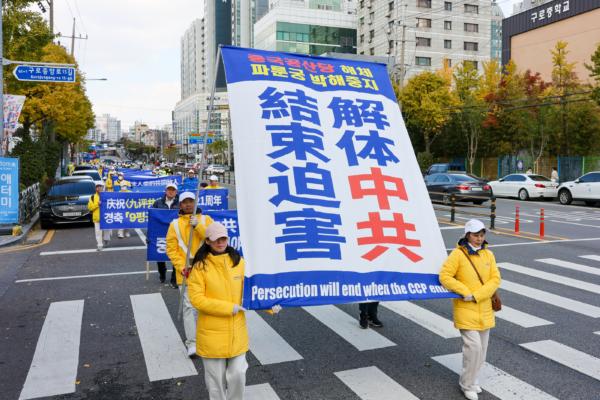
A parade celebrating the Three Withdrawls in South Korea
[People News]In 2025, a set of numbers emerged in China that are difficult to ignore, yet impossible to discuss within official narratives.
According to annual statistics from the Global Service Center for Quitting the CCP, a total of 15,494,903 people publicly declared their withdrawal from the Chinese Communist Party (CCP), the Communist Youth League, and the Young Pioneers in 2025. This averages 42,452 people per day, or about 1,291,242 per month. Since 2004, the cumulative number of withdrawals has exceeded 456 million.
Behind the Numbers: A “Withdrawal Wave” Without the Streets
This is not the peak of a political movement. There are no rallies, no leaders, and no organized mobilization. The setting for these “Three Withdrawals” is mostly anonymous statements, private expressions, and value choices made within families.
Because of its dispersed, low-profile, and long-term nature, this movement resembles a slow yet clear curve of public sentiment. It does not seek to change the regime, but rather refuses to continue being psychologically affiliated with a system viewed as illegitimate.
What Is “Three Withdrawals”?
“Three Withdrawals” refers to withdrawing from the CCP, the Communist Youth League, and the Young Pioneers. It began in 2005, initiated by Falun Gong practitioners. Its core demand is not to establish a new political organization, but to withdraw moral and psychological endorsement of CCP-affiliated organizations. The basic form is a voluntary statement, anonymous or real-name, without requiring collective action.
The Moral Consequences of Persecution
To understand the moral meaning of the “Three Withdrawals,” one must revisit a frequently underestimated historical background: since 1999, the CCP’s systematic persecution of Falun Gong has lasted for 26 years.
The impact of this persecution extends far beyond a specific belief group. It has gradually penetrated social operations, value judgments, and moral psychology. According to analysis by Minghui.org, this represents an ongoing process of reshaping society’s moral bottom line.
Several key shifts stand out:
-
Institutionalization of Lies
Official narratives in major events prioritize “political conclusions before facts.” Over time, truth no longer forms the basis of public discussion, replaced instead by the CCP’s political stance over verification and conscience. -
Erosion of Professional Ethics
When medical, legal, and educational sectors are required to serve political persecution tasks, traditional professional ethics give way to obedience and fear. -
Bystanding Becomes Rational
In a high-pressure environment, compassion, assistance, and adherence to principles are viewed as high-risk behaviors. Indifference is gradually rationalized as self-protection.
When a group advocating “Truthfulness, Compassion, and Forbearance” is demonized and suppressed, society receives the opposite message: sincerity may bring danger, kindness has no reward, and tolerance earns no respect.
This “reverse demonstration effect” gradually erodes the moral consensus of society.
From the Cultural Revolution to Today: Two Major Moral Ruptures in Chinese Society
-
The Cultural Revolution (1966–1976): Severed traditional culture and ethical order
-
Persecution of Falun Gong (1999–present): Reshaped definitions of “what is safe” and “what is right” under modern conditions
Common result: morality is no longer a shared social foundation but an individual risk.
The Essence of “Three Withdrawals”: Not Power Politics but Moral Separation
Against this background, the positioning of the “Three Withdrawals” movement becomes clearer.
It is not political mobilization aimed at regime change, but a grassroots moral action initiated by Falun Gong practitioners, centered on conscience. Its logic is straightforward: when individuals have been compelled to swear loyalty, drawn into collective responsibility for wrongdoing, or pressured to accept injustice, withdrawal becomes a way to revoke moral participation.
In 2025, withdrawal statements show clear practical and moral characteristics:
-
Reasons for withdrawal increasingly reference unemployment, medical hardship, propaganda disillusionment, and concern for the next generation, rather than political theory.
-
Words such as “conscience,” “karma,” and “not wanting to be an accomplice” appear more frequently.
-
Withdrawal is described as “peace of mind” or “leaving a path for one’s family.”
This suggests that more people see the “Three Withdrawals” as a way to reposition themselves morally in a society where ethical boundaries have been steadily lowered.
Data Signals: Three Characteristics of the 2025 Withdrawals
-
Sustained High Levels: No sign of decline
-
Broadening Base: Increasing participation from ordinary workers and family-level motivations
-
Language Shift: From political language toward ethical and everyday-life expressions
A Silent Boundary: The Social Turn Marked by Withdrawal
The “Three Withdrawals” have not caused immediate political upheaval, but they are forming a quiet yet clear social dividing line.
On one side is a sense of safety maintained through obedience, silence, and self-censorship. On the other side is withdrawal as a declaration: I will no longer provide psychological or moral support to this system.
From this perspective, the 2025 figures are more than annual statistics—they are a signal. Amid moral erosion caused by prolonged repression, some people are attempting self-repair in the gentlest and most individualized way possible.
As one frequently repeated sentence in withdrawal statements summarizes:
“Not seeking to change anything—only not to stand with it anymore.”
This may be the most essential—and hardest to ignore—meaning of the “Three Withdrawals” today.
△




News magazine bootstrap themes!
I like this themes, fast loading and look profesional
Thank you Carlos!
You're welcome!
Please support me with give positive rating!
Yes Sure!