

Zhang Youxia, Vice Chairman of the Central Military Commission of the Communist Party of China, remarked that Xi&9;s faction has been entirely apprehended. (Video screenshot)
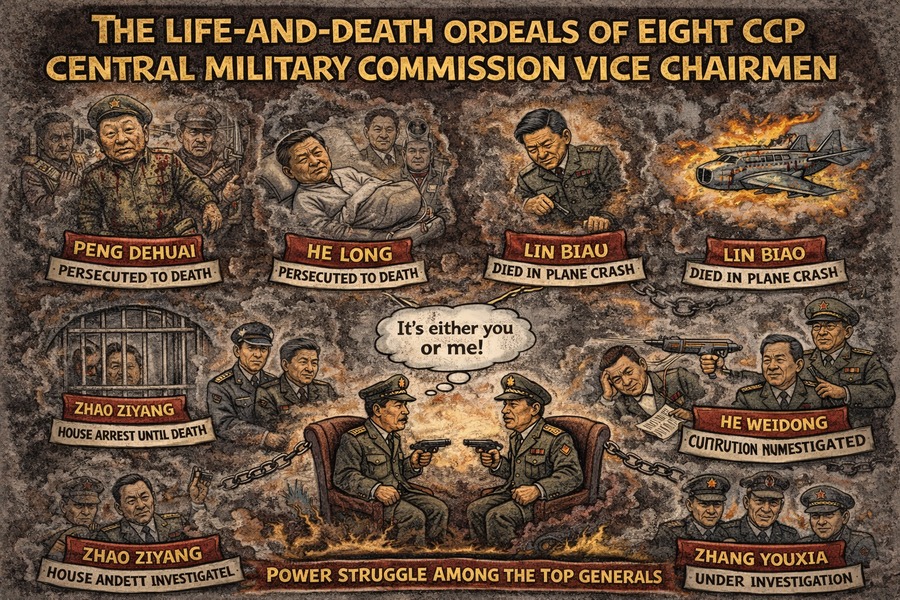
[People News] Following the reported downfall of Zhang Youxia, a vice chair of the Chinese Communist Party’s (CCP) Central Military Commission (CMC), outside observers note that the position itself appears increasingly dangerous. Since the CCP came to power, as many as nine CMC vice chairs have reportedly been purged in political struggles.
U.S.-based commentator Chen Pokong said that in democratic countries, the military belongs to the nation, but under CCP rule it functions as a party army — and in practice, the top leader’s personal force. He described the CCP system as a “meat grinder,” arguing that not only ordinary citizens but even top officials eventually become its victims. He added that Xi Jinping himself is now racing down that same path.
Australia-based legal scholar Yuan Hongbing made a similar analogy, saying the CCP political system operates like a giant grinder pulling in ever more officials. In his view, Xi’s repeated large-scale purges, intended to consolidate personal authority, are instead weakening the regime’s foundations.
Signs of Strain Inside the CMC
According to multiple sources cited by overseas Chinese-language media, the CMC’s internal operations have shown unusual changes in recent years amid an ongoing purge of senior officers. Several generals in command roles have reportedly been removed, and observers claim that only a very small number of top figures now remain active in day-to-day CMC operations.
People described as familiar with PLA structures say the role of CMC vice chairs has traditionally been to bridge top decision-makers and the operational chain of command. They participate in high-level deliberations while also ensuring policies are implemented across services, theater commands, and departments. Public appearances by vice chairs at key meetings and inspections have long been viewed as signals of stable command authority.
Military affairs scholar “Mr. Liang” (pseudonym) said that in the PLA system, extreme centralization does not automatically mean smooth functioning. Instead, mid-to-upper layers such as vice chairs are needed to absorb coordination pressure. “The vice chair position is functional, not decorative,” he said, especially during periods of instability or restructuring.
Public reporting in recent years showed that although authority has become more centralized, vice chairs like Zhang Youxia were still heavily involved in implementing reforms and stabilizing systems during major military restructurings.
Fewer Public Signals, More Uncertainty
After Zhang’s case surfaced, state media portrayals of top military leadership activity appeared to change. In events where multiple CMC leaders previously appeared together, vice chairs and other members have been seen less frequently.
Another military scholar, “Mr. Liu,” noted that in highly centralized systems, public appearances themselves function as organizational signals. “Who shows up — and who doesn’t — tells the force where authority is flowing,” he said. If vice chairs disappear from view for long periods,基层 units may hesitate, slowing execution while waiting for clearer direction.
Political commentator “Jin Zhe” (pseudonym) said that while the system can technically operate without specific individuals, the absence of established coordination nodes affects tempo. Pressure that was once distributed becomes concentrated at the very top — primarily on Xi Jinping and a shrinking number of senior aides.
He added that many mid- and lower-level officers developed work routines tied to particular leaders. When those figures suddenly vanish, transmission of orders can slow and feedback loops lengthen.
“In this condition,” he said, “the military is like a sports car whose engine is still running — but it can’t accelerate at full speed.”
Overall, analysts cited in these reports argue that the vice chair role — once a powerful and prestigious stepping stone — now appears politically perilous, reflecting deeper tensions inside the CCP’s command system.△






News magazine bootstrap themes!
I like this themes, fast loading and look profesional
Thank you Carlos!
You're welcome!
Please support me with give positive rating!
Yes Sure!