
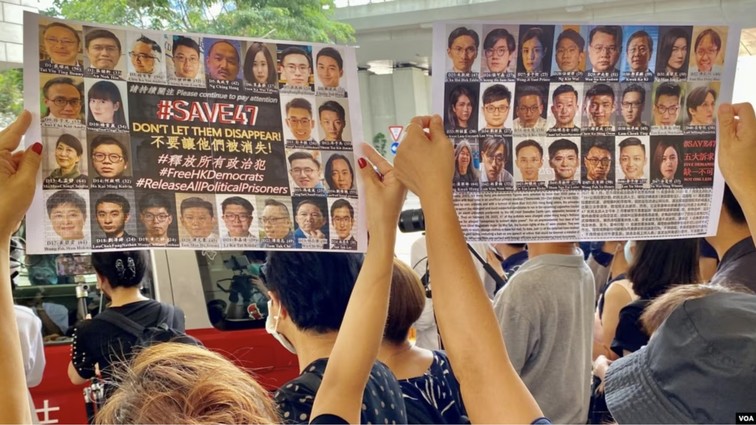
Photo: On January 17, 2023, prior to the trial of 16 defendants who pleaded not guilty in the democratic primary '47 People Case', supporters protested by holding banners featuring their photos, calling out 'Do not let them disappear!' (VOA)
[People News] On Monday, February 23, the Appeal Court of the Hong Kong High Court dismissed the appeals of 12 convicted defendants in the democratic primary '47 People Case' concerning their convictions or sentences. Human rights organisations criticised the Hong Kong authorities for 'missing the opportunity to rectify unjust rulings' and urged the release of all 47 individuals.
Appeals of 12 Defendants Rejected by Authorities
According to reports from Voice of America, the 12 defendants whose appeals were rejected include former Legislative Council member Leung Kwok-hung, known as 'Long Hair', former Kowloon West Legislative Council member Wong Pik-wan, former BBC Chinese and Stand News reporter Ho Kwai-lam, and former North District Council member and former vice-chairman of the Democratic Party Lam Cheuk-ting. Other defendants who filed appeals include Chow Ka-shing, Ng Cheng-hang, Yu Wai-ming, Ho Kai-ming, Chan Chi-chuen, Cheng Tat-hung, Yang Suet-ying, and Wong Tze-yuet, among others.
According to the Hong Kong government news website, the judges of the Court of Appeal concluded that the defendants' planning of the primary election aimed to force the Chief Executive of Hong Kong to resign, paralyze the government, compel the central government to declare an end to 'one country, two systems', and even subvert the constitutional order of the Hong Kong Special Administrative Region. As a result, their appeal against the conviction was denied. Regarding the appropriateness of the sentence, the court stated that the original trial's sentencing benchmark of seven years was not obviously excessive, and therefore did not grant a reduction in the defendants' sentences.
Following the unsuccessful appeal, the 12 defendants will serve their sentences as previously determined by the High Court, which range from four years and five months to seven years and nine months.
Additionally, the Hong Kong Department of Justice's appeal against the acquittal of Liu Wei Cong (Liu Weicong) in the original trial was also dismissed by the Court of Appeal, which upheld the not guilty verdict. However, as reported by the Hong Kong government news website, the Department of Justice will 'carefully review the judgment and consider whether to file an appeal'.
Human Rights Organizations: A Missed Opportunity for Correction
After the Hong Kong Court of Appeal rejected the appeals of the aforementioned 12 defendants, Zhang Chao Xiong, spokesperson for the Hong Kong branch of Amnesty International, issued a statement saying: 'Today's court ruling to reject the appeal once again underscores the dire human rights situation in Hong Kong and reveals the nature of the large-scale political prosecution in the case of the 47.'
The statement further noted, 'These 12 defendants have not committed any internationally recognised crimes; they have been sentenced to long-term imprisonment solely for exercising their rights to freedom of expression, freedom of association, and participation in public affairs.'
The statement indicated that the court's failure to overturn these wrongful convictions and sentences represented a "missed opportunity to rectify this large-scale injustice." It stressed that peacefully opposing the government is not a crime and called for "the authorities to immediately and unconditionally release all those still detained in the '47-person case.'"
The '47-person case' pertains to the prosecution of 47 pro-democracy figures in Hong Kong, who were charged under the Hong Kong National Security Law for allegedly 'conspiring to subvert state power' and subsequently convicted. This case, also known as the 'pan-democratic primary case,' is the largest national security case since the Chinese Communist Party enacted the National Security Law in Hong Kong in 2020, involving nearly all prominent political leaders and activists from the pro-democracy camp.
In November 2024, the authorities handed down sentences in the '47-person case,' which attracted global attention. At that time, the U.S. government issued a strong condemnation of the severe sentences imposed on 45 individuals simply for "peacefully participating in political activities protected by the Hong Kong Basic Law," and introduced new visa restrictions on several Hong Kong officials responsible for enforcing the National Security Law. As of the time of this report, the U.S. State Department had not responded to a request for comment from Voice of America (VOA) regarding the rejection of appeals for 12 defendants on Monday.
Case Overview
In 2019, following the outbreak of the anti-extradition movement in Hong Kong, the pro-democracy camp achieved a significant victory in the district council elections. Hong Kong legal scholar Dai Yaoting proposed that the pro-democracy camp should aim to secure a majority in the Legislative Council elections, specifically more than 35 seats, a strategy referred to as the '35+ plan.'
On July 1, 2020, China began the enforcement of the "Hong Kong National Security Law," which states that anyone who organises, plans, executes, or participates in actions aimed at subverting state power through force, threats of force, or other illegal means is guilty of the crime of subverting state power.
In the same month, the pro-democracy camp in Hong Kong held a primary election that saw participation from hundreds of thousands of voters. The authorities labelled this primary election as a subversive crime.
Amnesty International reported that the Chinese Communist Party (CCP) authorities perceive the primary elections organised by political parties as a genuine threat to the survival, territorial integrity, or political independence of Hong Kong. However, this "does not align with the high standards set by international human rights norms for applying 'national security' crimes."
In early 2021, Hong Kong police arrested 55 individuals involved in the Legislative Council primary election activities, with 47 of them later charged with "conspiracy to subvert state power." In 2023, the authorities formally tried the "47-person case," which lasted 118 days, resulting in 31 of the 47 pleading guilty and 16 maintaining their innocence.
In November 2024, the Hong Kong court delivered its verdict on the case. Aside from two individuals who were acquitted, the remaining 14 who pleaded not guilty were convicted. Among them, Hong Kong legal scholar Dai Yaoting, considered by the Hong Kong government as the "brain and main driving force," received the longest sentence of 10 years; activist Zou Jiacheng was sentenced to seven years and nine months; former district council member Au Nok-hin received six years and nine months; and former Secretary-General of the Hong Kong Alliance, Joshua Wong, was sentenced to four years and eight months. Twelve of the "convicted defendants" have appealed their convictions and sentences.
△








News magazine bootstrap themes!
I like this themes, fast loading and look profesional
Thank you Carlos!
You're welcome!
Please support me with give positive rating!
Yes Sure!