
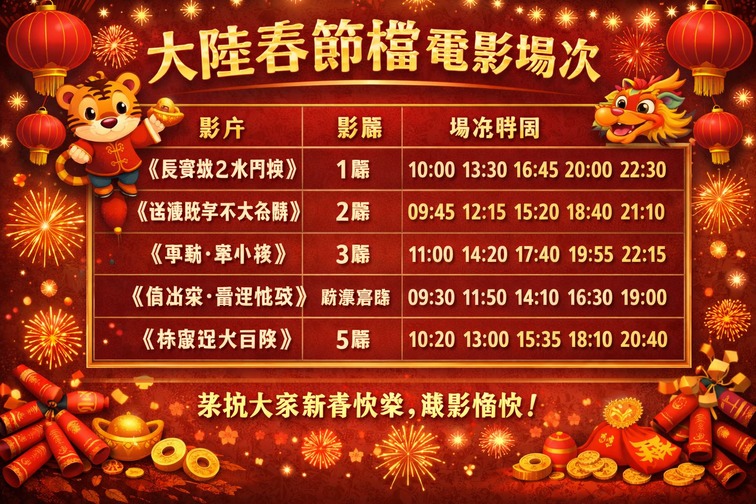
Film screenings during the Spring Festival in Mainland China (made by ChatGPT)
[People News] According to a report by the China Youth Daily on February 21, following the release of the 2026 Spring Festival movie data, data from Maoyan Professional Edition indicated that as of February 21, the total number of Spring Festival screenings exceeded 3.947 million, setting a historical record. The cumulative box office during this period was 3.932 billion yuan, reflecting a year-on-year decrease of approximately 58%, bringing it back to levels seen around 2017.
As reported by Radio Free Asia, by 6 PM on February 22 (the sixth day of the Lunar New Year), official updated data revealed that this year's Spring Festival box office had risen to 5 billion yuan. In comparison, the figures for previous years were 9.510 billion yuan in 2025, 8.016 billion yuan in 2024, 6.765 billion yuan in 2023, 6.039 billion yuan in 2022, 5.771 billion yuan in 2018, and 3.419 billion yuan in 2017. While the Spring Festival box office has generally shown an upward trend in recent years, this year has seen a notable decline, falling below the peaks of the last two years and also below the levels during the pandemic, approaching the figures from around 2017.
In light of this, Chinese film producer Nan Ping (pseudonym) commented in an interview with Radio Free Asia that this year's Spring Festival should not only focus on the number of screenings but also consider the number of viewers, as this is crucial for determining box office revenue. He stated, "The essence of the Spring Festival is not merely the number of screenings, but the efficiency of each screening. An increase in screenings during peak season should ideally coincide with a rise in audience numbers and box office revenue. If there is a disconnect between the two, it suggests that the film's appeal to the audience is lacking, or that there has been a shift in residents' willingness to spend."
Average Attendance of 20 People Diluted by Holiday Box Office
According to Nanping, the total number of moviegoers during this year's Spring Festival was 80.723 million. With 3.947 million screenings recorded as of February 21, this translates to approximately 20.4 attendees per screening, meaning the average audience size is about 20 people. During the same period, the box office revenue of 3.932 billion yuan, when divided by 3.947 million screenings, results in an average income of about 996 yuan per screening. This data indicates a basic correlation between attendance numbers, ticket prices, and box office revenue.
Nanping suggests that if we consider most cinemas with 100 to 150 seats, using 120 seats as an example, 20 audience members would correspond to an occupancy rate of around 16.7%, with overall rates ranging between 15% and 20%. He remarked, "The Spring Festival period has always been the peak time for cinema utilisation. This year, the screening schedule reached its highest point, yet the number of viewers per screening remains relatively low."
Li Chuncheng, a researcher at the China Film Archive, stated in an interview with Radio Free Asia that, based on data from February 21, this year's box office is approximately 40% of last year's figures: "Last year's box office revenue was 9.5 billion yuan, while this year it has fallen to 3.9 billion yuan. Nearly all films released are domestic productions, with no major imported films entering the main schedule. Genres such as science fiction, military action, comedy, and animation are predominantly produced by local companies, often featuring mainstream themes, and their box office performance is below that of previous years."
From IP-driven to aesthetic fatigue, the industry faces challenges
Public data indicates that the films set to be released during the 2025 Spring Festival include "Ne Zha: The Devil's Child" (Na Zha Zhi Mo Tong Nao Hai), "Detective Chinatown 3" (Tang Tan 1900), "The Investiture of the Gods Part 2: The Battle of West Qi" (Feng Shen Di Er Bu: Zhan Huo Xi Qi), "The Legend of the Condor Heroes: The Great Hero" (She Diao Ying Xiong Zhuan: Xia Zhi Da Zhe), "Boonie Bears: The Future Reboot" (Xiong Chumo: Chong Qi Wei Lai), and "Operation Dragon" (Jiao Long Xing Dong), among others, many of which are sequels or part of established franchises. According to data from the National Film Administration, the box office for this period reached 9.51 billion yuan, with 187 million admissions, setting a historical record for the Spring Festival. The concentration of major films being released has significantly boosted box office performance.
In contrast, while the number of screenings for the 2026 Spring Festival has reached a new high, there has been a shift in the film lineup. Notable titles include "Racing Life 3" (Fei Chi Ren Sheng 3), directed by Han Han and starring Shen Teng, "Silent Awakening" (Jing Zhe Wu Sheng), produced by Zhang Yimou, as well as "The Courier: Winds Rise in the Desert" (Biao Ren: Feng Qi Da Mo) and "Boonie Bears: Year of the Bear" (Xiong Chumo: Nian Nian You Xiong). The overall film lineup has not achieved the same concentration effect as seen in 2025.
According to data from Maoyan Professional Edition, as of 6 PM on February 22, the total box office for the 2026 Spring Festival has exceeded 5 billion yuan. Although the number of screenings has increased, the number of admissions and per-screen revenue have not risen correspondingly, suggesting that the increase in screenings has not translated into a proportional increase in viewership.
Mainstream sequels are struggling to maintain their prominence
Mr Gu (Gu Xiansheng), a retired teacher from the Cultural Industry Research Institute at Peking University, shared in an interview with Radio Free Asia that the number of screenings during the Spring Festival has reached a record high. However, the audience attendance for each screening is below 20 people, highlighting a shift in market structure. He remarked, "The film market is not sustained by the number of screenings, but rather by the audience's willingness to attend. Despite nearly 4 million screenings, the box office has reverted to levels seen in 2017. This issue is not technical; it reflects a disconnect between content and reality."
Mr Gu believes that if audiences were willing to purchase tickets, attendance rates would not linger around 10% or 20%. "The current data illustrates not only market competition but also the active choices made by viewers," he explained. He pointed out that this year, the structure of cultural consumption is shifting, as evidenced by changes in sales at Xinhua Bookstore, where sales of promotional books have slowed, while popular reading materials are seeing increased demand.
He emphasised that the Spring Festival period has traditionally been viewed as a crucial indicator of film market trends. The data from this year suggests that when films fail to resonate with audiences, the sheer number of screenings does not automatically lead to effective viewership, and market responses will be directly reflected in box office earnings and attendance rates.
△








News magazine bootstrap themes!
I like this themes, fast loading and look profesional
Thank you Carlos!
You're welcome!
Please support me with give positive rating!
Yes Sure!