
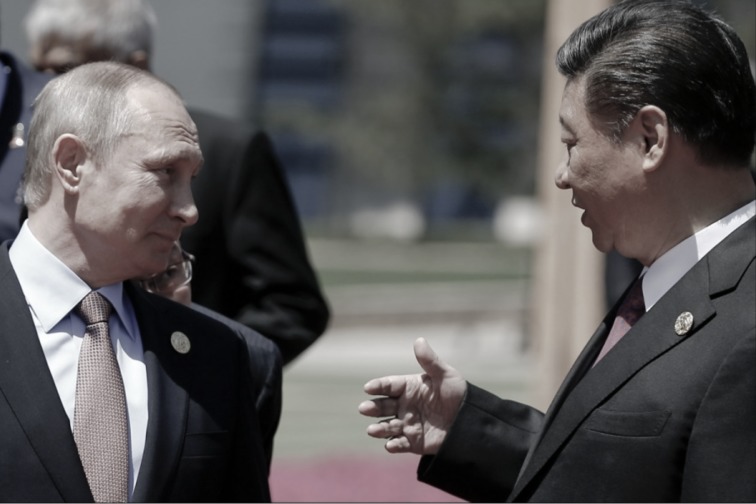
File Photo: Putin and Xi Jinping Posing for a Photograph
[People News] The war in the Middle East is intensifying, and Iran is seeking peace. The Chinese Communist Party (CCP) has sent special envoys to Iran, while both Russia and the CCP are providing political and other forms of support to the country. What is the purpose of the CCP's special envoy's visit to Iran? What kind of support is being extended to Iran? Will the CCP and Russia get drawn into the war? Could the Middle East act as a powder keg, igniting the outbreak of a third world war?
Escalation of the Middle East War
On March 6, Ukrainian President Volodymyr Zelensky announced the dispatch of drone technology to support the US-Israel coalition. Earlier, British Prime Minister Keir Starmer had publicly expressed his agreement for the US to utilise British military bases. However, less than an hour after his statement, a massive explosion was reported at the Akrotiri Air Base in southern Cyprus. The British Daily Mail disclosed that the base was likely attacked by Iranian drones. British officials indicated that the UK 'has not ruled out the possibility of future involvement in strikes against Iranian ballistic missile launch sites.'
Iran not only retaliated against Qatar but also launched indiscriminate attacks on several countries in the Middle East. On the 5th, it carried out a drone strike on an international airport in Azerbaijan. However, neighbouring countries quickly responded, indicating that the conflict has now expanded beyond the Middle East.
Following devastating strikes from the US and Israel, members of the Islamic Revolutionary Guard Corps, who had previously been involved in the massacre of protesting citizens, sought refuge in schools, using students and teachers as human shields.
To avoid airstrikes, a spokesperson for the Islamic regime held a press conference in a school classroom, carelessly putting more children at risk in the ongoing war. An Iranian internet user shared the video of this event and provided the coordinates of the school building to the Israel Defence Forces, commenting, 'Don't let a bad guy escape.'
The Chinese Communist Party Sends Envoys to the Middle East for Diplomatic Maneuvering.
On March 5, U.S. President Trump disclosed at the White House that Iran is seeking negotiations, but he believes it is now "too late." Trump stated, "They have been calling, asking how to reach an agreement, and I told them, you are a bit late. Now we want to go to war more than they do."
In this context, the Chinese Communist Party has dispatched envoys to the Middle East to mediate and "de-escalate the situation." This raises questions about whether the CCP's actions are intended to advocate for Iran and provide covert support.
On March 5, Chinese Foreign Ministry spokesperson Mao Ning announced at a regular press conference that China (the CCP) will send Middle East special envoy Zhai Jun to visit the region soon, aiming to promote a reduction in tensions.
So, who is Zhai Jun? According to Wikipedia, he has held various diplomatic positions within the CCP for many years, serving as Deputy Minister of Foreign Affairs in 2009. In January 2014, he was appointed Ambassador to France, and in September 2019, he became the special envoy for Middle East issues.
What will he do in the Middle East? How will he approach this task? To what extent will he mediate in the U.S.-Israel-Iran conflict? An EFE reporter pressed for details, asking when China plans to send the envoy to the Middle East and what authority he will have to conduct the mediation.
Mao Ning employed a delaying tactic, stating: We will release information in due course.
On March 6, during a press conference at the Chinese Foreign Ministry, a Bloomberg reporter inquired: The Iranian Foreign Minister has stated that Russia and China are providing political and other forms of support to Iran. What specific support has China provided, and does it include military or dual-use material assistance?
Spokesperson Mao Ning responded indirectly, stating that China opposes the violations of international law by the United States and Israel, as well as their military actions against Iran, and supports Iran in defending its sovereignty, security, and territorial integrity, among other things. Mao Ning's response seems to hint at some unspoken challenges faced by the Chinese Communist Party (CCP).
However, speculation from outside sources suggests that Zhai Jun may be carrying directives from the highest levels to offer support to Iran. This political backing essentially means endorsing the theocratic dictatorship that merges Islam with governance. In terms of military or weapon support, what specific actions will the CCP take, and what are its objectives? Mao Ning's evasive response only deepens the suspicion.
Beijing's so-called 'strong condemnation' and 'firm opposition' to the US-Israel coalition imply that the CCP has likely received multiple requests for assistance from Iran. Now, as Iran appears to be struggling, it cannot be ignored, but overt military support would make it a target for criticism. Thus, the CCP may have to plan its actions in secret.
Interestingly, Iran has clearly stated that it currently does not require financial support from Beijing.
The United Morning Post cited a statement from the Iranian Embassy in China, released on March 5 via its WeChat public account, which indicated that, based on a careful assessment of its current national capabilities, the Islamic Republic of Iran does not plan to accept financial assistance from friendly organisations and individuals in China at this time. If circumstances change in the future and assistance becomes necessary, they will notify accordingly.
In other words, the CCP's offers of financial support have been rejected by Iran, possibly because what they need more is military strength.
So, will the CCP provide military support and weapons?
Will the Chinese Communist Party (CCP) provide military forces and weapons to Iran?
The CCP is Iran’s most important economic partner, purchasing about 90% of Iran’s oil and providing a financial lifeline to this heavily sanctioned regime. According to a report by the U.S.–China Economic and Security Review Commission, over the past eight years, more than 100 entities from mainland China and Hong Kong have been placed on the U.S. Entity List for helping Iran evade export controls.
On March 5, a statement from the Iranian embassy used wording similar to that of the CCP, speaking as if it represented the entire nation and repeatedly describing the CCP state as “civilised,” “just,” and “humanitarian.” Iran said it would “remember the friendship.” Even without mentioning the strategic cooperation agreement signed between the CCP and Iran a few years ago—which included $400 billion in investment—nor Iran’s joining of CCP-led organizations such as the Shanghai Cooperation Organization, the BRICS bloc, and the Belt and Road Initiative, the information above already shows that the depth and breadth of interaction between the CCP and Iran in the past is something ordinary countries can hardly imagine.
However, the CCP and Iran have both been described by Western developed countries’ political leaders as two of the world’s four “axes of evil.” When evil forces associate with each other, they gather for profit and disperse for profit, and the relationship is exclusive in nature. What does that mean? It means they use each other. When disaster strikes, they will despise each other—if not even push the other down further. As U.S. and Israeli airstrikes on Iran intensify, the CCP has so far limited itself to verbal statements, and the outside world has seen almost no indication of any Chinese national defence support for Tehran.
On the contrary, relationships among such “evil partners” often involve ingratitude. When dealing with countries that are more beneficial to them, they may even betray good friends and old friends. For example, the CCP maintains productive relations with Iran’s regional competitors, including Saudi Arabia and the United Arab Emirates. Within groups of Arab countries that Iran views as rivals, the CCP consistently plays a balancing game.
When Xi Jinping visited Saudi Arabia in 2022, he did not visit Iran as he had during his Middle East trip in 2016. Xi Jinping and Saudi Arabia issued a joint statement criticising Tehran for “activities that undermine regional stability” and for “supporting terrorism and sectarian groups.” Afterwards, some Iranian lawmakers and officials strongly criticised the trip.
Just as North Korea sometimes calls the CCP a “millennia-long enemy” and sometimes praises it as a “friendship forged in blood,” whether a country is a friend or an enemy can change according to interests. Similarly, in the 1960s and 1970s, the CCP sometimes called the Soviet Union its “big brother,” and sometimes denounced it as a revisionist enemy.
Let us mention another example that can make it clearer what kind of relationship the CCP actually has with Iran. Let’s take Cuba as an example.
After the Venezuelan presidential couple were arrested in the United States, Cuba’s oil supply tightened and fuel shortages emerged. “The Cuban government is already on the brink,” and the regime is facing “collapse.” According to many media reports, the Cuban dictatorship will soon fall from power, with some estimates saying it could happen by the end of this year at the latest.
Cuba and the CCP claim to form a “community of shared destiny.” If the Cuban Communist Party is about to collapse, it would naturally go to Beijing to ask for help—after all, they supposedly share the same fate. On February 5, Cuba’s party and government envoy and foreign minister Rodríguez went to Beijing seeking assistance. Most likely, he hoped to obtain oil and energy resources, as well as political and economic support. But when he arrived in Beijing, aside from meeting Wang Yi, the CCP arranged for him to meet Wang Huning, the chairman of the CPPCC who handles united front and ideological work. Rodríguez did not even meet Li Qiang, let alone Xi Jinping himself.
What Wang Yi and Wang Huning said to Rodríguez was almost identical: firm support for Cuba in opposing foreign interference, confidence that the Cuban Communist Party would overcome difficulties, encouragement to continue achieving new accomplishments on the path of building socialism, and praise for not fearing powerful forces or hardships. All of it was useless talk—almost like a teacher lecturing a student—stern yet powerless. Rodríguez returned to Cuba empty-handed. Meanwhile, Donald Trump said in a media interview on March 5 that the Cuban dictatorship would soon collapse.
In other words, with the current Iranian regime facing the possibility of collapse, the CCP sees the situation clearly and will absolutely not provide real weapons or military forces to this old friend. Especially with the Trump–Xi meeting scheduled for the end of March and only a few weeks remaining, the CCP will surely abandon or even betray Iran. It is believed that when Zhai Jun visits the Middle East this time, Iran will also end up empty-handed.
World War III Will Not Break Out
What will Iran’s future look like? Will it follow the contingency plan of the current regime and allow the dictatorship to continue? It should be noted that the purpose of the United States’ military actions this time is directly aimed at regime change in Iran.
On March 5, in an interview with the news website Axios, Trump said that he must take part in the appointment of Iran’s next leader, and that the succession of Mojtaba, the son of Khamenei, would be absolutely unacceptable. He would not accept any successor who continues Khamenei’s policies.
Trump stated directly that what the United States wants is someone who can bring harmony and peace to Iran. He warned that installing a leader who follows the same path might force the United States to “return to war within five years.”
From this perspective, the situation of the war against Iran by various countries is becoming clear: more and more countries will strike Iran, while the CCP and Russia will certainly not participate. Iran will inevitably be left isolated, being attacked alone until the current regime collapses.
Had it been known that this would be the outcome, Iran should not have listened to the CCP in the first place and played games with the United States. It even used its air defence facilities and became cannon fodder for Beijing. Thinking about it now, the realisation has come too late.
Seen in this way, World War III will not break out. On the contrary, the dawn of world peace may already be visible.
(People News first publication)



News magazine bootstrap themes!
I like this themes, fast loading and look profesional
Thank you Carlos!
You're welcome!
Please support me with give positive rating!
Yes Sure!