

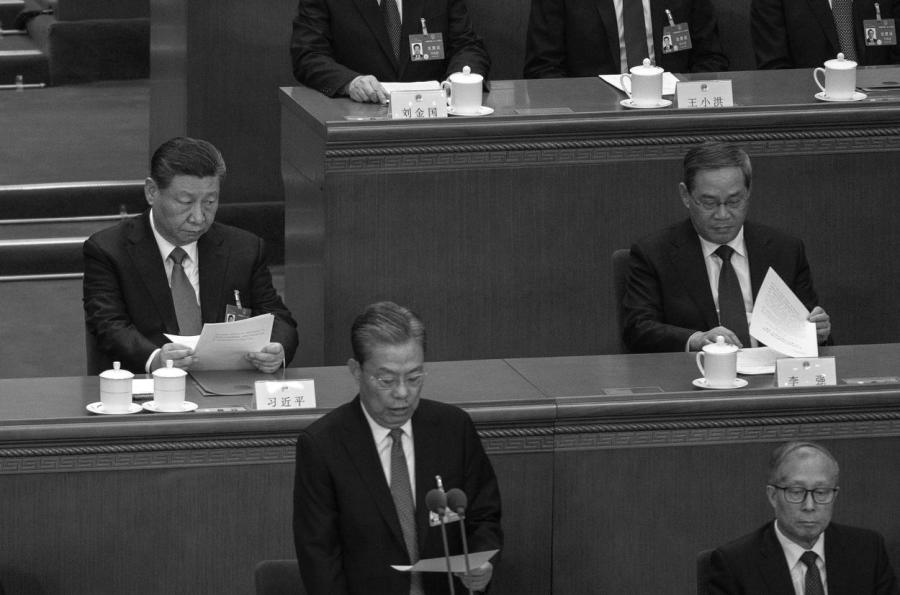
On March 5, 2023, Chinese Premier Li Keqiang (right) walked past Chinese President Xi Jinping after delivering the government work report during the opening session of the National People's Congress (NPC) at the Great Hall of the People in Beijing. (Photo by Noel Celis/AFP via Getty Images)
[People News] On the eve of the Two Sessions every year, the top leadership of the Chinese Communist Party stages what appears to be routine business but is in fact a political drama full of undercurrents — the “written work report.” Many people may not know that behind this system lies a years-long struggle between Xi Jinping and Li Keqiang over “collective leadership” versus “personal dictatorship.”
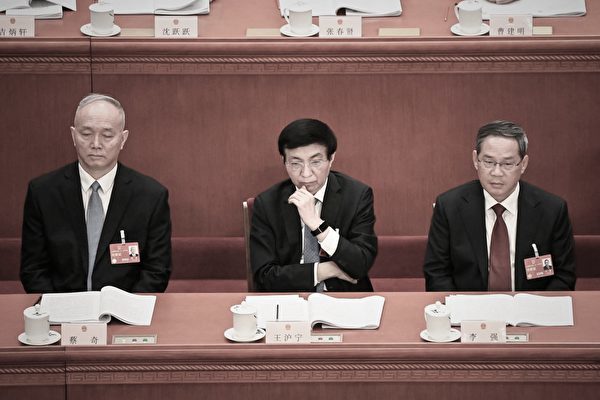
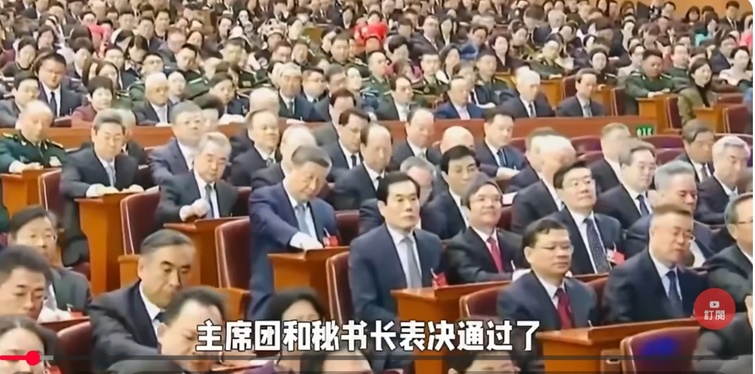
So what does “written work report” mean? On February 26, state media once again released the news that members of the Politburo, the State Council, the National People’s Congress, the Chinese People’s Political Consultative Conference, and the Party groups of five major institutions had once again submitted “written work reports” to Xi Jinping. Many people hearing this may think, is this not just reporting accounts and writing a summary? What is there to make a fuss about?
Did General Secretary Xi think he was the emperor?
To understand this conflict between Xi Jinping and Li Keqiang, we have to first trace back through history. Before 1982, the highest office in the Chinese Communist Party was called “Chairman,” a legacy left over from the Mao Zedong era, symbolizing personal authority and final decision-making power. But in order to prevent personality cults and life tenure, Deng Xiaoping amended the Party Constitution in 1982, abolished the title of “Chairman,” and replaced it with “General Secretary.”
The original intention of the words “General Secretary” was not “emperor,” but rather “convener.” He was one member among the Politburo Standing Committee, equal in status, responsible for coordinating differences and carrying out collective decisions, rather than personally making the final call. This is what we used to call the Chinese Communist Party’s internal “collective leadership” and “democratic centralism.”
However, by the Xi Jinping era, all of this underwent a subversive change. After the Chinese Communist Party’s 19th National Congress in 2017, the Politburo passed a new regulation requiring all senior officials other than Xi Jinping — from all Politburo members to Secretariat secretaries — to report annually to the “Party Central Committee” and to “General Secretary Xi Jinping.” Please note that the “Party Central Committee” is in fact another name for Xi Jinping alone. With this move, collective leadership as it had continued from the Deng Xiaoping era was completely ended, marking a shift in the power structure from “horizontal balance” to “vertical subordination.” Xi Jinping clearly regarded himself as the emperor.
The breaking point in the Xi-Li conflict: the words “written”
Now here comes the key point. When this reporting system was being formulated, Xi Jinping and Li Keqiang erupted into a fierce conflict. Du Wen, a former Inner Mongolia official, revealed a little-known inside story. It turns out that Xi Jinping’s original intention was to make these national-level and vice-national-level bigwigs report to him face to face.
Just imagine: if each Politburo Standing Committee member and the premier of the State Council lined up like elementary school students, sat in front of Xi Jinping, gave an oral work report, and accepted his comments, what kind of power ritual would that be? It would practically be a “parents’ meeting” or an ancient “court audience.” On the psychological level, this would greatly reinforce the subordinate relationship between upper and lower ranks, making the equality among Standing Committee members disappear completely. At this point, Li Keqiang stepped forward and voiced opposition.
Du Wen revealed that Li Keqiang clearly — even strongly — insisted on adding the two words “written.” His reason was that there were many relevant leaders, and the General Secretary was busy with countless affairs every day. If face-to-face reporting were carried out, it would seriously delay the General Secretary’s energy and time, which would not be conducive to his handling of other important work. This was also why Li Keqiang, before leaving office, shouted, “What people do, Heaven is watching.”
Du Wen believes that Li Keqiang was not openly confronting Xi, but rather carrying out a limited correction through the language of制度. The reason Li Keqiang gave sounded like consideration for the leader, but in reality he was guarding the last formal buffer zone for the system of collective leadership.
“Written work reports” belong to the document process: they can be archived and can follow procedures. They preserve a trace of equal dignity and avoid the awkwardness of being publicly lectured or humiliated by Xi Jinping. At that time, Xi’s power was not yet completely secure. Even if he was unwilling inwardly, in the dispute over the two words “written,” he could only temporarily swallow the setback and endure it.
Behind the nine-year reporting system: a ruler unsure of himself
So why was Xi Jinping determined to implement this reporting system before the Two Sessions, and keep doing it for nine years? Veteran commentator Cai Shenkun believes it is because Xi Jinping feels insecure and afraid.
Cai Shenkun pointed out that the reason Xi Jinping requires senior officials to report year after year is that he fears officials are “divided in heart and virtue,” fears that everyone is privately “making improper comments about the central leadership,” and fears that they are secretly resisting his policies. Through this humiliating compulsory method, he needs to gather the senior officials together and “knock them into line” in order to consolidate the foundation of his absolute power.
This year’s background for the reports is especially unusual. On the eve of the Two Sessions, a major earthquake occurred within the military. In addition to Zhang Youxia and Liu Zhenli being officially announced as under investigation, the Standing Committee of the National People’s Congress, convened on February 25, also announced the removal of the qualifications of 19 National People’s Congress deputies, including nine generals. Cai Shenkun analyzes that the military is now basically a pile of loose sand, and Xi Jinping is just a commander without troops. Under such circumstances, he wants to prevent anyone from making any critical comment about the matter.
The contents of these work reports are not public, but according to the official communiqué, this is more like a session of “self-criticism.” The senior officials must comprehensively summarize their thinking and work, analyze their own shortcomings, and then await Xi Jinping’s comments. If Xi Jinping is dissatisfied with someone’s report, that senior official’s power may be weakened, or he may even be marginalized. This is not merely reporting work; it is a “loyalty test.” The purpose is for him, on behalf of the “central leadership,” to tell officials: your thinking, politics, and actions must remain “highly consistent” with me.
Now, this system has already been in operation for nine years. Du Wen believes that the line of defense Li Keqiang left behind — the word “written” — may not hold out much longer. As Xi Jinping’s power becomes further consolidated, this system is very likely to change at a future Party congress, such as the 21st National Congress: the word “written” may be removed, turning it into collective face-to-face reporting by the entire group.
Cai Shenkun emphasized that the weakening of power is often the result of multiple factors piling up, such as deteriorating health or factional imbalance. Even within Xi’s own camp, there will be infighting because of struggles for favor. And the side that originally holds the advantage may also find itself in defeat at a critical moment. The investigation of Zhang Youxia makes Xi Jinping’s power seem stable on the surface. But Chinese Communist Party politics is a life-and-death struggle. There has never been stability. New forces will soon rise, and the internal fighting will continue in storms of blood and violence.
(First published by People News)





News magazine bootstrap themes!
I like this themes, fast loading and look profesional
Thank you Carlos!
You're welcome!
Please support me with give positive rating!
Yes Sure!