
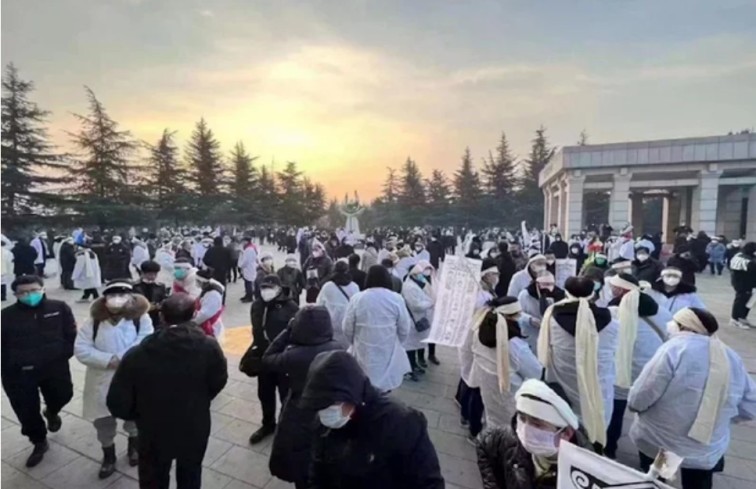
In December 2022, outside the Xi ’an funeral home, a large number of relatives of the deceased were waiting. (Weibo image)
[People News] The Qingming Festival is traditionally a time when 'travellers on the road feel their souls severed.' However, have you ever considered that in modern China, many people's 'places of severed souls' are not in the serene cemeteries surrounded by green hills and clear waters, but rather in the 'anonymous apartments' next door that are perpetually dark, with their windows bricked up? This represents an extremely absurd and somewhat chilling social phenomenon on the mainland: 'ash rooms.'
If you notice that your neighbor has not opened their windows for years, and has even sealed them tightly with red bricks, with almost no one entering or exiting throughout the year, only to hear the sounds of worship and chanting during the Qingming Festival, do not assume it is an empty house; the neighbor living there is very likely 'not a living person.'
This is not a story from 'Strange Stories from a Chinese Studio'; it is the reality of large cities in China in 2026. From Chaoyang in Beijing to Tianjin, Jiangsu, and Hebei, this type of 'ash room' has emerged in many regions across the country. There are even specialised intermediaries who instruct you on how to 'bury your ancestors' without disturbing your neighbours, and how to quietly pay respects during the Qingming Festival without drawing complaints.
Why do Chinese people risk neighbourhood disputes to place their loved ones' ashes in residential buildings? The answer is both simple and tragic: 'While alive, one cannot afford a house; when dead, one cannot afford a grave.'
Let’s do some calculations; this does not require any financial expertise, as the common people have an innate sense of value.
Reports from mainland media indicate that in the Chaoyang District of Beijing, a resident named Ms Zhao disclosed that the cost of a standard burial plot in a remote cemetery is approximately 100,000 yuan, while in major cities, it can soar to around 500,000 yuan. Even more ridiculous is the fact that the lease for these burial plots lasts only 20 years. After this period, families must pay a renewal fee; otherwise, the remains of their loved ones may be 'relocated'.
In stark contrast, many third- and fourth-tier cities, as well as the suburbs of larger cities, are experiencing a real estate crisis characterised by an oversupply of apartments and plummeting housing prices. A small apartment with a 70-year ownership can be priced at just over 200,000 yuan.
The general public is quite shrewd: spending 500,000 yuan on a burial plot that lasts only 20 years versus purchasing a house for 200,000 yuan that lasts 70 years and can accommodate the ashes of three generations. Moreover, if property values increase in the future, the house can even be sold to 'preserve asset value'. This kind of wisdom is a survival instinct honed by the pressures of high housing and burial costs.
Why are funeral expenses in China ranked among the highest globally? Surveys indicate that the average funeral cost in China in 2020 was around 30,000 to 40,000 yuan, nearly equivalent to an individual's annual income. The primary reason can be summarised in two words: monopoly.
In China, the funeral industry is one of the least regulated, most lucrative, and a stable source of income for local governments. The land resources for urban cemeteries are entirely controlled by local authorities, and decisions regarding land allocation and pricing are shrouded in political opacity. Every aspect, from urns and wreaths to the setup of mourning halls, is highly profitable, and it represents a form of semi-compulsory consumption that individuals feel they must engage in during their most vulnerable moments.
In recent years, the authorities have taken steps to regulate the internet, crack down on education and training, and manage the entertainment industry, yet they have left untouched the 'funeral cake' that has caused widespread distress among the populace. This is because addressing it would disrupt the local government's financial interests.
We find ourselves at a critical historical moment. By 2025, China's death toll is projected to reach 11.3 million, while births are expected to be only 7.9 million, marking three consecutive years of negative population growth. The baby boomer cohort from the 1950s and 60s is now entering old age, a situation that is academically termed the 'demographic peak of mortality.'
With more deaths than births, burial spaces are becoming increasingly limited, and formal channels are growing more expensive. In major cities, cremation services can require several days of waiting, and securing a spot in public columbariums may take over a year. When demand skyrockets and supply is monopolised by those in power, peculiar market alternatives like 'urn rooms' are inevitably going to arise.
To address this issue, the Chinese Communist Party government enacted a revised 'Funeral Management Regulations' on March 30, 2026, which explicitly prohibits the use of residential properties for storing ashes.
Ironically, the timing of this law's implementation coincides with the eve of the Qingming Festival, even around April 1st, which is April Fool's Day. The regulations call for 'correction and education,' but they lack specific penalties or enforcement mechanisms. What does this imply? It suggests that as long as the funeral monopoly persists, properties will remain vacant, and the underground dealings of ordinary citizens will continue unabated.
The government is currently promoting 'ecological burials' with great enthusiasm, including options like sea burials and tree burials. While they offer subsidies of several thousand yuan for Chinese families who hold traditional beliefs emphasising 'being buried in the earth for peace', this feels like a deprivation of their ancestors' final dignity.
Xi Jinping's ten-year slogan 'housing is for living, not for speculation' has led to an unexpected outcome: houses are no longer being speculated on; instead, they are being repurposed to store ashes. The grand narratives of 'great rejuvenation' and 'comprehensive well-off society' seem utterly insignificant when faced with the reality of 'ash houses'.
If a government that claims to be 'people-centred' cannot even ensure that its citizens can 'afford to die and be buried peacefully', and if paying respects to loved ones during the Qingming Festival must be done in secret, like a thief hiding in residential buildings, then whose glory is it truly reviving? Life was once difficult, and now it seems we face the reality of 'not being able to die well'. This is not a dark joke; this is the stark reality of China during the Qingming Festival of 2026.
In those vacant apartments that remain dark, countless black-and-white photographs silently observe this chaotic world. For those of us who are still alive, beyond expressing our sorrow, shouldn't we also question: what is the true source of all this absurdity? △






News magazine bootstrap themes!
I like this themes, fast loading and look profesional
Thank you Carlos!
You're welcome!
Please support me with give positive rating!
Yes Sure!