
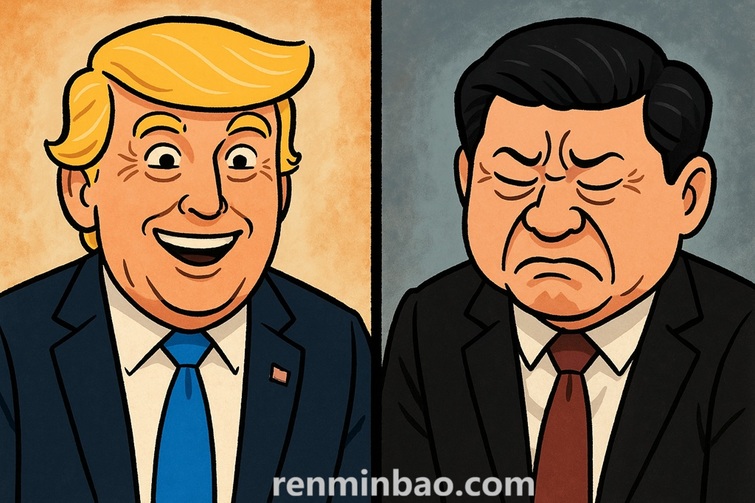
Thinking about taking action against Taiwan? Trump: You are free to think about it, but what are you actually going to do? (People News/AI-generated image)
[People News] The Trump-Xi meeting has garnered significant international attention, with initial perceptions suggesting that the Taiwan issue would be the main focus of the discussions. However, following the conclusion of the talks, it became evident that the Taiwan issue was not the sole core topic of Trump's visit to China. Nonetheless, for Xi Jinping, the Taiwan issue remains one of the most critical subjects.
Why is it stated that 'Taiwan is not the main topic of Trump's visit to China'?
In the summary released by the White House, it was observed that there was limited emphasis on Taiwan, with greater focus placed on trade, investment, the situation in the Middle East, and strategic stability.
Trump's visit to Beijing resulted in some tangible outcomes, with the most significant achievements centred around economic and trade matters and the de-escalation of tensions. However, there were virtually no substantial breakthroughs on key issues such as Taiwan, technology restrictions, and geopolitical security.
Trump's achievements can be categorised into several areas:
1. Economic and trade aspects: Trump secured some 'quantifiable results,' including: according to disclosures from the White House and various media outlets, the Chinese side agreed after the meeting to increase purchases of American agricultural products over the coming years, with an annual value of at least approximately $17 billion; to restore or expand the entry of certain American beef, poultry, and other products into the Chinese market; the Chinese side is reportedly set to procure around 200 Boeing aircraft, which is viewed as one of the largest related orders in nearly a decade; both sides agreed to establish a new China-U.S. trade and investment coordination mechanism to address market access, tariffs, and investment disputes.
The primary beneficiaries of these developments are the agricultural states in the American Midwest, such as Iowa, Nebraska, and Kansas. In recent years, the US-China tariff war has adversely affected American agricultural exports. Therefore, if China commits to increasing its purchases annually, it will provide some support for farmers' incomes and agricultural product prices. This is also significant for Trump's political base.
Furthermore, if China indeed follows through on its commitment made during the talks to purchase approximately 200 Boeing aircraft, it will have a direct positive impact on Boeing and its supply chain, which includes aircraft manufacturing, parts supply, high-paying technical jobs, and will be advantageous for US exports and certain employment markets. However, even large orders are insufficient to alter the overall economic trend within the context of the US economy, which is valued at around $30 trillion. Thus, it can be concluded that Trump's sale of 200 Boeing aircraft to China is beneficial for specific industries and has a positive effect on manufacturing and employment, but these outcomes cannot reverse the overall economic situation.
2. Iran and the Strait of Hormuz: Reports from foreign media indicate that after leaving Beijing, Trump mentioned that there is a certain level of consensus between the US and China regarding the Iran issue, including the desire to keep the Strait of Hormuz open and to prevent the situation in the Middle East from spiralling out of control.
Some analysts suggest that Beijing is willing to engage in limited cooperation on this issue because China is heavily reliant on Middle Eastern energy and global shipping, and it does not want regional conflicts to negatively impact its own economy.
3. Taiwan issue: Based on the information currently available, Taiwan is not a primary topic of discussion during this visit to China.
Several analyses suggest that Xi Jinping adopted a tough stance on the Taiwan issue during the talks, but the U.S. did not publicly offer any new policy concessions, nor were there indications of the previously speculated 'deal on Taiwan.' Instead, the U.S. maintained its existing position, simply avoiding escalating tensions in public forums.
For Xi Jinping, the Taiwan issue has always been non-negotiable; it is the central topic that must be addressed in the Xi-Trump meeting. Beijing's preferred outcome is not an immediate military action against Taiwan, but rather a negotiation with the U.S. that would lead to reduced arms sales and less intervention, thereby ensuring stability in the Taiwan Strait under the principle of 'no independence, no military action.' This is particularly relevant given the recent large-scale purges and internal unrest within the Chinese military, as avoiding an early involvement in an uncontrollable large-scale military conflict may better align with Xi Jinping's current strategic considerations.
In this light, the Chinese Communist Party reiterated four red lines, including Taiwan, through the Ministry of Foreign Affairs just before the talks, prioritising the Taiwan issue and signalling a strong intention to pressure Trump not to avoid discussing it. However, the results of the talks indicate that the Taiwan issue was effectively 'marginalized' by Trump, who managed to address it with minimal effort.
In response, macroeconomist Wu Jialong remarked on Facebook on the 17th that Trump's visit to China is essentially a final diplomatic push to prepare for a renewed conflict with Iran!
Wu Jialong remarked, "Trump's visit to Beijing now appears to have been focused not on Taiwan, but rather on Iran! Ultimately, the Chinese side agreed to two key U.S. demands: that Iran must not possess nuclear weapons and must not block the Strait of Hormuz, and must also pay tolls. This effectively means that China is no longer politically supporting Iran and is instead siding with the United States. In simple terms, China (the CCP) has abandoned Iran, which is precisely what Trump wanted! Consequently, if the U.S. takes action against Iran, the Chinese side will have little room to respond."
Wu Jialong further estimated, "If this reasoning is valid, then after Trump returns to Washington, he will undoubtedly initiate military actions, having already made a trip to Beijing and established communication with China, thus laying the political groundwork. The Chinese side's cooperation with the U.S. signifies a concession to American demands, prompting them to seek another topic to divert attention and mask their latest position on Iran. Additionally, in order to accept the U.S. stance, the Chinese side must demonstrate firmness on other issues, pushing back against pressure to show they have not yielded to U.S. demands. This way, when they eventually make concessions on Iran, it will be less noticeable to others. This explains why the U.S. is not genuinely interested in discussing Taiwan, while Xi Jinping remains fixated on it. In summary, after all is said and done, Trump's visit to Beijing was about Iran, not Taiwan. The conclusion is that Trump emerged victorious!
(People News first published) △





News magazine bootstrap themes!
I like this themes, fast loading and look profesional
Thank you Carlos!
You're welcome!
Please support me with give positive rating!
Yes Sure!