
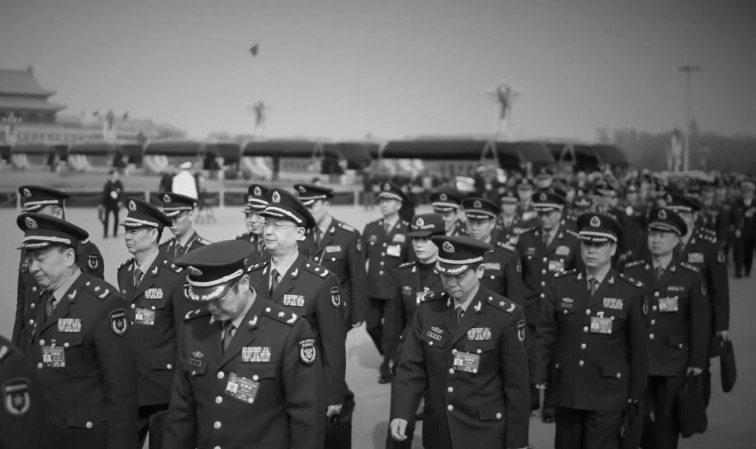
The image shows the representatives of the Chinese military attending the Two Sessions in Beijing. (Video screenshot)
[People News] On June 3, the front page of the Chinese Communist Party’s military newspaper and its website published a report under the column “Establishing a Correct View of Achievements,” titled “A Regiment of the Beijing Garrison Corrects Deviations in Achievement Views with a Pragmatic Approach — A Delayed Combat Training Meeting.” Notably, throughout the entire report, there is not a single mention of “Chairman Xi” or any expression of loyalty to Xi.
The reason for saying “again” is that over the past few months, more than twenty similar reports published in this column—from the Air Force, Navy, Rocket Force, Armed Police, Information Support Force, the Army’s 81st Group Army, the Central Theater Command, and the Northern Theater Command—have not mentioned “Chairman Xi” at all, let alone the usual loyalty phrases such as the “Two Establishes” and “Two Upholds.”
The only article that mentioned “Chairman Xi” was a summary report. However, when detailing the study reflections of units such as the Central Military Commission Equipment Development Department, the Cyberspace Force, the Armed Police, the Army, the Information Support Force, the National University of Defence Technology, the Southern Theatre Command, and the Northern Theatre Command, none mentioned “Chairman Xi” or expressed loyalty.
Is this situation normal? After widespread rumours over the past year suggesting that the CCP leader had lost control of the military and the Party, and following his removal in January of Vice Chairman Zhang Youxia of the Central Military Commission and Chief of Staff Liu Zhenli of the Joint Staff Department, has he truly regained control of the military?
If so, why has the military remained so restrained in its statements on issues he is currently most concerned about?
If so, why have all branches of the military continued to respond so passively to the removal of Zhang and Liu?
If so, why does Zhang Youxia still appear on the list of Politburo members and remain a deputy to the National People’s Congress?
If so, why did the newly appointed Vice Chairman of the Central Military Commission, Zhang Shengmin, use unusual wording at a recent meeting on deepening the study of Xi Jinping’s thought on strengthening the military, calling for “transforming study results into concrete actions to firmly support the ‘Two Establishes,’ resolutely achieve the ‘Two Upholds,’ and implement the responsibility system of the Chairman of the Central Military Commission”? Does this not imply that the military’s loyalty to Xi remains only verbal?
Clearly, the more likely reality is that Xi still holds only the title of “Chairman of the Central Military Commission,” and despite large-scale purges, dissatisfaction within the military has not been eliminated.
What is most noteworthy in this report is its subject: “a regiment of the Beijing Garrison.” The Beijing Garrison falls under the CCP Army Headquarters and is directly commanded by the Central Military Commission. Its primary responsibilities include safeguarding the security of the capital, protecting CCP leaders, covering the evacuation of central organs in wartime, defending against external enemies, and handling counterterrorism and riot control. For this reason, it is often referred to as the “Imperial Guard.”
There is a common saying that whoever controls the Beijing Garrison effectively controls half of Beijing. Historically, the commander of the Beijing Garrison has always been appointed by the Chairman of the Central Military Commission and is someone he trusts. If the Beijing Garrison is ignoring “Chairman Xi,” does this mean it is not actually under his control?
It may be helpful to compare two statements made by the Beijing Garrison before and after the incident involving Xi at the Third Plenum in July 2024.
In June 2024, Xi led a group of senior military officials to Yan’an and convened a political work conference of the Central Military Commission, targeting high-ranking officers for rectification. Shortly afterwards, on July 16, the military newspaper published a front-page report titled “A Regiment of the Beijing Garrison Studies and Implements the Spirit of the Central Military Commission Political Work Conference — Loyal to the Mission, Practising Responsibilities at Their Posts.”
The report stated that officers and soldiers of the regiment engaged in “heated discussions” around Xi’s speech, and it mentioned “Chairman Xi” multiple times. One officer was quoted as saying: “With Chairman Xi steering the course, the centennial goal of building the military will surely be achieved on schedule. … We must firmly follow him in thought, show absolute political loyalty, sincerely love him emotionally, and closely align our actions.”
It also included statements such as “unifying thoughts and actions with Chairman Xi’s important speech and the conference’s deployment requirements,” “Chairman Xi has condensed the political strategy for building the military in the new era into ‘ten clarifications,’ rich in content and systematic… we must integrate the study and implementation of Chairman Xi’s important speech with research and investigation,” and “always remember Chairman Xi’s instruction to ‘maintain a high state of alert and fulfill assigned responsibilities.’”
However, after the incident involving Xi in July, power shifts occurred within the CCP leadership. On November 13 of that year, the military newspaper again published a front-page report titled “The Beijing Garrison Studies and Implements the Spirit of the Central Military Commission Political Work Conference — Focusing on Special Missions, Cultivating Loyal Character.” This time, the entire report mentioned “Chairman Xi” only once, and instead emphasised that “absolute loyalty to the Party is the foremost political requirement for the military.”
This shift in tone—from loyalty to “Chairman Xi” to loyalty to “the Party”—does it confirm that Xi’s control over the military has weakened?
So, who actually controls the Beijing Garrison? According to public data, since the 18th Party Congress, Xi Jinping has replaced five commanders of the garrison: Zheng Chuanfu (2009–2013), Pan Liangshi (2013–2016), Wang Chunning (2016–2020), and Fu Wenhua (2020–early 2026). The current commander is Chen Yuan, formerly commander of the Shanghai Armed Police Corps, who was parachuted into Beijing after Zhang Youxia was removed. The reason was Xi’s distrust of Fu Wenhua, who had ties to Zhang. Meanwhile, the garrison’s political commissar has also been replaced four times: Gao Donglu, Jiang Yong, Zhang Fandi, and Zhu Jun.
Given that Xi has installed Chen Yuan, someone he relatively trusts, as commander of the Beijing Garrison, why does the garrison still refrain from mentioning “Chairman Xi” in its statements? Could it be that Chen Yuan, like Xi himself, holds only a nominal title without real control?
The information revealed by the military newspaper and website repeatedly signals to the outside world that divisions within the military persist, and that Xi faces significant difficulty in consolidating military loyalty. The low-profile stance of various branches may reflect passive resistance, self-preservation amid uncertainty, or perhaps the brewing of a major shift within the CCP.
(People News first published) △




News magazine bootstrap themes!
I like this themes, fast loading and look profesional
Thank you Carlos!
You're welcome!
Please support me with give positive rating!
Yes Sure!