
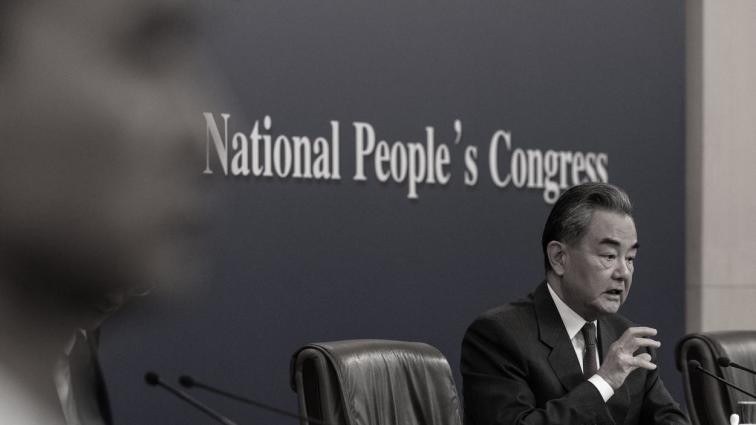
Image: Chinese Foreign Minister Wang Yi. (Photo by Kevin Frayer/Getty Images)
[People News] On August 19, Wang Yi, the Foreign Minister of the Communist Party of China, made a secret visit to South Korea, where he discussed issues related to the Korean Peninsula with South Korean Foreign Minister Zhao Xian. Wang Yi employed clichéd and superficially grand language, expressing hope that dialogue would improve relations on the 'Peninsula.' Zhao Xian emphasized South Korea's commitment to achieving denuclearization and peace on the Peninsula.
On the same day, Chinese Foreign Ministry spokesperson Lin Jian stated that China hopes Wang Yi's visit will help advance the strategic partnership with South Korea.
Wang Yi's visit followed US President Trump's push to revive diplomatic efforts towards North Korea. Earlier that day, Trump announced that the US-South Korea military exercises would conclude six days earlier than planned, stating that 'the military exercises sent a completely inappropriate and hostile signal to Pyongyang.' Trump referred to Kim Jong-un as a friend and expressed hope to restore diplomatic relations with him, indicating that he would meet with him within the year.
The US-South Korea joint military exercises, which began on August 17, aimed to simulate combat operations between US-South Korean forces and North Korean troops, and made adjustments based on the practical combat experience gained from North Korean troops participating alongside Russia in the Ukraine conflict regarding modern warfare technology.
Trump's announcement to end the military exercises early surprised South Korea. On the 19th, Zhao Xian stated in Congress that the US had not informed South Korea of this decision in advance. According to AFP, a South Korean military official acknowledged that this decision was 'unusual.' However, the South Korean military confirmed that the exercises, originally scheduled to continue until August 27, would conclude early this Friday.
The annual joint military exercises between the United States and South Korea have consistently sparked strong discontent from North Korea. Just before the start of this military exercise, North Korea conducted a missile test. The official North Korean news agency, KCNA, reported on the 19th that the US-South Korea joint military exercises represent 'the most direct and blatant threat' to North Korea and 'regional security,' asserting that it will exercise its 'right to self-defense to eliminate the military threat posed by hostile forces.'
On the same day, Lin Jian, during a regular press conference, was ambiguous in his remarks regarding 'Trump's claim that the good relationship with Kim Jong-un necessitates a reduction in the scale of military exercises,' stating that he would advocate for a political resolution to the issues on the Korean Peninsula...
Park Won-keun, a professor at Ewha Womans University in South Korea, told AFP: 'The suspension of joint military exercises has always been a prerequisite for North Korea to engage in dialogue with the United States.' He believes that this reduction in exercises 'may have an impact in this regard.'
On the same day, Trump also provided an unusual and very specific official estimate of North Korea's nuclear arsenal, claiming that the country possesses '57 nuclear weapons.' He added, 'This should not be happening.'
US intelligence agencies have consistently viewed the nation led by Kim Jong-un as a significant threat to US security. The Department of Defense also stated on the 19th that the adjustments to the exercises 'will not affect core objectives regarding readiness and training.' The US military command emphasized: 'The training objectives of the US side will not be reduced in any way.'
Some analysts suggest that a meeting between Trump and Kim Jong-un could occur during the APEC summit in China in November.
This year, following North Korea's announcement to remove socialist references from its 'Constitution', senior officials Wang Yi, Xi Jinping, and Wang Huning made separate visits to North Korea. Such a concentrated series of high-level visits is quite rare in the history of the Chinese Communist Party's diplomatic relations with North Korea, highlighting a unique diplomatic bond with the country.
At the same time, the Chinese Communist Party is also demonstrating its diplomatic strategy towards South Korea. On August 19, the South Korean Ministry of Foreign Affairs reported that Wang Yi indicated that China is 'actively considering' a meeting between the leaders of China and South Korea during the APEC leaders' summit in Shenzhen in November. Additionally, Wang Yi extended an invitation to Zhao Xian to visit China, which Zhao Xian accepted. △







News magazine bootstrap themes!
I like this themes, fast loading and look profesional
Thank you Carlos!
You're welcome!
Please support me with give positive rating!
Yes Sure!