
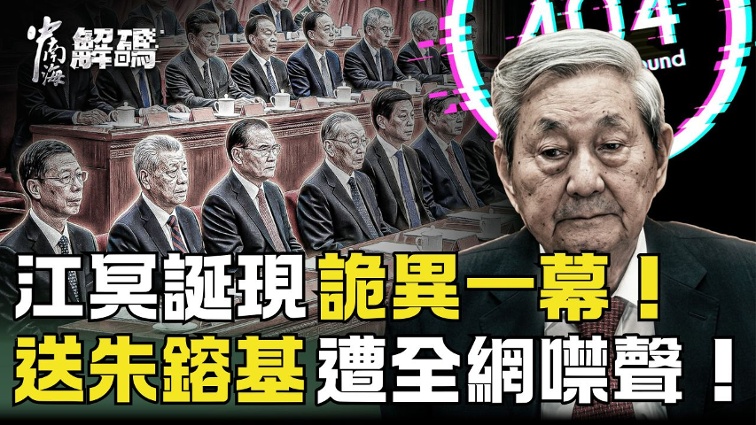
In the Underworld Memorial, Observing the Universe: Jiang Zemin's Farewell Ceremony and the Sound of Thunder (Video)
[People News] The Xi Jinping administration of the Chinese Communist Party (CCP) made a high-profile visit to commemorate Jiang Zemin, the executioner whose hands are stained with the blood of the Chinese people and who has been gone for nearly four years, around the time of his centenary on August 17, surprising many good-hearted individuals.
Indeed, as an unwritten rule of the CCP, after the death of each faction leader or bigwig, the authorities will hold commemorative events in significant years. This serves two purposes: first, to consolidate the loyalty of the faction and continue brainwashing the masses; second, for the current leader to set the tone for their own posthumous honors.
However, Jiang Zemin, this human scum, does not deserve to be commemorated. The main reason is that he hijacked the machinery of the CCP state to launch a crackdown on one hundred million people who believe in 'Truth, Compassion, and Tolerance,' and, in order to physically eliminate Falun Gong practitioners, he brazenly fabricated 'the evil that has never existed on this planet'—the large-scale live organ harvesting.
In the presence of high-ranking party officials and retired senior officials, Xi Jinping read a 45-minute speech praising Jiang, yet deliberately avoided mentioning his heinous crime of initiating the crackdown on Falun Gong, not a single word. This act confirms that this is a crime that cannot be exposed to the light of day.
The CCP's suppression of Falun Gong has lasted for over 27 years and has been continued by the Xi administration to this day. If this atrocity can be consistently touted as 'great, glorious, and correct,' why does Xi Jinping dare not mention it?
Large-scale live organ harvesting began in the Jiang Zemin era.
In the 77 years of violent power grabs by the CCP, countless political persecution movements have been initiated to maintain power, including the Three Anti and Five Anti campaigns, the suppression of counter-revolutionaries, the Anti-Rightist Movement, the Cultural Revolution, and the Tiananmen Square Massacre, resulting in the slaughter of one hundred million Chinese people, including a large number of elites from the Republic of China.
The Chinese Communist Party (CCP) is not only dismantling Chinese culture and moral traditions but is also promoting a culture of evil, intensifying brainwashing among the populace. Their goal is to transform Chinese citizens into subjects who submit to tyranny under any circumstances, akin to slaves or robots.
These cold and twisted actions have rendered the CCP infamous in the international arena.
It was in July 1999 that Jiang Zemin, ignoring opposition from other leaders, insisted on the suppression of Falun Gong. He issued the malevolent directive to 'discredit them in reputation, cut them off economically, and eliminate them physically,' and initiated the horrific practice of live organ harvesting from Falun Gong practitioners. This led to thousands of innocent individuals going missing, being arrested and detained, and even being used to create organ banks.
At this juncture, the Chinese Communist Party morphed into a malevolent entity, and Jiang Zemin, who orchestrated these heinous acts, became irredeemable.
It was only after more than twenty years of fearless investigations and evidence gathering by Falun Gong practitioners and informed individuals from various sectors that the extensive organ-harvesting crimes against humanity committed by the Jiang Zemin group were fully exposed.
The suppression of Falun Gong by Jiang Zemin coincided with a significant rise in the number of missing persons in China.
Reports and investigations from The Epoch Times, Minghui.org, and the 'World Organization to Investigate the Persecution of Falun Gong' (WOIPFG) indicate that after Jiang Zemin initiated the crackdown on Falun Gong in 1999, there was a simultaneous occurrence of large-scale disappearances and a dramatic surge in organ transplant numbers in mainland China. Key evidence includes:
1. Abnormal disappearances and the phenomenon of individuals living under assumed identities.
Between 1999 and 2002, hundreds of thousands to over a million Falun Gong practitioners from across the country traveled to Beijing to peacefully petition. To avoid repercussions for their families, workplaces, and local officials, many practitioners chose not to disclose their names or origins. They were assigned identification numbers by the public security and judicial systems and were transferred to various detention facilities or underground sites, with a significant number of individuals remaining missing for extended periods after being illegally arrested or transferred.
2. Surge in Organ Transplants and the Establishment of an Organ Donor Database
Following 2000, the number of organ transplants in China saw an unprecedented increase, which closely aligned with the timeline of missing persons:
According to official data from the Chinese Communist Party, there were only a few hundred liver transplants nationwide before 1999, but after 2000, the annual number of transplants surged to tens of thousands.
Former Canadian Deputy Foreign Minister David Kilgour and international human rights lawyer David Matas co-authored the investigative report "Bloody Harvest," which sent shockwaves around the world. Concurrently, extensive investigations and reports by organizations such as the World Organization to Investigate the Persecution of Falun Gong, Amnesty International, various human rights organizations, the United Nations anti-torture agency, and independent media abroad finally revealed the long-concealed state secret of the Chinese Communist Party—the crime of organ harvesting from living individuals.
The investigative report indicated that between 2000 and 2005, over 40,000 organ transplants in China had unknown sources of donors.
3. Allegations of 'Organ Harvesting' and Evidence Collection
In 2006, The Epoch Times first reported on the Sujiatun incident in Shenyang, Liaoning, alleging that the detention facility was involved in the organ harvesting of Falun Gong practitioners.
The organization "Investigate International" has released numerous recordings from telephone investigations targeting doctors in the transplant departments of major hospitals in China, as well as officials from the Political and Legal Affairs Commission, including Zhou Yongkang and Bo Xilai. Several individuals interviewed in these recordings admitted or suggested that they had used Falun Gong practitioners as organ donors.
Reports from Minghui.org detailing the experiences of victims indicate that in labor camps and prisons, Falun Gong practitioners are often subjected to forced blood draws and organ ultrasound examinations, which are not performed on other ordinary inmates, and no health feedback is provided after these examinations.
During this time, there has been a notable increase in international organ transplant tourism to mainland China. In Europe and the United States, waiting for matched organs typically takes several years, while in major transplant centers in China, the waiting time for organ matching can be as short as a few days to a few weeks, with some centers even unreasonably offering "scheduled surgery times."
"Investigate International" believes this indicates the existence of an extremely large reserve of living organ donors in China.
In response to these allegations, the Chinese Communist Party has consistently denied them. However, international organizations, including the U.S. Congress (House Resolution 343), the European Parliament, and the United Nations Committee Against Torture, have all passed resolutions or issued statements calling for independent investigations into the sources of organ transplants in China and the allegations of organ harvesting.
Bo, Gu, and Wang were the first to implement Jiang's orders for organ harvesting, with the Dalian body processing factory operating in conjunction with the persecution.
In independent investigation reports from abroad, Jiang faction officials Bo Xilai, Gu Kailai, and Wang Lijun have been identified as key figures and executors in the Chinese Communist Party's political and legal system responsible for the "live organ harvesting of Falun Gong practitioners."
The establishment and operation of the Dalian body processing factory is a significant part of the Chinese Communist Party's political and legal system's persecution of Falun Gong, as well as the creation of a "living organ bank" and the "commercialization of corpses."
Bo Xilai served as the mayor of Dalian from 1993 to 2000 and as the governor of Liaoning Province from 2001 to 2004. During this period, he actively supported Jiang Zemin's suppression policies, leveraging the large number of detained Falun Gong practitioners in Liaoning Province who refused to disclose their names. This allowed the province to become a living organ bank and a 'pilot base' for organ harvesting.
A recording released by the 'World Organization to Investigate the Persecution of Falun Gong' reveals that during Bo Xilai's visit to Germany in 2006, he acknowledged to undercover investigators that 'the order for organ harvesting was issued by Jiang Zemin.'
It is important to note that in July 1999, Jiang Zemin ordered the suppression of Falun Gong. In August of the same year, the German scientist von Hagens, with Bo Xilai's approval, invested in the establishment of 'von Hagens Bio-Plastination (Dalian) Co., Ltd.', which became the largest 'body processing factory' in the world at that time.
From 2000 to 2004, as many unnamed Falun Gong practitioners were transferred to various detention facilities across Liaoning Province, the Dalian body processing factory rapidly expanded. Subsequently, Professor Sui Hongjin from Dalian Medical University, who was familiar with von Hagens, founded a second body plastination factory, 'Dalian Hongfeng Bio.'
Investigations conducted overseas allege that Bo Xilai's wife, Gu Kailai, colluded with him and played a crucial role in this illicit industrial chain.
During his time as mayor of Dalian, Bo Xilai earned Jiang Zemin's favor for his crackdown on Falun Gong, which led to his promotion to governor of Liaoning Province. He personally approved the establishment of the plastination factory in Dalian and facilitated favorable policies and land provisions.
Gu Kailai, the wife of the former official, leveraged her control over legal and business networks to plastinate the bodies of Falun Gong practitioners from whom organs had been harvested. These bodies were used in global human body exhibitions, including illegal sales, generating substantial profits.
Neil Heywood, a British businessman, assisted Gu Kailai in managing overseas funds and organ/body trafficking. However, after becoming aware of too many sensitive details and entering into a conflict of interest with Gu, he was poisoned by her to silence him. This incident triggered a significant political upheaval in Chongqing and led to Wang Lijun's escape.
While serving as the director of the Jinzhou Public Security Bureau, Wang Lijun established the 'On-Site Psychological Research Center' and publicly announced research findings such as 'Organ Receptor Transplantation After Injection of Drugs.' In 2006, when Wang received the Guanghua Innovation Special Contribution Award, he acknowledged that his team had completed 'thousands of cases of organ transplantation and preservation experiments.'
In February 2012, Wang Lijun had a falling out with Bo Xilai after being slapped by him and subsequently stormed into the U.S. Consulate General in Chengdu at night. Reports indicate that the confidential materials Wang submitted to the U.S. included not only evidence of corruption and murder involving Bo and Gu but also numerous documents, tables, and images related to the live organ harvesting of Falun Gong practitioners by the Chinese Communist Party's Political and Legal Affairs Commission and the Public Security system.
According to incomplete statistics, in the early years following Jiang Zemin's initiation of the crackdown on Falun Gong, tens of thousands of practitioners were secretly subjected to live organ harvesting for profit by military hospitals, armed police hospitals, and civilian hospitals connected to public security, procuratorial organs, and prisons. The organs and skin of a single victim could be sold for at least hundreds of thousands of dollars.
Despite repeated denials of organ harvesting crimes by the Jiang Zemin faction of the Chinese Communist Party, parliaments in several countries, including the U.S. House of Representatives Resolution 343 and relevant resolutions from the European Parliament, as well as independent civil courts like the 2019 'China Tribunal' in London, have concluded—after reviewing investigation reports and hearing testimonies—that organ harvesting does indeed occur. They identified Liaoning Province, under the governance of Bo Xilai and others, as a critical hub in this illicit industry.
In response to public outcry and media criticism, the Chinese Communist Party enacted the 'Regulations on the Management of the Entry and Exit of Corpses and the Handling of Corpses' in 2006, which limited the commercial trade of corpses. This led to the closure of its Dalian office in 2011.
The CCP continues its organ harvesting crimes, with the range of victims now encompassing the entire population.
Following a unified condemnation of organ harvesting by the civilized world, the CCP remains reluctant to relinquish the substantial profits associated with organ transplantation. Instead, it has merely imposed superficial restrictions on illegal organ transplants while maintaining official protection for these activities. Furthermore, the number of organ harvesting cases has not diminished; rather, it has increased, with targets now extending beyond Falun Gong practitioners to include ethnic minorities in Tibet and Xinjiang, dissidents, and vulnerable populations in both urban and rural areas, particularly the youth.
On the international front, the number of medical institutions authorized by the CCP's National Health Commission (formerly the Ministry of Health) to perform human organ transplants has plummeted from over 600 prior to the strict admission criteria established in 2007 to just 187 by 2025 (which includes 47 training bases for human organ transplantation).
Despite the rapid technological advancements and pervasive surveillance, the number of missing persons has remained alarmingly high.
According to the "White Paper on Missing Persons in China," the annual number of missing persons nationwide reaches as high as 1 million, translating to an average of 2,739 individuals going missing each day.
Moreover, research based on official statistics indicates that the number of missing persons in China could skyrocket to 3.07 million by 2024.
In November 2025, a second-generation CCP official revealed that most of the missing youth in China have had their organs harvested.
He asserted that the abundance of surveillance cameras in China means that as long as there is a photo or name, the Sky Eye system can automatically verify the location, allowing all cameras nationwide to locate the (missing) person in under five seconds.
He stated, "Why can't we find them? I can tell you that they have all been subjected to organ harvesting; this is indeed true. The missing teenagers in China have essentially all had their organs removed. This is because the organs of teenagers are the healthiest and most valuable, and the main entity behind this organ harvesting is the government leading the operation."
According to a report from Xinhua News Agency, as of November 2022, the liver transplant surgeries at Shanghai Renji Hospital have ranked first in the country for 11 consecutive years, while pediatric liver transplants have held the top position globally for 9 consecutive years, with a total of 3,000 pediatric transplant cases completed. In 2018, Xinhua News Agency reported that a baby donor in Anhui was born just 10 days earlier.
Statistics and estimates from the Ministry of Health of the Communist Party of China indicate that the number of kidney and liver transplants from 1997 to 2009 showed a dramatic increase in organ transplant cases in China, surging from 1,049 cases in 1998 to 19,454 cases in 2019, representing an increase of over 17 times.
Due to U.S. sanctions, regions such as Taiwan and South Korea have prohibited organ tourism.
All these atrocities, hidden from public view, are a result of Jiang Zemin's initiation of "live organ harvesting."
The international organ trade is bound to provoke the vigilance and regulatory measures of civilized nations.
The United States' Foreign Relations Authorization Act, Section 232, prohibits the issuance of visas to foreigners involved in forced organ harvesting or organ trafficking. Recently, the U.S. House of Representatives passed the "Stop Forced Organ Harvesting Act" and the "Falun Gong Protection Act," which empower the President and the Secretary of State to impose sanctions, including asset freezes and visa restrictions, on individuals and entities involved in illegal human organ trafficking and forced organ removal. Additionally, states such as Utah and Texas have enacted laws that prevent state medical insurance from covering or reimbursing expenses for organ transplants conducted in countries suspected of illegal organ sourcing.
In Taiwan, the Republic of China has amended its "Human Organ Transplantation Act" to comprehensively ban "organ transplant tourism," organ brokering, and commercial transactions. South Korea has also strengthened its "Organ Transplant Act" to combat illegal organ brokering and to regulate overseas illegal transplants under the law.
Furthermore, several developed countries, including Israel, Spain, Italy, Norway, Belgium, the United Kingdom, and Canada, have revised their "Criminal Code," "Organ Transplant Act," or "Anti-Human Trafficking Act" to explicitly prohibit their citizens from participating in commercial organ transplants abroad, granting courts the authority to pursue criminal accountability.
Twenty-seven years ago, Jiang Zemin launched a nationwide crackdown on Falun Gong, employing all possible means to suppress it, but ultimately failed; even four years ago, when his decaying body was beyond redemption, he did not achieve his goals.
Chinese culture values the peaceful burial of the deceased and believes in repaying debts to seek rebirth in the next life. However, Jiang was aware that his sins were too severe, rendering him unworthy of hell and of a next life, leading him to choose to be ground to dust.
Regardless of how publicly Xi Jinping honors Jiang, he refrains from mentioning Falun Gong, fully aware that persecuting Buddhism will not be accepted in public discourse and will not end favorably.
The silence of the gods and Buddhas reflects the current moment of divine anger and public discontent, making the disintegration of the Chinese Communist Party unavoidable.
△






News magazine bootstrap themes!
I like this themes, fast loading and look profesional
Thank you Carlos!
You're welcome!
Please support me with give positive rating!
Yes Sure!