

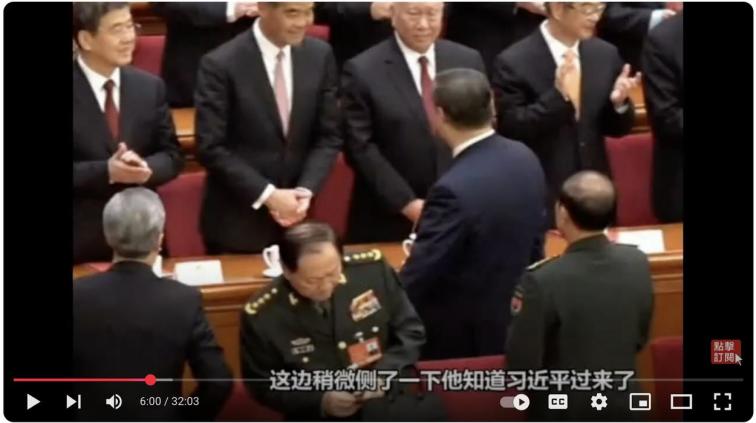
Image: During the March 2024 Two Sessions, Xi Jinping was photographed by foreign media in the Great Hall of the People with an expression of extreme pain while drinking tea. (Illustration by Qing Yu/People News)
[People News] Recently, numerous websites have been circulating rumors about Xi Jinping's declining health, particularly noting his absence from the leaders' dinner on the evening of September 12 during the BRICS summit in India. During the summit, Indian Prime Minister Modi unexpectedly paused his speech and asked Xi Jinping twice, 'Is it OK?' Furthermore, Xi Jinping appeared to have a pale complexion and was unsteady while walking. Most importantly, after returning from India, Xi Jinping has notably ceased public appearances in China. There are even online rumors claiming that he was rushed to the 301 Hospital for emergency treatment by military helicopter immediately upon his arrival in Beijing, suffering from an ischemic stroke, which is essentially a transient cerebral infarction.
Xi has vanished once again.
The author reviewed reports from party media concerning news about Xi Jinping since the 13th. The headline from the Ministry of Foreign Affairs of the Communist Party of China still focuses on the 'Return to Beijing from the BRICS Summit' dated the 13th. On the special page for Xi Jinping's activities on the China News Network, the most recent entries under categories such as 'Attending Meetings', 'Participating in Activities', 'Research and Investigation', 'Meetings and Reception', 'Official Visits', 'Speeches', and 'Phone Calls and Letters' include a letter from September 16 titled 'Xi Jinping Sends a Letter Congratulating Jilin University on Its 80th Anniversary'. Prior to that, there was a speech on the 15th at the 'Symposium on Strengthening Basic Research', but this article merely reiterates old news, as the event took place on April 30, 2026. On the Xinhua News Network's 'Xi Jinping Report Collection', the 'Latest Reports' section either compiles old news or applies Xi Jinping's viewpoints to recent events, with no accompanying images. Today (September 21), the People's Daily features a headline with Xi Jinping's proposal text from the United Nations meeting held on the 14th, which consists solely of text without any images.
Commentator Hu Liren remarked on his social media that Xi Jinping's health has indeed become a concern, and the party media is generating news about him. He analyzed that for a relatively obscure university like Jilin University, which has no direct connection to Xi Jinping, it is surprising that he would take the time to send a congratulatory letter. Those familiar with the power dynamics and news releases within the Communist Party understand that Zhongnanhai is intentionally concealing information and creating a false narrative.
As for the reasons behind Xi Jinping's health issues, some attribute it primarily to long-term alcohol consumption.
Xi enjoys drinking.
On September 18, The Wall Street Journal reported, citing Dennis Wilder (Chinese name: 韦德宁), a former senior CIA official now at Georgetown University, that Xi Jinping is overweight, dislikes exercise, and has a long-standing habit of drinking. Former Chinese Foreign Minister Qin Gang once told Wilder that Xi Jinping 'likes to drink,' and the two often enjoyed Moutai liquor together during long flights, reflecting their close relationship. Wilder recalled, 'They would drink until they were unconscious.'
Yuan Hongbing, a prominent scholar based in Australia, also revealed in a New Tang Dynasty Television program that Xi Jinping enjoys drinking, especially Moutai liquor. Yuan, who taught at Peking University, became drinking companions with Xi Jinping, who was then working in Xiamen but frequently returned to Beijing. They would often share a bottle of Moutai each, pouring and drinking for themselves, nearly finishing at the same time.
On June 30, 2005, Moutai Liquor News reported that on June 20, Xi Jinping, who was then the Secretary of the Zhejiang Provincial Committee, hosted a banquet at the West Lake State Guesthouse for the chairman of the Moutai Group, stating that he had always enjoyed drinking Moutai liquor.
On March 26, 2018, Xi Jinping hosted a banquet for North Korean leader Kim Jong-un at the Great Hall of the People in Beijing. Netizens noted from images taken at the event that the waiter was holding two bottles of 'sauce bottle short-neck Moutai.' At that time, the online store listed each bottle at a staggering price of 1.28 million yuan.
Medical professionals indicate that alcohol consumption is often the primary trigger for acute gout attacks, as it raises uric acid levels in the blood and accelerates the metabolism of purines—key metabolites in the metabolic process that are essential components of nucleic acids. This leads to an overproduction of purines and an increase in uric acid levels, which can easily result in blockages in blood flow to the brain, causing strokes or embolisms.
The Chinese Communist Party's officialdom is steeped in a culture of excessive drinking.
Party officials within the Chinese Communist Party have a penchant for alcohol, and the environment in the officialdom is characterized by a state of drunken stupor. Reports of party officials dying from alcohol consumption are not uncommon; rather, they have become a distinctive aspect of this ecosystem.
How many officials have fallen due to just one drink? An investigation by Sina.com revealed that the leading cause of abnormal deaths among officials is suicide, followed closely by alcohol-related incidents.
Li Ning, the former director of the National Tax Bureau of Wuzhou Industrial Park, hosted a banquet at a hotel, inviting leaders from his unit and the Mengshan County National Tax Bureau. During the gathering, a dispute over gambling escalated into a physical confrontation. Some attendees later moved to another hotel in the city. Upon learning of this, another group arrived and attacked them, resulting in one individual collapsing and later dying in the hospital.
Yang Xiaohan, the former director of the Joint Committee of the Political Consultative Conference in Luoyang Town, Zhongfang County, Huaihua City, violated regulations by organizing a housewarming banquet, where he invited six leaders from the Finance Bureau, the Township Political Consultative Conference, and the Family Planning Bureau to drink over two jin of white liquor together. That night, one attendee became intoxicated and was found dead in the hotel room the following day.
Some individuals have even succumbed to alcohol consumption in impoverished rural households. Zhou Daxu, the first secretary of poverty alleviation assigned to Xinxiao Village by the Disease Control Center of Zhenba County, visited five key poverty alleviation households in the village, accompanied by village group leader Li Mingliang, and drank at the home of one of the impoverished families. After finishing a bottle of white liquor, the group leader rode his bike home and tragically died after being pierced through the chest by a sharp branch from a pile of firewood by the roadside.
Some officials exploit political study sessions as an opportunity to gather and drink. For instance, in December 2022, six senior officials from the Communist Party of China (CPC) dined and drank together during a training session at the Qinghai Provincial Party School for the 20th National Congress, consuming seven bottles of liquor, which tragically resulted in one death. This incident was only made public nearly six months later.
Terms like "reception wine," "investment promotion wine," and "mixing wine" illustrate the culture of drinking among officials, who indulge in alcohol under the pretext of "public duty." They frequent various drinking venues with enthusiasm. When higher-ups visit, they are expected to drink; when colleagues from allied units come, they must also partake; and when someone arrives to handle official matters requiring approval and stamping, drinking becomes even more obligatory. Meetings related to promotions often involve excessive drinking as well. The drinking gatherings are extensive, with numerous relationships at stake; while drinking may seem trivial, the repercussions of refusing to drink can be severe. Subordinates often flatter their superiors by treating them to drinks, leading to embarrassing situations when intoxicated. There have been instances of individuals dying after consuming 11 cups on their first day in office just to show goodwill, and cases where mixed-gender dining turns women into mere companions, resulting in drunken debauchery. Additionally, there are reports of gambling leading to fatalities, with individuals displaying a rough demeanor. Some officials gather intelligence at drinking venues for personal gain, while others, driven by specific agendas, juggle a medicine bottle in one hand and a liquor bottle in the other, ultimately losing their credibility after getting drunk.
"What is being consumed is power and status, and it serves as a test of loyalty," stated Liu Yu, a secretary in a party committee office. "You might wonder how good Moutai liquor really is. Honestly, I can't discern anything special about it. So why do we drink it? Because it's expensive! Whether Moutai is authentic or not is evidently not the point; what truly matters is whether the 'power and status' behind the wine glass are real. Even if you know it's counterfeit liquor, you must drink it as if it were genuine. When a leader asks you to drink, it signifies trust, treating you as part of their inner circle, and it reflects respect for you. Additionally, it tests your loyalty to see if what my leader says can be taken seriously. This principle applies not only in the workplace but also at the dining table, as, to a large extent, the dining table serves as another office desk. If you fail to serve the leader well, your future could be challenging.
Another secretary pointed out that to achieve stable promotions in the officialdom, one must undergo an 'alcohol test,' allowing superiors to perceive one's straightforwardness and ability to grasp their intentions through one's 'drinking character.' The saying 'no joy without alcohol' underscores that 'if you don't drink, you can't get things done.' In the Chinese Communist Party (CCP), the appointment of officials follows a top-down approach; the more confused those below are, the more likely they are to be favored by leaders, thus enhancing their chances of promotion. Consequently, they will drink to the last drop.
According to reference data from a few years ago by the National Bureau of Statistics of the People's Republic of China, there were approximately 250,000 traffic accidents nationwide, resulting in about 65,000 fatalities, with an average of one person dying in a car accident every eight minutes. Among the top ten behaviors leading to accidents, drunk driving ranked fourth.
Revelations from the local disciplinary inspection and supervision commissions of the CCP indicate that drunk driving among public officials constitutes a significant portion of traffic accidents.
However, when officials drink, they are consuming public funds—taxpayers' money. The real intoxication lies not in the alcohol itself, but in the allure of power. As they exchange drinks, it becomes evident that the Chinese Communist Party's officials are primarily concerned with their own power and interests, showing little regard for the chaotic debauchery and the genuine struggles of the populace.
Despite the Chinese Communist Party's repeated alcohol bans, political analysts assert, 'It’s ineffective. Xi Jinping sets the example by drinking, and those below him are aware that as long as the higher-ups say to manage it, it doesn’t matter how excessive the behavior is down the line.'
Returning to the initial question: Is there truly an issue with Xi Jinping's health? Some analysts suggest there’s no need to rush; in a few days, he will be visiting the United States, and we can observe the situation then.
(First published by People News)
△





News magazine bootstrap themes!
I like this themes, fast loading and look profesional
Thank you Carlos!
You're welcome!
Please support me with give positive rating!
Yes Sure!