

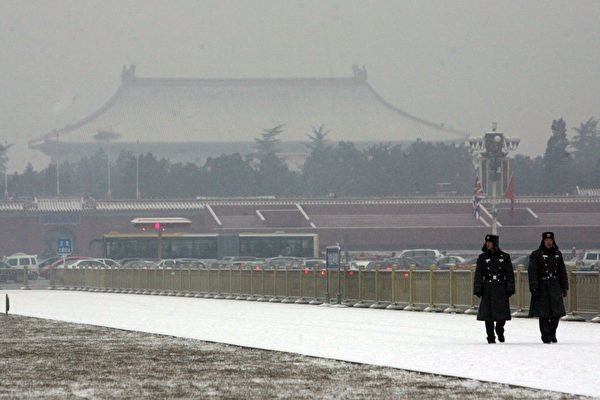
Photo Caption: The first session of the 14th National People's Congress will open on March 5, 2023, at the Great Hall of the People in Beijing, China. (Photo by Lintao Zhang/Getty Images)
[People News] Former Chongqing Mayor Huang Qifan is currently under investigation. Analysts suggest that this move reflects the Chinese Communist Party's (CCP) commitment to 'strict governance of the party' as discussed in the Fifth Plenary Session, and it also represents a significant maneuver in the personnel battles leading up to the 21st National Congress. Jiang Wangzheng, a former official from the Jiang-Zhejiang faction who accurately predicted Huang Qifan's investigation, disclosed in early October that there could be major adjustments in the CCP's senior leadership at the 21st National Congress: Xi Jinping is expected to retain his position as Chairman of the Central Military Commission, while Li Qiang is likely to take on the roles of General Secretary and President, and Ding Xuexiang is anticipated to become the Premier of the State Council...
Jiang Wangzheng indicated that his sources come from three channels: 'Zhijiang New Army, Minjiang Old Department, and Pujiang New Army.' Key points of interest from the Fifth Plenary Session include whether Cai Qi will resign as Director of the General Office of the Central Committee, and whether Zhao Yide or Chen Jining will succeed him; whether Wang Xiaohong's role as Secretary of the Party Committee of the Ministry of Public Security will be taken over by Yin Hong or Shen Xiaoming; whether He Lifeng will be replaced by Gong Zheng; and whether Chen Xiaojian, Zhang Shengmin, and others will be added as members of the Politburo.
Jiang Wangzheng frequently reveals secrets from the upper echelons of the CCP, including the fall of high-ranking officials and personnel changes, many of which have been confirmed by the CCP; thus, his disclosures have garnered significant attention.
However, changes in the power dynamics of the CCP's upper echelons, personnel shifts within the Standing Committee, particularly the resignation of the General Secretary, are among the most confidential matters within the CCP, as they pertain to internal conflicts and survival. A crucial point of analysis regarding whether Xi Jinping will step down from some positions at the 21st National Congress currently revolves around his health issues.
Many analysts believe that Xi Jinping holds multiple leadership roles within the Communist Party of China (CPC). His participation in last month's BRICS summit in India and discussions with Trump indicate that he is showing signs of health deterioration. If he is unable to manage the demands of these various roles due to his physical condition, it is plausible that he may choose to step back from some responsibilities. The Fifth Plenary Session serves as a significant observation point for this, along with subsequent reports regarding him and the senior leadership of the CPC. Typically, if a successor to the General Secretary is being groomed, there will be indications in important personnel meetings and subsequent reports leading up to the CPC's decisions. It is highly likely that this individual will undergo training within the Military Commission, potentially serving as a part-time Vice Chairman of the Military Commission.
The CPC is a rather unusual dictatorial organisation, functioning essentially as a warlord dictatorship. While the CPC asserts that the party must lead all aspects, in reality, it is military power that dominates. From Mao Zedong's establishment of power through military force, to Deng Xiaoping's authority to appoint and dismiss three General Secretaries as Chairman of the Military Commission, to Jiang Zemin's decision to retain the position of Chairman of the Military Commission after stepping down as General Secretary for self-preservation, and Hu Jintao being marginalised from military authority, which hindered directives from being issued from Zhongnanhai, it is clear that the General Secretary must possess dictatorial power supported by military strength. This is the primary reason why historical party leaders have aggressively sought military control. However, the CPC's malevolence is further exemplified by the requirement that the General Secretary also serves as the President of the State, and during Jiang Zemin's era, he even had to concurrently hold the position of Chairman of the National People's Congress. In essence, the CPC operates under any guise, both domestically and internationally, executing its will, akin to the CPC masquerading as a human to carry out its sinister activities.
In this context, if Xi Jinping relinquishes other powers while retaining military authority like Jiang Zemin, it is understandable. This is his only means of ensuring the party's obedience and safeguarding his own position. Officials within the Chinese Communist Party (CCP) are well aware that the party has committed serious crimes against China and its people. Some individuals recognise that their actions are unforgivable and, fearing retribution, choose to act with extreme ruthlessness. For them, seizing power becomes their sole guiding principle in life.
As the Fifth Plenary Session, set to convene later this month, draws near, state media has ramped up its coverage of Xi Jinping. In recent days, reports have highlighted his speeches at the Health and Wellness Conference, discussions with a foreign president, and meetings with a foreign prime minister the following day. This is intended to showcase his good health and solid grip on power. Consequently, the Xi faction must strategise, and it is likely that they will take action before the Fifth Plenary Session to intimidate the anti-Xi faction.
There are differing opinions about Huang Qifan; some claim he is aligned with Zhu Rongji, while others assert that he rose to prominence through the Jiang faction. Regardless of the narrative, over a decade ago during the Bo Xilai and Wang Lijun incident in Chongqing, Huang was able to follow Bo's orders and led a convoy of armoured vehicles to pursue his subordinate, Wang Lijun, at the U.S. Consulate in Chengdu. He later reported to the Hu-Wen central government about the secrets surrounding Bo's handling of the Wang case. This indicates that he is part of the fence-sitting faction and not aligned with Xi. Therefore, ahead of the crucial personnel positioning meeting for the 20th National Congress—the Fifth Plenary Session—using an individual as a warning example is also a possibility.
(First published by People News) △







News magazine bootstrap themes!
I like this themes, fast loading and look profesional
Thank you Carlos!
You're welcome!
Please support me with give positive rating!
Yes Sure!