
The Mbappé 'Insult to Mao' Controversy: Is Beijing Behind It? (Video)
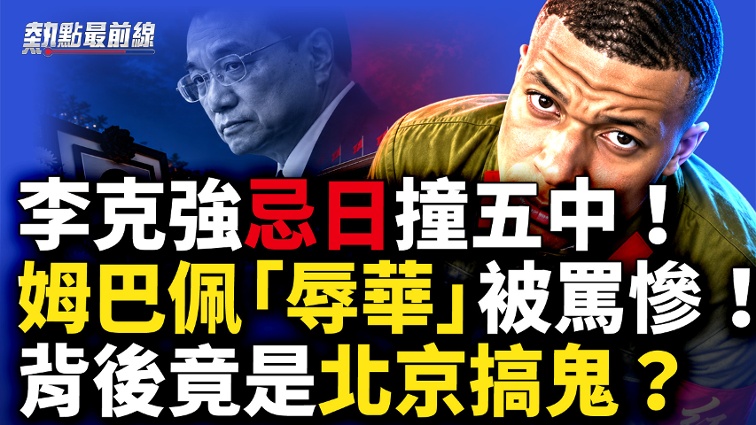
[People News] In April 2026, French football superstar and Real Madrid player Kylian Mbappé mentioned on the French football podcast The Bridge that he had seen an image in which his face had been digitally superimposed onto that of a Chinese historical figure. In English, he said: “Some guy — I think he's a Chinese dictator.” He also said that this manipulated image was one of the funniest internet memes he had ever seen and that he would occasionally share it with friends as a joke. According to the footage and related reports, the figure he was referring to was Mao Zedong.
The podcast had been available for several months, but it was not until around October 26 that the clip began circulating widely online. Then, suddenly, a storm erupted!
Whose Feelings, Exactly, Did Mbappé Hurt?
The interview clip triggered a strong backlash from the Chinese Communist Party (CCP) authorities and public opinion circles. Guo Jiakun, spokesperson for the CCP's Ministry of Foreign Affairs, subsequently stated that words and actions that hurt the feelings of the Chinese people would naturally meet with collective opposition from all sectors of Chinese society.
His remarks sounded righteous and stern, but they contained a fundamental problem: Whose feelings, exactly, did Mbappé hurt?
In an article, author Peng Jian pointed out that Mbappé did not hurt the feelings of the Chinese people. Rather, he hurt the political pride of the CCP. Conflating the two is precisely a political rhetorical tactic the CCP routinely employs.
First of all, Mao Zedong was merely the leader of the CCP. He was not synonymous with China, much less with the Chinese people.
Whether Mao Zedong was a dictator is a historical and political question open to discussion and debate. Chinese people have the right to express their opinions, and foreigners certainly have the same right. Does a historical figure automatically acquire the privilege of being beyond criticism simply because he once wielded supreme political power?
The political campaigns launched by Mao Zedong during his rule, particularly the Great Leap Forward and the Cultural Revolution, brought enormous disasters upon Chinese society. The Great Famine claimed tens of millions of lives, while the Cultural Revolution destroyed countless families and ruined countless lives. Are these historical facts no longer allowed to be mentioned or criticised simply because Mao Zedong was the leader of the CCP?
On what grounds does the CCP demand that all Chinese people must hold the same feelings toward Mao Zedong? And on what grounds does it demand that foreigners must also evaluate Mao Zedong according to the standards prescribed by the CCP?
Even more absurdly, the CCP has long been in the habit of distorting criticism of itself and its leaders into insults against China and the Chinese people.
Criticising the CCP is labelled anti-China; criticising Xi Jinping is portrayed as disrespecting China; criticising Mao Zedong is said to hurt the feelings of the Chinese people. The absurdity of this logic lies in the fact that it effectively binds a political party, a political regime, and its leaders together with an entire country and its people.
China has a history and culture spanning 5,000 years, a population of more than 1.4 billion, and a civilizational tradition far older and richer than the history of the CCP. The CCP is merely the ruling authority in China's present-day political system. It is not the embodiment of China, nor does it have the right to monopolise the feelings of the Chinese people.
The reason the CCP has consistently been so eager to package its own political sentiments as the national sentiments of the Chinese people is straightforward: Once the two are tied together, criticism of the CCP can be transformed into an offense against the entire nation and then assigned a kind of moral original sin. Critics no longer need to be confronted with facts and reason. Instead, they are first pushed into opposition to the Chinese people.
This is a classic form of rhetorical coercion.
A truly confident country would not feel that its national dignity was threatened simply because a foreigner criticised one of its historical figures. A truly self-assured government would not need to interpret every criticism directed at itself as an insult to its people.
Ultimately, what Mbappé touched was not a red line concerning the feelings of the Chinese people, but a political red line that the CCP does not allow anyone else to cross.
Mbappé’s Ordeal Has Taught the World a Lesson
Many Westerners believe that the CCP is not as frightening as people make it out to be. Some even believe that its system of governance is better than that of Western countries. They travel to China, engage in business cooperation with the CCP, or enjoy the hospitality extended by the authorities. After interacting with the CCP on several occasions without experiencing anything particularly troubling, they conclude that CCP rule is not really so frightening. Some even believe that the CCP's publicly reported atrocities have been exaggerated.
Author Zhao Ming wrote that Mbappé's firsthand experience has allowed the entire world to witness the Communist Party's "iron fist."
On October 26, videos related to Mbappé began circulating widely on social media. Chinese football media outlets and internet users began criticising his remarks. Some media outlets did not directly quote what he had actually said, instead vaguely describing his comments as "inappropriate remarks concerning China."
On October 27, Chinese brands including Dongpeng Beverage, Mengniu, and Milkground announced that they were terminating their partnerships with Mbappé. CCP Foreign Ministry spokesperson Guo Jiakun stated that words and actions that "hurt the feelings of the Chinese people" would naturally be met with resistance from all sectors of Chinese society. According to reports, China Central Television (CCTV) suspended broadcasts of related La Liga matches and removed Mbappé advertisements. Platforms such as Weibo and Xiaohongshu imposed restrictions on his accounts.
On October 27, Mbappé issued an apology statement in French, English, and Chinese.
On October 28, Real Madrid issued an apology statement.
After October 29, the commercial impact of the boycott continued to expand, with no sign of abating...
Mbappé could hardly have imagined that an ordinary comment would provoke such a massive campaign of boycotts.
In France, he could comment on Emmanuel Macron, Charles de Gaulle, Napoleon, the "Sun King" Louis XIV, or any other prominent figure in French history without ever facing such severe pressure or punishment.
If Mbappé believes that his remarks truly hurt the feelings of the Chinese people, he is completely mistaken. In reality, when he called Mao Zedong a dictator, he hurt only the "feelings of the CCP," not those of the "Chinese people." How many Chinese people did Mao Zedong persecute? How many Chinese people despise him? Many Chinese actually applauded when they learned that Mbappé had called Mao Zedong a dictator.
If Mbappé believes that the boycott against him and the termination of commercial partnerships by various companies were all spontaneous actions, he is equally mistaken. There is no need even to mention the high-profile involvement of the CCP's Foreign Ministry spokesperson or the fact that Chinese football media are, in essence, state-run media. Even the companies themselves, including Dongpeng Beverage, Mengniu, and Milkground, operate under the CCP's "whole-nation system" and within a society where the CCP controls everything. Their actions could hardly have been spontaneous or independent.
There is another matter that Mbappé and many Westerners would never have anticipated: In mainland China, no media outlet, including independent media platforms, dares to report exactly what Mbappé said. They all resort to vague descriptions, claiming only that he made "inappropriate remarks concerning China." Over the past few days, on the Chinese mainland internet, anyone who dares to ask what Mbappé actually said is immediately met with deleted posts and may even have their account or online group shut down. Across the entire Chinese mainland internet, only one voice is permitted: the voice supporting the boycott of Mbappé. Any expression of doubt is suppressed and erased. Think about it: Is this really a "spontaneous" action by ordinary citizens?
Clearly, what Mbappé has encountered is a systematic campaign of suppression directed, organised, and orchestrated by the CCP. It is by no means a spontaneous boycott by the "Chinese people" in response to hurt feelings.
Westerners, and indeed people throughout the world, should learn a lesson from this incident: They should recognise the CCP for what it truly is and gain a deeper understanding of its nature.
Many Westerners see only some superficial aspects of the CCP and conclude that it is not really so bad. To those who hold this view, someone once offered the following suggestion: Open an account on a Chinese mainland media platform and try posting about politics and political leaders just as you would in a foreign country. Discuss CCP policies and offer your opinions on CCP leaders. Just try doing that, and you will immediately discover what the CCP is really like! Even posts published by the official WeChat public account of the U.S. Embassy in China can be censored and the account restricted, let alone those of ordinary individuals.
Now, think about this: If even a foreigner who makes a single comment about a CCP leader can face such a massive campaign of suppression, what kind of persecution must Chinese people living in mainland China endure when they express their own opinions?
If people would take the time to calmly consider this question, they would begin to take reports about the CCP's atrocities, including its persecution of ethnic minorities, Christian house churches, Falun Gong practitioners, and allegations of forced organ harvesting, among other abuses. They would no longer dismiss such reports as exaggerations.
The CCP's persecution of these groups employs the same methods used in its suppression of Mbappé. In both cases, the CCP operates behind the scenes to plan, direct, organise, and drive the campaign, while disguising its involvement by claiming that the suppression is a "spontaneous action" by the public. The only difference is that the scale and consequences of the CCP's persecution of Falun Gong and other groups are far more severe than those of the campaign against Mbappé.
Think about it: What could an authoritarian regime as domineering as the CCP bring to China and to the world? If the CCP were allowed to rule the world, what would the world become?
Internet Users’ Wry Comments
Internet commentator Li Chengpeng (known as Big-Eyed Brother) put it bluntly and sarcastically: "Mbappé merely played along with a dictator meme. This kind of thing is extremely common in the United States and Europe. Don't assume that the 'Little Pinks' don't understand. The reason they reacted so strongly is that they are afraid that if this trend isn't stopped, sooner or later people will start making jokes about the dictator who is still alive. That's the real truth!"
△




News magazine bootstrap themes!
I like this themes, fast loading and look profesional
Thank you Carlos!
You're welcome!
Please support me with give positive rating!
Yes Sure!