
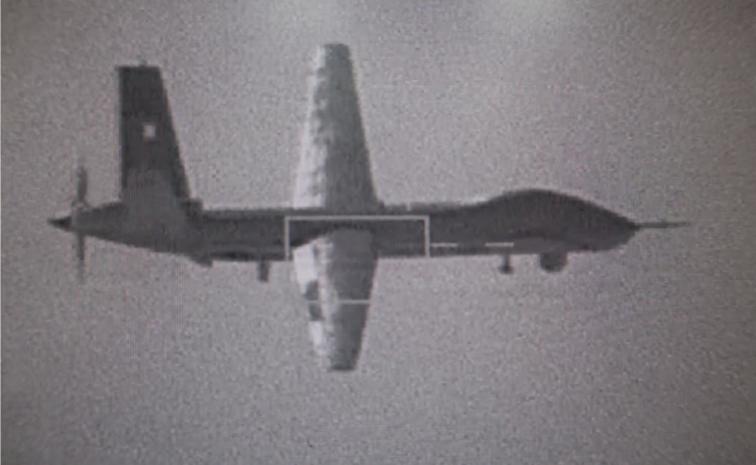
Republic of China Air Force F-16V fighter jets monitoring Chinese attack drones. (Provided by the Ministry of National Defense of the Republic of China /Dajiyuan)
[People News] The large-scale purge within the Chinese Communist Party (CCP) military is still continuing. A number of full generals from the Air Force, or with Air Force backgrounds, have successively been reported as having run into trouble. This development deserves close attention.
A number of heavyweight Air Force full generals have run into trouble or are suspected of having done so
1. Have the Air Force Commander and Political Commissar run into trouble?
On December 11, 2025, well-known Chinese political scholar Liu Junning broke the news on social media platform X that the current Air Force Commander, Full General Chang Dingqiu, suddenly died of a heart attack during a period of “detention and questioning” by the (Military Discipline Inspection Commission and Supervisory Commission).
This was yet another explosive piece of news from the CCP military this year, immediately triggering widespread attention and commentary both inside and outside China. However, to this day the CCP authorities have not issued any “rumor refutation,” and Chang Dingqiu himself has not appeared publicly to refute the rumors.
A search of Baidu Baike shows that the entries for Air Force Commander Chang Dingqiu, Air Force Political Commissar Guo Puxiao, and Air Force Deputy Commander Yu Qingjiang have all been deleted.
In Baidu Baike’s entries related to the CCP Air Force, clicking on the names of current Commander Chang Dingqiu and current Political Commissar Guo Puxiao yields the message: “Sorry, the page you visited does not exist.”
From October 20–23, the three Air Force Central Committee members—Chang Dingqiu, Guo Puxiao, and Yu Qingjiang—all attended the Fourth Plenary Session of the Central Committee. However, in the two months since the conclusion of the plenum, none of them has made a public appearance.
Central Committee member Zhong Shaojun, who also attended the Fourth Plenary Session, has already been removed from his post as Political Commissar of the National Defense University. To date, there have been no reports of him taking up any position in the National People’s Congress or the Chinese People’s Political Consultative Conference, making it highly likely that Zhong Shaojun has run into trouble.
Based on the above circumstances, it can be inferred that the two or three Air Force generals who attended the Fourth Plenary Session—Chang Dingqiu, Guo Puxiao, and Yu Qingjiang—may also have run into trouble.
2. Has Xu Qiliang, former Vice Chairman of the Central Military Commission with an Air Force background, run into trouble?
Xinhua News Agency reported that on June 2, 2025, Xu Qiliang, former member of the CCP Politburo and Vice Chairman of the Central Military Commission, died in Beijing “of illness” at the age of 75.
Hong Kong media quoted veteran Beijing media figure Ma Ling as revealing on her Moments that Xu Qiliang suffered a sudden myocardial infarction during an early-morning run, and despite being rushed to the hospital, could not be saved.
However, on May 31, former Chinese media figure Zhao Lanjian, now overseas, broke news on X stating that reports of Xu Qiliang’s death had already emerged in the early hours of May 28. According to internal official rumors, the cause was said to be “heart disease,” but text messages he received from military insiders suggested a more complex situation: Xu may have been subjected to prolonged high pressure, cooperated with pre–Taiwan Strait war rectification efforts, was “cleared out” and marginalized, became extremely panicked, and ultimately collapsed suddenly. Military friends directly said, “Xu Qiliang was scared to death.”
Xu Qiliang was a special-grade Air Force pilot by background, and his physical condition should have been very good. He had already been retired for more than two years and had no work-related pressure. As a vice–state-level official, he enjoyed the best medical care. Retired CCP officials at vice–state-level and above, except under extremely special circumstances, are almost all “long-lived,” with many living into their 90s or even over 100. During the September 3 military parade, Xi Jinping even spoke about “living to 150,” and Xu Qiliang was Xi’s number one trusted aide in the military during the decade from 2012 to 2022. Considering all these factors, the likelihood that Xu Qiliang died suddenly purely from a heart attack appears relatively low.
The CCP officially announced that Xu Qiliang died on June 2, while Zhao Lanjian revealed that Xu Qiliang died on May 28—a discrepancy of five days. What explains this?
Given that internal struggles at the top of the CCP are often a matter of life and death, that today’s CCP high-level politics is almost completely a black box, and in light of the series of abnormal phenomena mentioned above, I believe that the possibility that Xu Qiliang ran into trouble due to internal military infighting is relatively high.
3. Has former Air Force Commander Ma Xiaotian run into trouble?
On October 29, 2025, Zhao Lanjian broke news on X: “CCP Air Force Commander Ma Xiaotian has been arrested. This is the twelfth time since 2023 that I have accurately revealed months in advance the purge of top CCP military and political officials.”
Ma Xiaotian served as Air Force Commander from October 2012 to August 2017. His successor, Ding Laihang, served from August 2017 to September 2021. Chang Dingqiu, who succeeded Ding Laihang, has served as Air Force Commander from September 2021 to the present.
Reviewing the résumés of Ma Xiaotian and Ding Laihang shows that they have certain connections. Ma Xiaotian once served as commander of the 72nd Regiment of the 24th Air Force Division, while Ding Laihang once served as commander of the 71st Regiment of the same division. As successive Air Force Commanders, there may have been some form of linkage between Ma Xiaotian and Ding Laihang. Ding Laihang had already fallen in 2023 (to be discussed below).
To date, CCP party media have not reported any public appearances by Ma Xiaotian. The CCP authorities have not refuted the above revelations, and Ma Xiaotian himself has not appeared to deny them.
Against the backdrop of the current large-scale purge in the CCP military, the possibility that Ma Xiaotian has run into trouble cannot be ruled out.
4. Former Air Force Commander Ding Laihang has already fallen.
In November 2023, former Air Force Commander Ding Laihang was reported to be under investigation by the military discipline inspection authorities for involvement in the corruption case related to the Beijing Western Suburbs Airport project.
On December 4 of the same year, Ding Laihang was removed from his position as a deputy to the 14th National People’s Congress by the Air Force servicemen’s representative assembly due to “suspected serious violations of discipline and law.” On December 29, the Standing Committee of the National People’s Congress issued an announcement terminating Ding Laihang’s qualifications as an NPC deputy.
Ding Laihang’s investigation is already a settled matter. He may already have been expelled from the Party and the military, stripped of his rank as full general, and transferred for judicial review.
5. Has Xu Xueqiang, Director of the CMC Equipment Development Department with an Air Force background, run into trouble?
Full General Xu Xueqiang of the CCP Air Force, Director of the Central Military Commission’s Equipment Development Department, did not attend the Central Economic Work Conference held in Beijing from December 10 to 11, 2025, as was customary. After assuming the post in 2022, Xu Xueqiang attended the conference in 2022, 2023, and 2024 for three consecutive years.
On November 5, 2025, the commissioning ceremony for the CCP’s so-called “first electromagnetic catapult aircraft carrier,” the Fujian, was held in Sanya, Hainan. Xi Jinping and officers and soldiers from relevant CMC departments, the Southern Theater Command, and the Navy attended, but Xu Xueqiang, Director of the Equipment Development Department, was absent.
Xu Xueqiang, along with 13 other full generals who are also Central Committee members, was absent from the Fourth Plenary Session held from October 20–23.
On October 18, 2025, U.S.-based commentator Cai Shenkun revealed to The Dajiyuan that Xu Xueqiang had already fallen.
Based on the above abnormal phenomena and revelations, it is highly likely that Xu Xueqiang has run into trouble.
6. Has Wang Qiang, Commander of the Central Theater Command with an Air Force background, run into trouble?
Xi Jinping’s 2025 “September 3 Military Parade” was a globally watched event. According to convention, the parade commander should have been Full General Wang Qiang, Commander of the Central Theater Command with an Air Force background. However, the parade commander was not Wang Qiang, but Lieutenant General Han Shengyan, Commander of the Central Theater Command Air Force. On July 31, Wang Qiang was absent from the reception marking the 98th anniversary of the founding of the PLA.
Both of these anomalies triggered speculation that Wang Qiang might have run into trouble.
However, Wang Qiang did attend the Fourth Plenary Session convened on October 20. But this does not mean that he could not later run into trouble.
As mentioned above, Air Force Commander Chang Dingqiu, Air Force Political Commissar Guo Puxiao, and Air Force Deputy Commander Yu Qingjiang all attended the Fourth Plenary Session, yet now they may very well have been “wiped out in one sweep.”
Since the Fourth Plenary Session, there have been no reports of Wang Qiang making any public appearances. Judging from all the abnormal situations mentioned above, Wang Qiang may already have run into trouble.
7. Has Xu Xisheng, Rocket Force Political Commissar with an Air Force background, run into trouble?
After the major Rocket Force case broke out in 2023, Rocket Force Commander Li Yuchao, Deputy Commander Li Chuanguang, Deputy Commander Liu Guangbin, former Deputy Commander Zhang Zhenzhong, Chief of Staff Sun Jinming, and others were all “wiped out in one sweep,” and Rocket Force Political Commissar Xu Zhongbo was also sidelined.
At that time, Xi Jinping had no trust in Rocket Force generals and decided to transfer in a commander and political commissar from outside the Rocket Force. Xi entrusted this task to his “organization minister” within the military—Miao Hua, Director of the CMC Political Work Department. Miao Hua selected one person each from the Navy and the Air Force as candidates for the new Rocket Force commander and political commissar: then–Navy Deputy Commander Wang Houbin and Southern Theater Command Deputy Political Commissar and Southern Theater Command Air Force Political Commissar Xu Xisheng.
On October 17, 2025, a Ministry of National Defense spokesperson announced that Rocket Force Commander Wang Houbin, suspected of serious violations of discipline and law, had been expelled from the Party and the military and transferred for judicial review. The fourth Rocket Force commander, Wang Houbin, had been in office for just over two years before falling for “serious violations of discipline and law.”
Although the CCP authorities have not announced that Rocket Force Political Commissar Xu Xisheng has fallen, Xu Xisheng was absent from the Fourth Plenary Session.
On June 28 of this year, Du Wen, a former Inner Mongolia official living in Europe, revealed on X: “CCP Air Force Lieutenant General Qiao Xiangji, currently Deputy Commander of the Southern Theater Command and Commander of the Southern Theater Command Air Force, was taken away today by the military discipline inspection authorities at the scene of the Southern Theater Command Air Force conference.” More than ten hours later, Du Wen revealed again that Rocket Force Political Commissar Xu Xisheng was also arrested along with Qiao Xiangji.
Around 2014, Qiao Xiangji served as Commander of the Air Force Fuzhou Command Post, and at that time the Political Commissar of the Fuzhou Command Post was Xu Xisheng.
Based on the above, the likelihood that Xu Xisheng has run into trouble is also relatively high.
8. Has former Air Force Political Commissar Yu Zhongfu run into trouble?
Yu Zhongfu, a full general of the Air Force who transferred in 2023 from Air Force Political Commissar to the National People’s Congress, was absent from the NPC Standing Committee meeting held the day after the close of the Fourth Plenary Session (October 24).
As early as April 2025, there were online reports that Yu Zhongfu had been taken away by military discipline inspection authorities and that his home had been searched.
When Yu Zhongfu served as Director of the Political Department of the Lanzhou Military Region Air Force from 2010 to 2012, he had dealings with Miao Hua, who was then Director of the Lanzhou Military Region Political Department. When Ding Laihang was Air Force Commander, Yu Zhongfu served as Air Force Political Commissar, and the two worked together as the military and political chiefs of the Air Force for four years.
Both Ding Laihang and Miao Hua have already fallen. Yu Zhongfu may have run into trouble due to being implicated.
Reasons why the above Air Force full generals have run into trouble or are suspected of having done so
1. Possibly related to the major cases involving He Weidong and Miao Hua.
On October 17, a Ministry of National Defense spokesperson announced that CCP Politburo member and Vice Chairman of the Central Military Commission He Weidong, former CMC member and Director of the Political Work Department Miao Hua, and nine other full generals, suspected of serious violations of discipline and law, had been expelled from the Party and the military and transferred for judicial review.
He Weidong was personally, exceptionally, and rapidly promoted and heavily trusted by Xi at the CCP’s 20th National Congress, becoming a Politburo member and Vice Chairman of the CMC in charge of political work and personnel matters. Miao Hua was personally promoted and trusted by Xi as the “organization minister” of the military, responsible for the selection and appointment of senior generals across the entire armed forces, and the “chief political commissar” among all political commissars.
Given the special positions of He and Miao in the military, their downfall is certainly not about ordinary corruption, but rather about major political issues. What major political issues did they have? In the words of a CCP military newspaper editorial, it was “loss of loyalty” and “serious damage to the principle that the Party commands the gun and the system of responsibility of the CMC chairman.”
What does this mean? It means that within the CCP military there emerged an “anti-Party group” headed by He and Miao, which not only accepted bribes of “especially huge amounts” economically, but also posed political problems of being “anti-Party,” “disrupting the military,” and “seizing power.”
The “anti-Party group” of He and Miao extended from the Vice Chairman of the CMC, to CMC departments such as the Political Work Department and the Joint Operations Command Center, to services such as the Rocket Force, Navy, and Army, to theater commands such as the Eastern Theater Command, to the Armed Police Force—and naturally could not exclude the Air Force.
2. Possibly related to the sudden death of Xu Qiliang.
Xu Qiliang, with an Air Force background, served as a CCP Politburo member and Vice Chairman of the Central Military Commission for a full ten years and was one of Xi’s most important assistants in carrying out the large-scale military purge, military reforms, and reshuffling of senior military leadership.
Xi’s military purge, reforms, and reshuffling of senior generals were in fact a process of redistributing interests at the top of the CCP military. Some people lost out, even becoming prisoners, and some even lost their lives; others benefited, with promotions in rank or position, gaining both fame and fortune.
In this process, Xu Qiliang promoted and reused a number of Air Force generals, while also offending quite a few people.
When infighting at the top of the military resumed shortly after the conclusion of the 20th Party Congress, although Xu Qiliang had retired, he could not remain completely detached and may even have become one of the focal points of the power struggle.
Xu Qiliang’s sudden death may be related to sharp and intense infighting at the top of the military.
After Xu Qiliang fell, a number of senior Air Force generals whom he had promoted and reused may also have fallen in turn.
3. Possibly related to retroactive investigations into Air Force equipment procurement.
On December 15, the CCP’s “Military Procurement Network” issued an “Announcement on Soliciting Information on Irregular Procurement Issues in Air Force Units.” The announcement stated that it mainly accepts reports of irregularities related to material and service procurement activities organized by Air Force units (including projects organized by bidding agencies), including but not limited to demand formulation, procurement evaluation, contract performance, supplier punishment, selection of bidding agencies, online procurement, and so on.
The announcement stated that suppliers participating in Air Force procurement activities, evaluation experts, bidding agencies, bidding agents, and internal military personnel related to projects may submit real-name reports by mail. The deadline for acceptance is June 30, 2026.
This is the first time the CCP has publicly launched such an investigation targeting a specific military service.
In July 2023, the Central Military Commission publicly solicited clues regarding violations and disciplinary breaches by experts involved in equipment procurement bid evaluations across the entire military, retroactively investigating back to October 2017. Subsequently, a group of senior generals fell, including the first, second, and third Rocket Force commanders Wei Fenghe, Zhou Yaning, and Li Yuchao; CMC member, State Councilor, Minister of National Defense, and former Director of the CMC Equipment Development Department Li Shangfu; as well as senior executives of major state-owned military-industrial enterprises such as China North Industries Group.
The “Military Procurement Network” issuing a special announcement to solicit information on irregular procurement issues specifically for the Air Force indicates that another group of senior Air Force generals will fall due to serious violations of discipline and law in military equipment procurement.
Conclusion
Less than half a year after the conclusion of the CCP’s 20th National Congress, in the spring and summer of 2023, the large-scale purge within the CCP military began with the Rocket Force, then spread to the CMC Equipment Development Department, the Logistics Support Department, the Joint Staff Department, the Joint Operations Command Center, the Political Work Department, the Political and Legal Affairs Commission, the CMC General Office, the Navy, the Army, the Armed Police Force, the Information Support Force, and the five major theater commands. Now, it has spread to the Air Force.
What does this indicate? It indicates that infighting within the CCP military is escalating, has expanded to encompass the entire armed forces, and shows no sign of ending.
(Source: The Dajiyuan)
△







News magazine bootstrap themes!
I like this themes, fast loading and look profesional
Thank you Carlos!
You're welcome!
Please support me with give positive rating!
Yes Sure!