
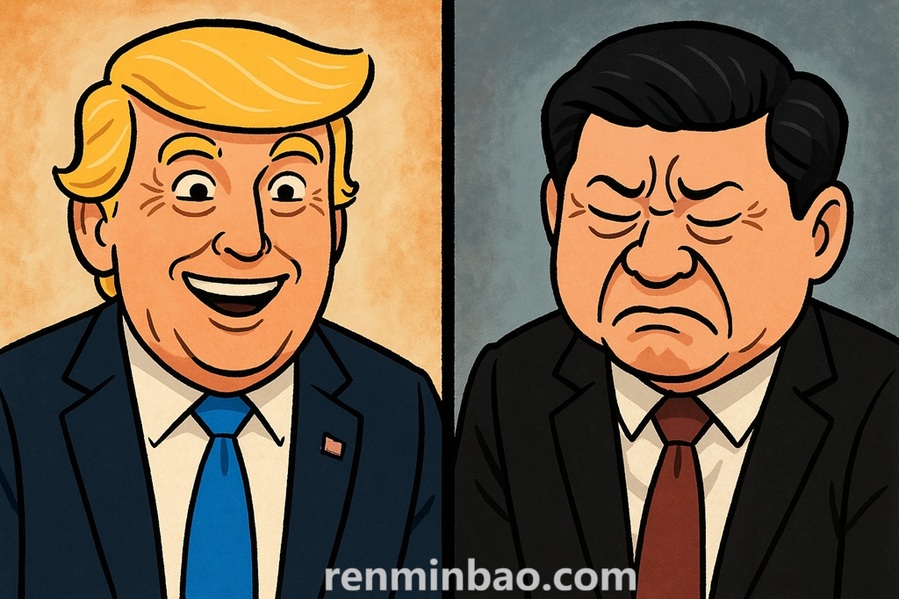
Thinking about taking action against Taiwan? Trump: You are free to think about it, but what are you actually going to do? (People News/AI-generated image)
[People News] On February 4, CCP leader Xi Jinping spoke by phone with U.S. President Donald Trump, making additional commitments at a moment of internal turmoil in Beijing. Observers say Xi appeared to soften his stance toward Washington, possibly hoping the U.S. would avoid involvement in CCP internal power struggles — and perhaps even offer him indirect political support. Both sides’ statements suggested subtext beneath the formal language. The sudden political infighting in Beijing shows no clear path to resolution.
A “New Gift List” for Trump
After the call, Trump posted that they discussed trade, Taiwan, Russia–Ukraine, Iran, and Chinese purchases of U.S. goods. He said Xi pledged to raise soybean imports to 20 million tons this quarter and 25 million tons next quarter, along with increased purchases of U.S. oil, natural gas, and aircraft engines.
If accurate, that would represent a major increase from previous levels and signal a new goodwill gesture from Beijing. Energy purchases from the U.S. could also affect China’s imports from Russia.
Xi had already made commitments during an October 2025 meeting with Trump. With no major deterioration in U.S.–China relations since then, analysts find it notable that Xi offered new concessions now — suggesting unusual pressure on Beijing’s side.
Subtext in the Diplomatic Language
Beijing’s official readout used standard slogans, with Xi saying China “keeps its word and delivers results.” However, unlike typical Chinese statements, Trump’s version included specific purchase figures — suggesting Xi emphasized fulfilling and even expanding earlier promises.
Trump responded warmly, emphasizing that his personal relationship with Xi was “very good” and that both sides value maintaining that relationship. Days earlier, Trump had publicly described Xi as the “boss” of China, reinforcing the idea that Washington still sees Xi as firmly in control — a statement that may help stabilize perceptions during internal CCP uncertainty.
Xi’s comment that he “highly values U.S.–China relations” may signal that continued cooperation — and possibly further concessions — depends on his remaining in power.
Softer Tone on Taiwan?
China’s statement mentioned Taiwan separately but only urged the U.S. to “prudently handle arms sales to Taiwan.” Previous wording usually demanded Washington “prudently handle the Taiwan issue” more broadly.
This narrower phrasing may indicate a temporary lowering of rhetorical pressure — possibly another sign Xi is prioritizing external stability while facing domestic challenges.
Trump mentioned Taiwan only briefly, focusing more on Ukraine and Iran.
Silence on Russia and Iran
Notably, China’s readout did not mention Ukraine or Iran at all, even though Trump said both were discussed. Before calling Trump, Xi also spoke with Vladimir Putin, yet neither side’s public summary emphasized Ukraine.
At the same time, Trump has been strengthening energy and trade ties with India while pressuring countries buying Russian oil. If China continues large-scale Russian energy imports, it risks secondary U.S. sanctions — something Beijing may be trying to avoid.
Mounting External Pressures
Beyond U.S. relations, Beijing faces growing challenges elsewhere:
-
The EU recently launched an investigation into Chinese wind turbine giant Goldwind over alleged unfair subsidies.
-
The U.S. is leading a multinational effort to secure critical mineral supply chains, reducing dependence on China.
-
Panama’s top court ruled against a Hong Kong firm’s control of key canal ports, seen as a geopolitical setback for Beijing.
These developments suggest China’s global leverage is under strain.
A Regime Under Dual Pressure
With internal political tensions rising and external economic and diplomatic pressure intensifying, Xi’s new concessions to Trump may reflect both state-level vulnerability and personal political calculation.
Whether aimed at preventing foreign pressure or securing symbolic international backing, the call indicates that Beijing’s crisis runs deeper than official messaging suggests. The unfolding struggle inside Zhongnanhai could shape not only China’s future path, but also global stability in the years ahead.△




News magazine bootstrap themes!
I like this themes, fast loading and look profesional
Thank you Carlos!
You're welcome!
Please support me with give positive rating!
Yes Sure!