

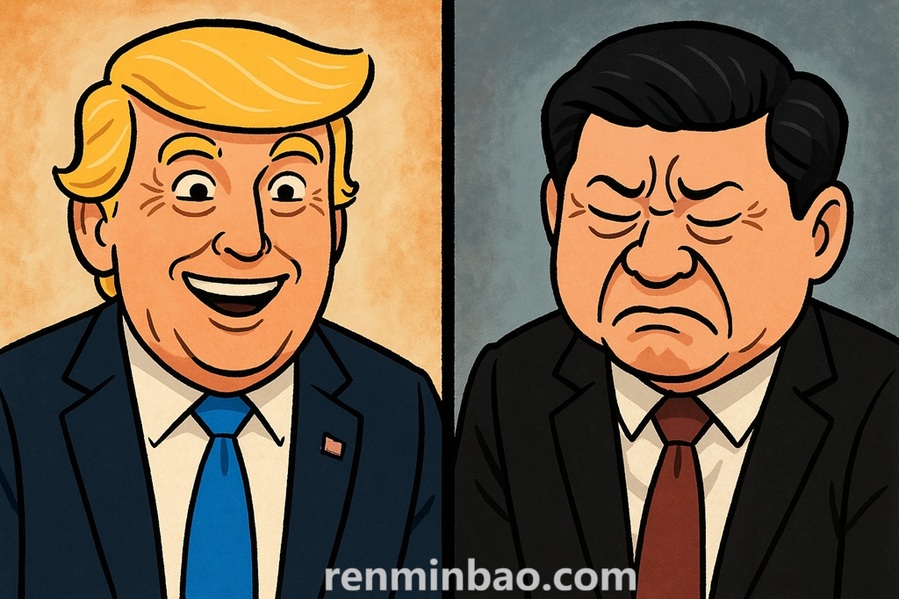
On September 19, 2025, during a phone call between Trump and Xi, Trump came away with a double win, while the CCP’s wolf warrior diplomacy was left deflated. (Image by People News)
[People News] On February 4, U.S. President Trump posted on the “Truth Social” platform about the contents of his just-completed call with CCP leader Xi Jinping: “We discussed many important topics, including trade, the military, my upcoming trip to China in April (I very much look forward to it!), the Taiwan issue, the Russia–Ukraine war, the Iran situation, China buying oil and natural gas from the United States, China considering increasing purchases of agricultural products (including raising this quarter’s soybean purchases to 20 million tons—they have already promised next quarter’s purchases will be 25 million tons!), aircraft engine deliveries, and many other topics.”
From the information Trump provided, he has clearly applied new pressure on Xi and the CCP. In particular, Trump’s demand that Xi buy U.S. oil and natural gas is something that had not appeared in previous calls.
What makes the CCP especially uncomfortable is that what Trump wants to sell to the CCP is precisely Venezuelan oil.
It turns out that after U.S. forces captured Venezuelan President Maduro alive in early January, the United States had already reached an oil arrangement with Venezuela: Venezuelan oil would be sold by the United States, and the proceeds would be allocated at the discretion of the U.S. government—used to stabilize Venezuela’s situation, keep the government functioning, and provide assistance to the public, among other purposes. In mid-January, the United States had already obtained 50 million barrels of crude oil from Venezuela; in early February, Venezuela received the first tranche of $500 million in sales proceeds.
Over the past decade-plus, the CCP, aiming to expand its influence in Latin America and constrain the United States, has strongly supported Venezuela, a country of major strategic geographic importance. Beyond political backing, investment cooperation, and close collaboration in trade, energy, agriculture, technology, education, and other fields, the CCP has also provided military support. For example, since 2000, the CCP has made large-scale investments and, through multiple funds, provided Venezuela with nearly $60 billion in support—helping build infrastructure in exchange for oil supplies.
As of 2025, China had already become Venezuela’s largest creditor. Venezuela owed China tens of billions of dollars, with some repaid through oil shipments. Not long ago, overseas sources also exposed a scandal alleging Xi Jinping’s elder sister, Xi Qiaoqiao, profited from oil.
However, Venezuela is not China’s most important source of oil imports. According to CCP official data, in 2025 Russia remained China’s largest source of crude oil imports. In 2025, China imported 101 million tons from Russia, worth 356.4 billion yuan, accounting for 16.8% by value. Clearly, countries around the world know that Russia’s ability to sustain the Russia–Ukraine war cannot be separated from the CCP’s economic “blood transfusions,” as well as its military and high-tech support.
In terms of financial support, for instance, even before Russia invaded Ukraine in 2022, during Putin’s visit to China, the two sides’ relevant departments and enterprises signed 15 cooperation documents, including purchase-and-sale agreements for Russia to export bulk commodities such as oil and natural gas to China.
For example, Rosneft and China National Petroleum Corporation (CNPC) signed an agreement to supply 100 million tons of oil to China over a 10-year period via transit through Kazakhstan. The two sides also signed a supplementary agreement to ensure crude oil supply for refineries in western China. Rosneft’s website stated that the total value of the agreement was not fixed, because it would depend on oil market prices—meaning “the price for each delivery is calculated using a formula based on crude oil market quotations,” with the current calculation being $80 billion (about 500 billion yuan).
In addition to the oil supply agreement, CNPC also signed a long-term natural gas supply agreement with Gazprom. Under the agreement, Gazprom would supply CNPC with 10 billion cubic meters of pipeline gas via the China–Russia Far East route. After the Far East route is completed, Russia’s total annual pipeline gas supply to China will reach 48 billion cubic meters—about a 26% increase over the planned level of existing supplies.
Reports from Russian news agencies show that Russian gas exports are transported to China through the Power of Siberia pipeline, with 2025 supply reaching 38.6 billion cubic meters—up 25% from 31.0 billion cubic meters in 2024. This figure, for the first time, exceeds total pipeline exports to Europe.
Since Russia’s invasion of Ukraine in 2022, countries including China, India, and Brazil have been buying Russian oil and petroleum products. Among them, the CCP purchased about 45% to 50% of Russia’s oil, India purchased about 40%, and other buyers included Brazil and other Latin American countries.
China’s and India’s purchases have objectively served as a “blood transfusion” enabling Russia to prolong the war, because Russia’s oil revenue has not declined. This has also helped the Russian authorities mitigate their increasingly deteriorating economy.
The world has long known all this. But given the CCP’s rogue posture and retaliatory tactics, many governments, for various reasons, have not dared to provoke the CCP. Trump—who, from the start of his term, has been making every effort to mediate an end to the Russia–Ukraine war—also knows that he must cut off Russia’s economic “blood transfusion,” and one of the measures is to use tariffs to force purchasing countries to stop buying.
Backed by strength, Trump first warned European countries not to import Russian oil and natural gas; next, on February 2, he reached an agreement with India, lowering U.S. tariffs on Indian goods from 50% to 18%. In exchange, India would stop buying Russian oil and lower trade barriers.
Now, having dealt with multiple parties, Trump’s demand in his call with Xi that China buy U.S. oil likely also uses tariffs as leverage. Although neither Chinese nor U.S. official media stated this explicitly, it is highly possible that the underlying logic is: if the CCP buys, tariffs will be lowered; if it continues buying from Russia, tariffs will be raised. Is this Trump issuing Xi an ultimatum?
Xi and the CCP know that Trump is not easy to fool. After the CCP already played tricks on Trump over issues like soybeans, if it again says one thing and does another, it is entirely possible Trump would raise tariffs—or even impose secondary tariffs.
Materials show that U.S. external economic sanctions are divided into “primary sanctions” and “secondary sanctions.” The former mainly constrain Americans (including U.S. companies) and non-Americans with a “U.S. nexus”—for example, if a company’s transactions involve U.S. products, technology, or software; if the transaction location includes the United States; if it uses U.S. dollars or the U.S. financial system, and so on. The latter mainly constrain other countries—targeting countries or entities that trade with a sanctioned country. Once Chinese companies are placed under “secondary sanctions,” the CCP’s losses would be far from minor.
Facing Trump’s ultimatum—wanting to continue supporting Russia, yet unable to bear the greater shock of high tariffs—how will Xi and the CCP choose? If they continue sacrificing the interests and well-being of the Chinese people, are they not afraid of “the water that bears the boat also overturning it”? △






News magazine bootstrap themes!
I like this themes, fast loading and look profesional
Thank you Carlos!
You're welcome!
Please support me with give positive rating!
Yes Sure!